
What’s going on with women’s basketball?
Within the span of about a day, two former NBA players announced that they intend to enter the 2027 WNBA draft. Yes, the “W” NBA, where the W stands for “Women’s.” The first to announce his intentions was Enes Kanter Freedom, a 6-foot-10, 250-pound center who played in the NBA for 11 seasons and averaged 11.2 points and 7.8 rebounds per game. Then, on the heels of Freedom’s announcement, Royce White, a 6-foot-8, 270-pound former Houston Rockets first-round pick, announced similar plans.
Finally, a reason to check your email.
Sign up for our free newsletter today.
Were these men struggling internally for years before feeling safe enough to announce their true female identities? Pride Month in June would have been an optimal time to do that. No, these men are instead making a timely political point. Freedom, in a video posted on X, said that after reviewing the eligibility guidelines, he was declaring himself a WNBA draft prospect. White was even more explicit, telling Fox News, “I’m just having a blast in my feminine era.”
How we got here requires some explanation. Oddly enough, the path runs through Sophie Cunningham’s index finger.
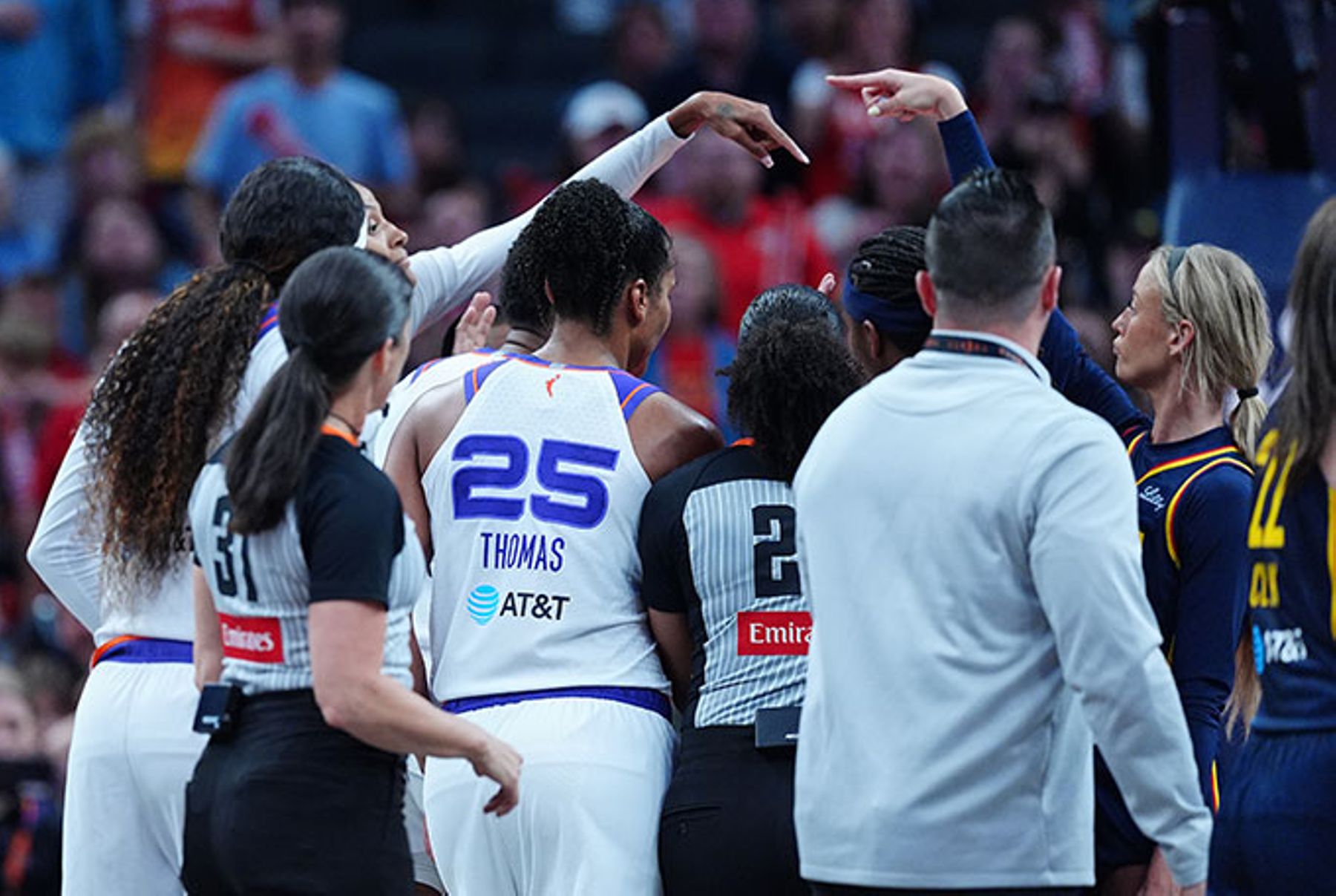
During a June 22 game between Cunningham’s Indiana Fever and her former team, the Phoenix Mercury, WNBA star Caitlin Clark received a technical foul following an altercation with DeWanna Bonner. Cunningham responded by pointing insistently at Bonner, coupled with a skeptical and accusatory stare, seemingly demanding to know why Bonner had not also been assessed a technical. She kept pointing. And pointing. For about 22 seconds. The video got clipped and went viral on social media, where it escaped its original context and took on a meme life of its own.
By then, ESPN had already interviewed Cunningham for a lengthy feature. The viral finger-pointing episode had elevated her profile and turned her into one of the WNBA’s most recognizable personalities. The interview was released on July 21 and included Cunningham’s never-before-known views on males who identify as women competing in women’s sports. Cunningham wanted to “protect young girls” who should not be forced to compete against “biological men.” She harbored no hatred of transgender people, she said, but believed we can treat people with kindness while still being honest about sex differences. The following day, after her response had been officially drafted into the culture war, reporters gave her an opportunity to walk back or soften her remarks. “I said what I said,” she told them, while adding that her position was “common sense.”
Cunningham immediately transformed into one of the most prominent athletes calling to protect women’s sports. Her remarks set off a fight that the WNBA had mostly managed to avoid.
Minnesota Lynx coach Cheryl Reeve then shared her views. “I come from a space of inclusion,” she said, arguing that the transgender-athlete issue was being blown out of proportion. “We need to protect trans kids,” Reeve added. “To me, it’s a human rights issue.” She later wore a shirt reading “Trans Kids Belong” during Minnesota’s game against Indiana. Golden State Valkyries forward Gabby Williams went even further: “I would welcome a trans athlete on my team or against my team, anytime.” She characterized objections as “another way to kind of attack trans people” and described transgender rights as “the next battle we have to fight as athletes.”
The debate then entered the stands. When two 16-year-old girls attending a Seattle Storm game displayed signs thanking Cunningham for speaking up for girls, Storm minority owner Celeste Keaton confronted the teenagers and used profanity toward them. The Storm apologized, and the WNBA later fined Keaton and suspended her for five home games. Some Storm players also reportedly directed thumbs-down gestures at the girls.
All of this led to enhanced scrutiny over the WNBA’s eligibility criteria. Many sports organizations such as the International Olympic Committee, World Athletics, and World Rugby have tightened up their rules with explicit language after experiencing significant controversy with male athletes vying for inclusion. The WNBA is, obviously, supposed to be a women’s league. Its collective-bargaining agreement says that “players who are women” are eligible, though it contains no additional language about whether “women” refers to sex, gender identity, or a natural or medicalized physiological state. This is likely because the WNBA has yet to face a serious test case—until now.
On declaring himself eligible for the 2027 WNBA draft, Enes Kanter Freedom said, “If simply declaring who you are is all that’s required, then I meet every single requirement necessary to compete in the WNBA.” Royce White, since his announcement, has been describing himself as a “sometimes identifying transgender woman” and even a “Black trans lesbian with a penile aesthetic.”
It’s easy to call for inclusion, or feign ignorance about what a woman is, or claim not to know the purpose of women’s sports when presented with abstract hypotheticals. But the WNBA has just been presented with two very real, very large, and very male test cases.
Their declarations have been dismissed by many as “stunts.” And in one sense, of course, they are stunts. Neither Freedom nor White genuinely believes he is a woman with sudden desires to come out of retirement and play professional women’s basketball. They are deliberately creating a spectacle.
But stunts can be effective in highlighting absurdity and forcing clarity—in this case, about where the WNBA truly stands on transgender inclusion. Either the league blocks these men from playing, revealing that it understands what a woman is and why excluding males is necessary, or it lets them in, likely prompting a backlash so extreme that indifference on the “What is a woman?” question won’t be sustainable.
One common way to dismiss concerns about male athletes who identify as women participating in female sports has been numerical: no males currently play in the WNBA, so why obsess over a theoretical problem? This response takes no stand on the merits about whether male inclusion is fair; it only observes that it’s rare. That’s a strange premise on which to design the rules of a sport.
If, for example, a sport’s rules contained vague language about whether performance-enhancing drugs were permitted, and objections were made calling for clearer wording, those criticisms would not be answered by stating that only three athletes are taking those drugs. And, technically speaking, those athletes wouldn’t be cheating because they would be competing under the rules as written. That’s why good rules are written in advance to close obvious, exploitable loopholes before they become major problems or sources of embarrassment.
Freedom and White have opted for an accelerationist approach. Why tolerate badly articulated rules and wait for them to be exploited in the future when they can be easily fixed right now?
If Freedom and White are ineligible, the WNBA will have to explain why. If it’s because they are biologically male, the league will need to clarify this in the rules language. If, conversely, Freedom and White can play with the women, and all that matters is a person’s “gender identity,” then the league will need to make that explicit. If eligibility is more complicated, and depends on hormones, puberty, medical transition, or some other standard, that, too, will need to be stated clearly and justified.
In response to the announcements by Freedom and White, WNBA Commissioner Cathy Engelbert convened a task force of team presidents and general managers to discuss eligibility rules on August 12. The meeting apparently did not produce any clarification; discussions will continue over the “coming weeks and months,” the league says. However long that may take, the WNBA can no longer respond to concerns by asserting that only women are allowed to play in the women’s league. Everyone knows what the W stands for. The question—for some people, anyway—is how to define “woman.”
Most of us already know the answer. We’ll wait to see if the WNBA does.