
Elvis Presley is on a short list of the most quintessentially American figures. He lived an American life, defined by humility and excess, faith and transgression, soaring highs and wrenching lows. As an artist and phenomenon, Elvis could not have happened anywhere else.
His biography is littered with Americana. He was born in the Jim Crow South and worshipped as a boy in a one-room Pentecostal church. He was drafted and served in the Army. He met Richard Nixon, considered J. Edgar Hoover a hero, and sang a protest song on national television months after Martin Luther King’s assassination. He spent the twilight of his life in Las Vegas, wore gaudy jumpsuits, and has been immortalized by a horde of impersonators. Graceland is the second-most visited home in America behind the White House.
Finally, a reason to check your email.
Sign up for our free newsletter today.
Across three decades in music, Presley recorded 18 Number One hits, topped the charts in multiple genres, and commanded massive crowds until his death. But his singular contribution to American culture—“the most American song that this most American of artists ever sang,” as Mick Brown put it—occurred in 1973, at his Aloha from Hawaii concert, broadcast internationally by satellite, where a sweat-drenched, bedazzled Presley sang an obscure three-part ballad called “An American Trilogy.”
The performance came near the end of Presley’s career (he died in 1977 at 42). Elvis won his reputation as the “King of Rock and Roll” in the 1950s for breakout hits like “Jailhouse Rock,” “All Shook Up,” and “Hound Dog.” After serving in the military, Presley returned home, frittered much of the 1960s away making mediocre films, and finally returned to live music in 1968 with his eponymous “comeback special” on NBC.
Presley’s style defied labels. When he recorded his first song at Sun Studios—a recording he made for his mother’s birthday in 1953—an employee noted simply that he was a “good ballad singer.” One of his most popular Number One hits, “It’s Now or Never,” was an adaptation of an Italian ballad. He regularly appeared on the country charts and won his only Grammys for gospel recordings. Presley’s voice—capable of operatic crescendos, throaty riffs, and deep, velvety baritone—was one of a kind.
By the 1970s, Presley had embraced his roots as a ballad singer, recording songs like “Always on My Mind,” “Hurt,” and “Solitaire.” His early rock hits often featured as change-up pieces in his eclectic Vegas set lists, which Presley interwove with gospel, newer rock like “Suspicious Minds,” and dramatic ballads like “It’s Over.”
Presley had long wanted to tour internationally. He had played concert venues across the country—Vegas’s International Hotel, of course, but also several convention centers and Madison Square Garden—and wanted to bring the show overseas. His manager, Colonel Tom Parker, was an illegal immigrant, and did not want to leave the country. Presley had also received death threats, which raised security concerns.
Parker, reportedly inspired by President Nixon’s televised visit to China, suggested that his star perform for the world via satellite. Presley agreed. Hawaii was chosen as the venue, and NBC as the producer.
Marty Pasetta, an NBC producer, prepared the logistics for the televised concert. He suggested a massive lights display rendering Elvis’s name in the native languages of countries receiving the broadcast, and a lower stage with a runway lined with “lei-bearing women.” He told Presley to lose weight, which reportedly prompted Elvis to stand up, toss his hat and glasses aside, and hug him. “You’re the first person who’s been honest with me,” he said.
Presley lost the weight, following a strict, 500-calorie-per-day diet. He arrived in Hawaii tanned and trim. The Aloha From Hawaii concert would benefit a cancer charity and be broadcast—either live or delayed—in over 35 countries. The set list included his by-then typical mix of ballads, rock hits, and pop ditties.
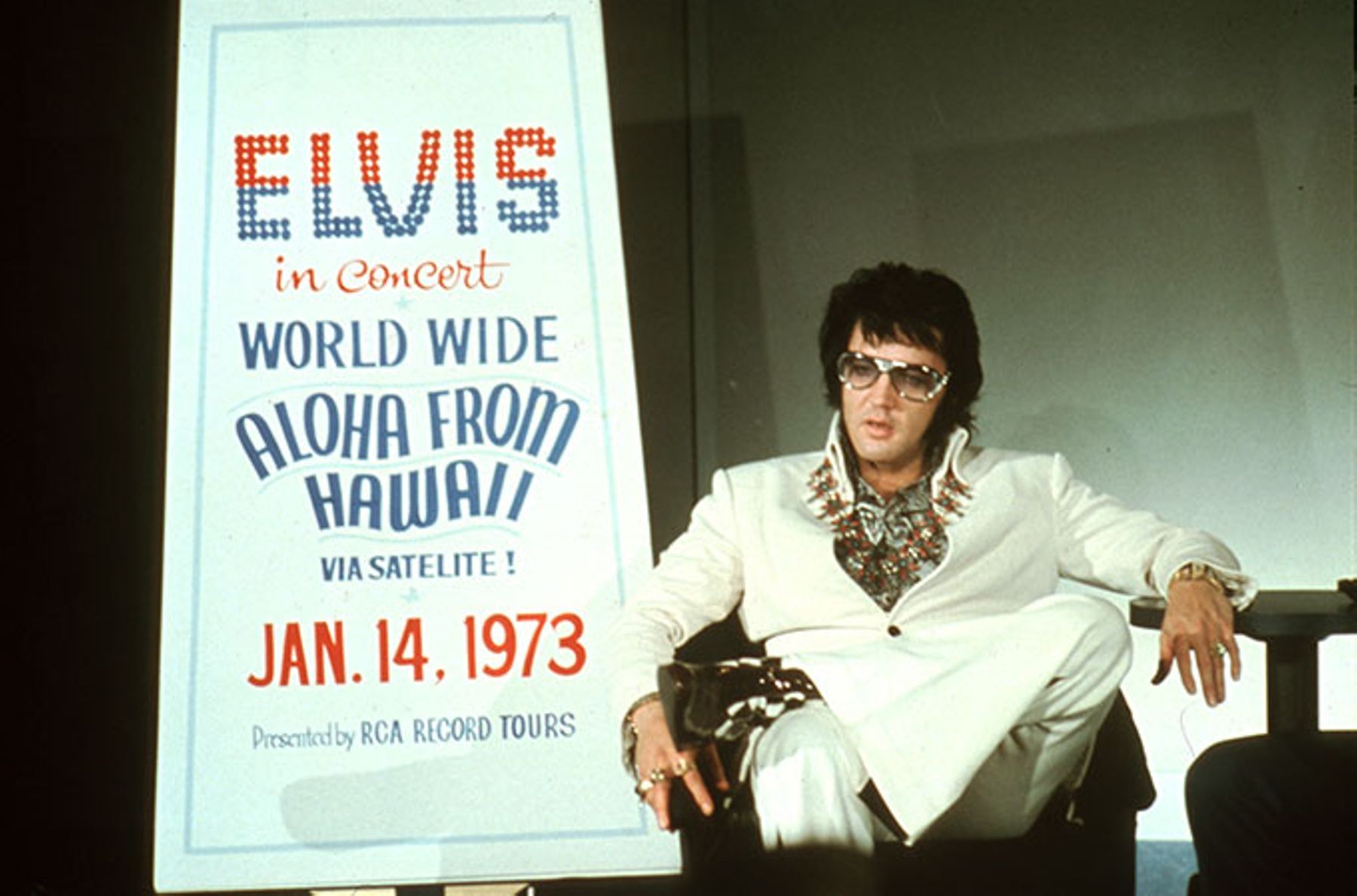
On January 14, 1973, Presley strode out on stage wearing a white jumpsuit bejeweled with red, blue, and gold. His belt featured golden eagles surrounded by stars and stripes. The Honolulu International Center Arena was packed to the teeth. More than half of American households tuned in when it aired in the United States.
The defining performance of the show, and perhaps of Presley’s career, came in the show’s third-to-last number. “An American Trilogy” is a three-part ballad first arranged by Mickey Newbury. It had been a modest commercial success. Newbury combined three songs—“Dixie,” the controversial Southern folk song; “All My Trials,” a protest spiritual; and “The Battle Hymn of the Republic”—to tell in one song the fractured but ultimately united history of America.
Presley, a son of the American South, had made the song part of his regular tour routine. In Hawaii, he was surrounded on stage by a team of background singers: the Sweet Inspirations, a trio of black women, and the Stamps, a four-man gospel group. The song begins with Presley—lei around his neck and jewelry all over his hands—facing his guitarist, who spins out the opening riff.
“Oh, I wish I was in the land of cotton. Old times there are not forgotten. Look away, look away, look away, Dixieland.”
The first part of the song moves quickly. The Stamps, at Presley’s prompting, harmonize on a verse. Presley turns, faces the crowd, and rounds out the opening third, with his final call of “Dixieland” ushering in Ronnie Tutt on the drums.
The horns blare, the women sing, and Elvis teases the “Battle Hymn of the Republic.” The instruments fall mostly silent before Presley excerpts “All My Trials,” the bridge to the song’s conclusion, as sweat rains on his face. At Presley’s declaration that “all my trials will soon be over,” Gabe Baltazar, a flutist, begins a solo.
What transpires next is probably the best minute of Elvis Presley’s career. He turns and faces the band. A moment of near-silence falls as Presley stares intently at the players. Tutt pounds on the drums, and the horns join in unison. Presley clenches his face with each beat, grunts, and points at his singers, whose voices descend as if from a choir loft. Elvis bellows out the song’s operatic conclusion.
“Glory, glory, hallelujah. His truth is marching on. His truth is marching on.”
Presley rips his hands apart. The crowd goes wild. He tosses his belt into the bleachers, sings two more songs, and leaves the stage.
“An American Trilogy” called on the entire American experience. “Dixie” was, in 1973, illegal to perform in some states, but it had been a touchstone in the South for generations. “All My Trials” channeled popular protest energy but couched it in a spirit of biblical mourning. The excerpts from “Battle Hymn of the Republic,” a Union marching song, centered on God as a guiding hand of the United States.
After the show, Presley reportedly approached Elise Pasetta, the NBC producer’s wife. She says he walked over to her, picked her up, and spun her around.
“This the best time I’ve ever had.”