
On a summer evening in 2024, two bullets pierced the walls of our home in Washington, D.C. One shattered the leg of my writing desk, where I would normally have been sitting at that hour. The other came through our kitchen door and hit the refrigerator. Our daughter was nine months old. We were lucky: we weren’t home.
In search of answers, I found only resignation and shoulder-shrugging—from the police department, from the leaders of a homeless shelter a few blocks away (outside of which sat an informal curbside “shop” for dirt-bike riders), and from neighbors who might have seen something had we been a real community. The closest thing to an explanation came from the hyperactive group text of the neighborhood mothers’ group to which my wife belonged. One of the moms had spotted some kids in the park near our house—dirt-bikers—playing around with what looked like guns, and she thought stray shots may have been fired in our direction.
Finally, a reason to check your email.
Sign up for our free newsletter today.
D.C. long ago abandoned any serious effort to police the dirt-bike gangs that have seized many of its streets. Chasing them, the reasoning goes, is too dangerous—for officers, riders, and bystanders alike. So the gangs have grown increasingly emboldened, popping wheelies down residential blocks where kids play. The riders have learned that there is strength in numbers: reach a critical mass, and no one will stop you.
Humans have formed tribes for as long as we have kept records. One reason is safety; another is community. Few members of a dirt-bike gang likely woke up one morning with a sudden passion for riding. It is an acquired hobby, embraced by young men desperate for something to belong to. As much as I dislike these gangs—and as much as I blame them for the bullets that struck my home—they are symptomatic of a broader problem: the erosion of the small, meaningful associations through which people once bonded, not to race through the streets, but to inhabit them.
We need intermediary institutions of civic association, as the sociologist Robert Nisbet understood three-quarters of a century ago. That a new-mothers group chat was the only “institution” that helped us find an answer suggests how much thicker forms of association have declined. In place of the hunting club, the cooking club, the card table, or the Elks Lodge, we have group chats, from which we expect a sense of community they were never designed to provide. The more associations move online, the more our skills of real association erode.
When Alexis de Tocqueville toured America in 1831, he set down a line that has never ceased to be true: “The science of association is the mother science; the progress of all the others depends on the progress of that one.” What he found exceptional about the United States was not the ambition of great men or the design of government. It was the ordinary citizen’s capacity to associate with others—to build the intermediate institutions that accomplish what neither isolated individuals nor the state can.
We are losing that gift. Our institutions are weaker than they once were, and weaker, I believe, in four specific ways. First, they are nihilistic: they no longer commit to anything themselves and instead rely on their members to supply, in private, the meaning the institution will not claim. Second, they are extractive: people take what they can without giving, and institutions extract in return. Third, they are mimetic: reactive and rivalrous, organized around zero-sum competition. Finally, they are fragile: they have lost the capacity to repair themselves, heal from injury, or grow through disorder.
Each of these four pathologies has a remedy, and in every case, it is a kind of courage. The healthy institutions our society needs must be built on it: the willingness to take risks, make mistakes, sacrifice, and remain in communion with real people, who cannot be muted or ignored like a group chat.
The framework that I believe can help us rebuild comes from an unlikely source: The Courage to Be, a slim 1952 book by the theologian Paul Tillich, largely forgotten today. Tillich himself, by many accounts, led a turbulent and not always admirable personal life—which is oddly fitting, because his central claim is that courage is plural. A person may possess one kind in abundance and badly lack others.
Most of us treat courage as a single virtue, something easier to picture on a battlefield than in a workplace or a marriage. Tillich saw at least three distinct forms of it. I have tried to synthesize them into a fourth, which I regard as the most important.
Together, these four forms of courage are the true measure of an institution's quality. They distinguish institutions worth belonging to from dirt-bike gangs and group chats. To illustrate, I will show each operating in a setting where its presence or absence appears clearly.
Let’s begin with the form of courage the other three stand on.
The courage to be, in Tillich’s words, is the willingness to affirm that something is real and worth its cost. Courage does not abolish anxiety—rather, it is affirmation in the face of challenge and doubt.
For an individual, courage is the answer to a silent question: Should I exist? It is an affirmation made despite anxiety, suffering, and the certainty of death. For an institution, it means affirmation despite public attack, internal doubt, and the temptation to trade a founding purpose for mere survival. It is the courage to remain a live wire in the world—to refuse to go numb.
In his book Tribe, the journalist Sebastian Junger recounts a hitchhiking trip across the country as a young man. On the outskirts of Gillette, Wyoming, a man with wild, matted hair and a tattered jumpsuit approached him from a highway on-ramp. The man was destitute, living in a broken-down car and walking three miles to a coal mine each morning to ask, fruitlessly, for a day’s labor. When he learned that Junger was a hungry hitchhiker, he handed over his own lunch and walked on.
The encounter haunted Junger for decades, until he came across the words of another man who had inexplicably given away his last food to strangers: to have done otherwise, he said, would have left him “just dead inside.” That was the one thing the man Junger had met years earlier refused to be. Having nothing, on a day that had given him nothing, he affirmed the goodness of existence anyway. That refusal to be dead inside is the courage to be in its purest form.
We rarely confront that question so starkly. But we encounter a quieter version of it at work: after years in jobs that hollow them out, people go numb, stop believing their efforts mean anything, and begin to feel dead inside. An institution can do that to a person. But it can also be the thing that prevents it.
Take the hospital. It rests on an unusually ambitious claim: that a human life has worth independent of the patient’s productivity, age, or prospects. The physician’s vocation is built on that premise. Without it, the bedside becomes little more than a transaction with bad lighting.
American health care has spent the last 40 years quietly losing its nerve about this claim. The institution has increasingly behaved as though it had traded its commitment to human dignity for an operational one: throughput, billing codes, 15-minute appointments, and patient-satisfaction scores that measure the experience of being processed rather than known. Yet many doctors and nurses still hold the line, exercising the courage to be at real personal cost—and many burn out in the process.
They show up and provide care because they refuse to surrender to the meaninglessness that would hand their work—including critical life-and-death decisions—to something like artificial intelligence, which does not need to exercise any form of courage. And that is precisely what makes its moral calculus hollow. It takes facing the totality of the human experience, which A.I. cannot do, to know that without courage in the face of death, no serious morality exists.
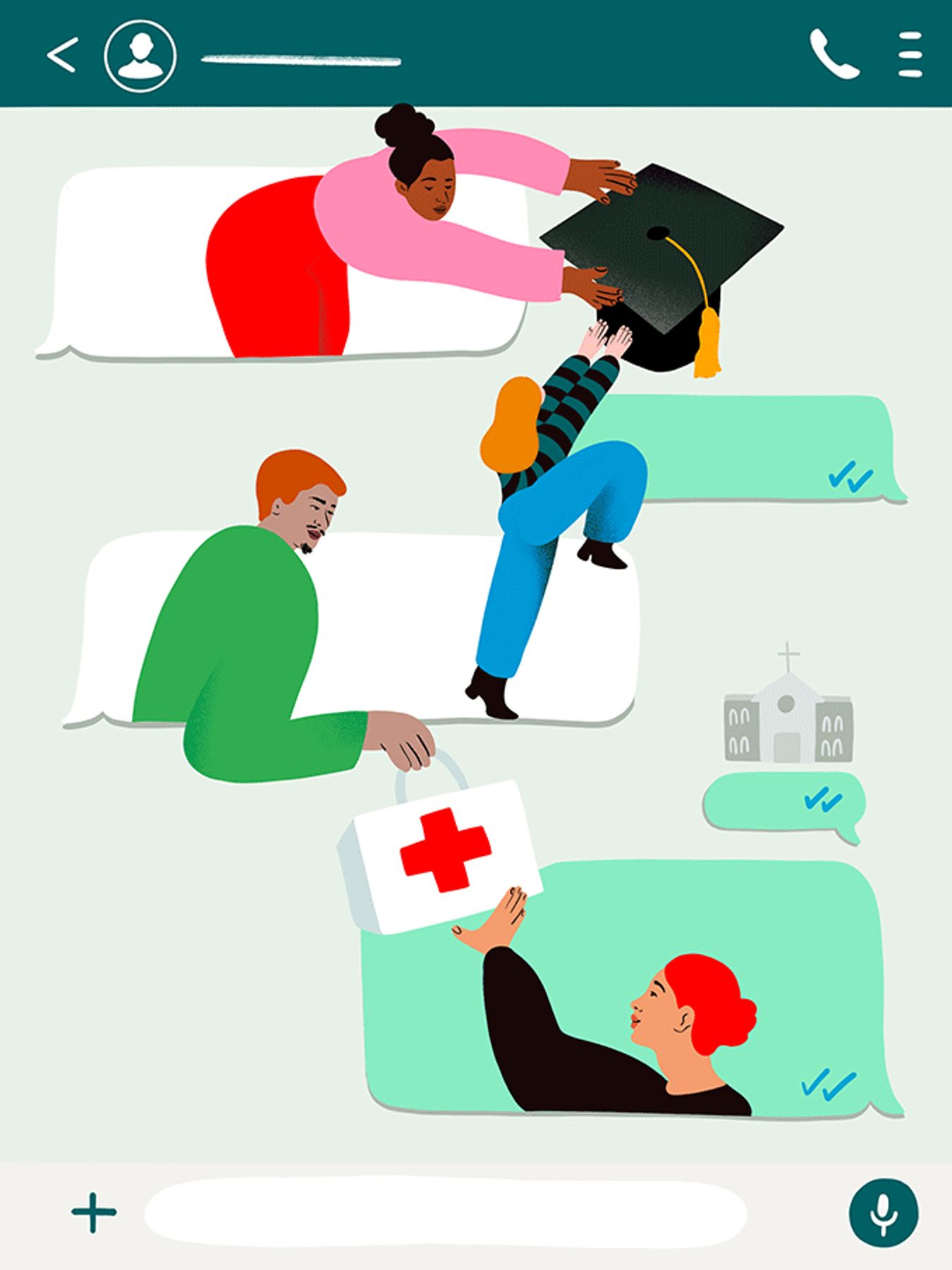
Another form of courage is required to be truly part of something—to participate fully, even when the return is uncertain. It is what Tillich called the courage to “be a part.”
The courage to be a part is familiar to anyone who works in an environment where participation may cost more than it yields. You probably know the feeling. I work in academia these days, so I have heard all the jokes. Raise your hand for one faculty committee and you have volunteered for the next three; keep your head down and nothing is asked of you. The rational move is often not to participate. This is the extractive institution at work: treating a member’s generosity as an opportunity to take more.
The courage to be a part is the courage to give anyway. It is not naïve, however. Rather, it is a test you put to an institution. Offer something real and unglamorous, then watch what it does with the offer. An institution worth joining shows, over time, that it owes you something in return. If it fails that test, you can decide what kind of relationship to have with it. But you will never know if you do not first participate.
This courage to be a part is easily counterfeited. The danger is collectivism: the self dissolving into the group—fusion mistaken for belonging. It is the danger a politician invites when he vows, as Zohran Mamdani did in his 2026 inaugural address as New York’s mayor, to replace “the frigidity of rugged individualism with the warmth of collectivism.” Notice that what is being offered is not something that requires courage, but something easy: moving toward what feels warmer. And collectivism is not the opposite of individualism; it is its mirror image.
We are not short on opportunities to belong. Why have hundreds of books been written over the past two decades about “finding your tribe,” and almost none about what to do once you have found it? Because a tribe is not an institution. A tribe is easy to be part of; it makes you feel warm. An institution is demanding. It may even feel cold to those unaccustomed to the work of genuine participation.
Most of us suspect that we are not quite ourselves at work. Our culture has turned that suspicion into both comedy and drama: first Office Space, then Severance. Work becomes the coldest institution, the place where the self goes to die.
Tillich railed against this notion, writing at a time when corporate America increasingly treated people as interchangeable parts. He called for a new kind of personalism in response. The courage to be oneself, he wrote, is “the courage to follow reason and to defy irrational authority.” It means refusing to live by the lies of soft totalitarianism and choosing instead to live within the truth—not merely going along with the narrative but exercising discernment and conforming one’s life to what is real.
Tocqueville saw it coming: under a king, he observed, the dissenter risks his body; under a democracy, he risks his soul. The new tyranny reaches not for the rack but for the slow social erasure of whoever thinks aloud against the prevailing orthodoxies. The rebel goes unread, unhired, unfollowed, unfriended. The courage to be oneself is the courage to write anyway, knowing the price is not prison but the invitations that stop arriving.
But this courage has a counterfeit, just like the last. The dissenter may decide that the only way to preserve his integrity is to keep his own company—to leave the institution, build his own audience, answer to no editor, have no shared standard. That is not the courage to be oneself. It is individualism: self-affirmation, in Tillich’s phrase, “without regard to its participation in its world.” Real courage involves something harder than leaving; it requires staying in the room and saying the true thing to people who can make you pay for it—to remain, as oneself.
Selfhood that costs you nothing because no one is left to challenge you is not selfhood; it’s just solitude with a newsletter. The harder thing, and ultimately the more formative, is to stay and wrestle with an institution that is worthy of the struggle.
The first three courages, if exercised in isolation, eventually devour themselves. The courage to be metastasizes into existential loneliness. The courage to be a part collapses into collectivism. The courage to be as oneself ends in Ayn Randian heroism detached from community.
A person can hold these three courages in tension for a time, but an institution must hold them in tension across decades—against the slow accumulation of grievances and failures of nerve that dissolve most human arrangements. What is needed at the institutional level is something not unlike what is needed in a church or parish community: the courage to be in communion. It is the willingness to remain in relationship long enough for bonds deeper than ideology to form. It means staying when leaving is easier, forgiving when resentment is more satisfying, rebuilding when starting over would be cleaner. It is the least dramatic of the four courages, and by far the rarest.
Some institutions deserve to be left behind. But a society in which exit becomes the reflexive response to failure will eventually run out of institutions worth belonging to.
Communion is what enables one to see an institution’s brokenness as an occasion for repair rather than flight. It is what the trustee does when she stays on the board through a scandal. It is what the parishioner does when he keeps bringing his children to the parish that has failed him, because it is also where they were baptized. These acts are how association is really practiced: among particular people, in particular places, over a span of time that no group chat can simulate.
Community is a group. Communion is a bond. And only communion gives an institution the power to survive its own brokenness without denying it.
There is, after all, a lesson in association to be learned from the dirt-bike gang. Its riders had built, without intending to, what Nisbet called an intermediary association, something outside official institutions that met a genuine human need.
Look closely at what the gang gives its members. It gives them safety, a place to belong, and something to do with their nerve and vitality. And on those bikes, the risks are real—real enough that some would call facing them courage. It even keeps them, in its own way, from going numb. Strip away the awful lawbreaking, and you are left with young men who found something most of our institutions had stopped offering.
A society like ours will always form intermediary associations. The question is their quality. The dirt-bike gang possesses the raw appetite of the courage to be, and almost none of the rest: no courage to be a part of anything that asks something in return; no courage to be itself apart from the pack; no communion, no object worthy of sustained investment. It is courage with nowhere to go.
I have made all this sound tidier than it is. Courage has never been sufficient on its own. Laws, budgets, and institutional design matter, too, of course. A hospital starved of resources cannot be rescued by brave nurses alone. I have watched good institutions fail for structural reasons that no individual virtue could overcome. The four courages are not a machine that, once switched on, produces a healthy institution.
What, then, must we do?
Naming the four courages is the easy part. The science of association is not a body of knowledge or an essay. It is the set of things ordinary people do—or fail to do—in the particular places where they live.
I should tell you what we did. We moved, though only a handful of blocks from where those bullets came through our walls. The block we left has since been cleaned up, though not by me. I am not going to dress that up as courage. By the argument I have just made, it was closer to the opposite: the reflexive exit, the move a healthy society cannot afford to make its default. A country where everyone relocates a few blocks away will eventually run out of blocks worth staying on.
The honest ending is an assignment, and I am writing it first to myself, on this new street. Gather a few people—enough to know by name, few enough that their absence would be felt—and commit to something together. That is, finally, how neighborhoods and institutions get rebuilt: not through better policing or better governance, but through more courage. All four forms of it.