It’s mid-December, a cloudy, humid day in Jacksonville, Florida, and I’m in the corner of a second-grade classroom watching a teacher and 17 students power through a phonics lesson. The day before, I’d attended a trustee meeting at New College of Florida in Sarasota, where we discussed higher-education curricula and long-term strategy. Now I’m among seven-year-olds.
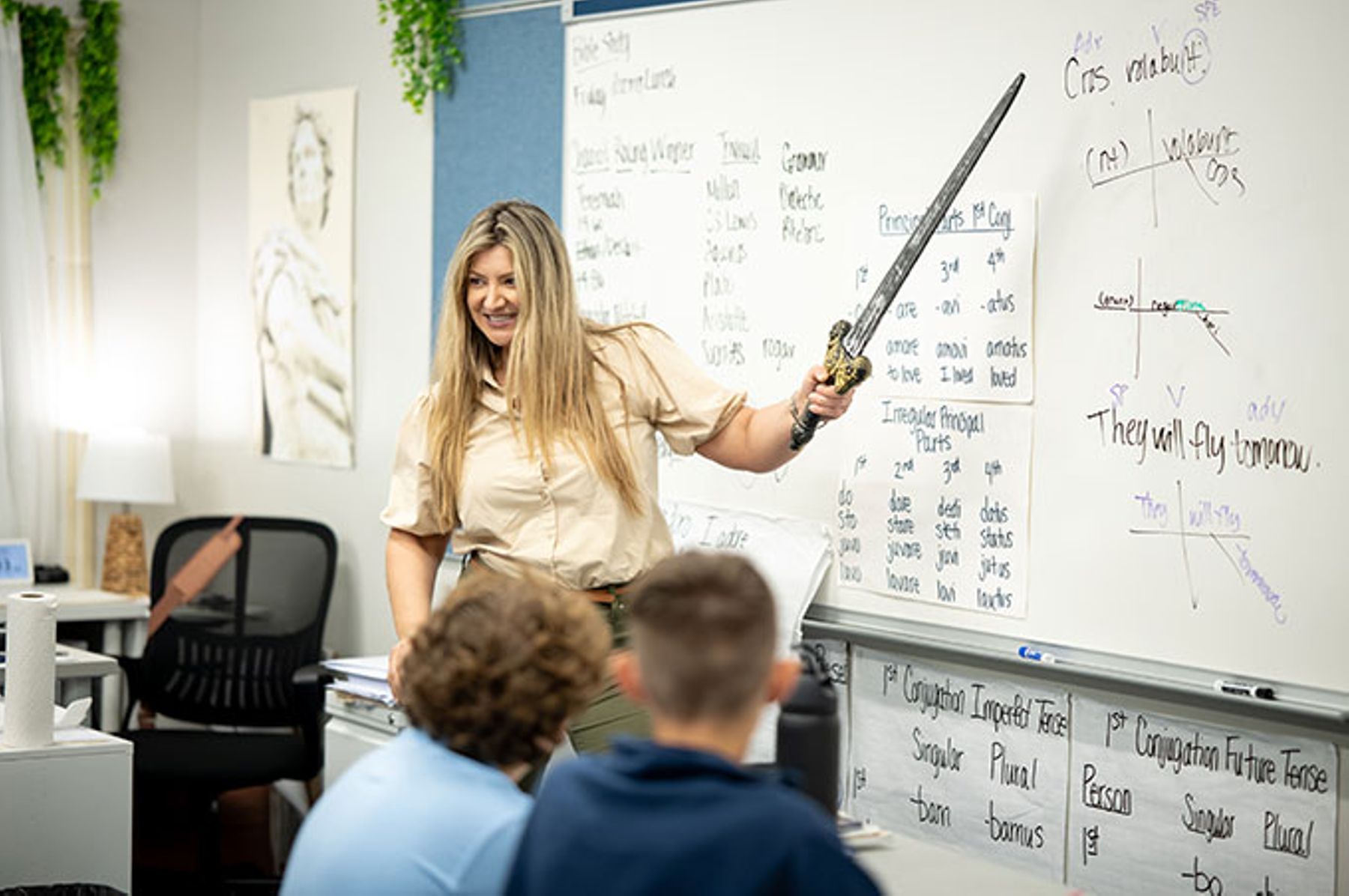
There’s only one screen in the room—an overhead projector at the front—where Ms. Bajalia writes phonograms as she peppers the kids with questions. She paces up and down and back again, keeping every child on task through sheer presence and a drill-sergeant briskness. The students write in their notebooks as the lesson moves from one sound to the next, with special attention to single sounds spelled with two letters.
Finally, a reason to check your email.
Sign up for our free newsletter today.
“Two letters,” she says.
“Make one sound,” the class responds.
“So we—”
“Underline it.”
It’s tightly structured, with no downtime—precisely what progressivist educators deride as “rote learning” or “drill and kill.” Yet the students show no sign of strain or boredom. They relish it, firing back answers as if they’re contestants on Jeopardy. Ms. Bajalia is the maestro; her students, the orchestra.
This, my guide explains, is the “science of reading” in action: teaching the alphabet through sounds first, not letter names, a steady progression from sounds to syllables to words to sentences. Hands shoot up as tasks are completed, as words are assembled from parts, “ree-vi-ew” resolving into “review.” The students write in cursive in their “orthography notebooks,” and Bajalia reminds them: “You want to be proud of your work. . . . You want your handwriting to be nice.” A child poses a question; she answers without breaking stride. The lesson ends in call-and-response cadence: “We flatten”—“syllables”—“and we count”—“sounds.” Since September, they’ve studied Greek mythology, read Charlotte’s Web, and listened to Vivaldi. Everyone wears a uniform.
This is Cornerstone Classical Academy (CCA), a charter school that opened in August 2020 after securing a five-year contract with the state. It sits on 16 acres three miles east of downtown, with separate buildings for the upper and lower schools, along with a new gym, a playground, and a football/soccer field gleaming with artificial turf. The school enrolls 1,100 students in grades K–11 (12th grade will be added next year) and has a waiting list of 900, a striking level of demand for a school so new.
In CCA’s first year, when it served only grades K–6, 440 students enrolled. A year later, with seventh grade added, enrollment rose to 600 and the waiting list climbed into the hundreds. Teachers and staff were just as eager. A first-grade teacher who had worked at an inner-city charter and whose own children were school-aged calls CCA’s opening “a prayer answered.” A biology teacher recruited by a colleague echoes familiar refrains from former public school educators: fewer behavioral problems, stronger parental support, a better student work ethic, and real collegiality.
One counselor, after nine years in public schools, was asked to join a panel supporting LGBTQ students. When she replied, “Let’s treat every individual with dignity,” she was branded a dissident and left for CCA, where LGBTQ status carries no special designation. Principal Dawn Oehmann, who had taught for years at a Catholic school, had hoped to move into administration and build a more classical curriculum there. When that proved impossible, she found her opportunity at CCA.
My guide is CCA’s founder, Lindsay Randall, an energetic 43-year-old mother of two and the driving force behind the school’s growth. She once worked in Washington, D.C., for Eagle Forum and Concerned Women for America but grew disillusioned during the Obama years with what conservative advocacy in the capital was actually achieving. In 2013, she returned to Florida, took a job in personnel recruitment, and started a family.
As her children approached school age, she knew she wanted a classical education for them, an instinct shaped in part by watching her mother home-school her siblings through Classical Conversations. But Jacksonville offered few options. So Randall decided to start her own: a charter school in a state whose governor favored expanded parental choice. She credits CCA’s popularity to its curriculum—a classical model with a patriotic cast—and to its policies, including a bell-to-bell cell-phone ban and a mask-optional approach during the Covid lockdowns.
At first, prospective donors were skeptical. In 2019, as plans moved forward and Randall submitted a 462-page application to the state for charter approval, she worked hard to recruit students. “I would accost everyone . . . families in my church . . . the Target line, the Starbucks line.” She could tell in seconds who “got it”—which mothers and fathers were eager for a non-woke, pro-America, traditionalist education in phonics, Latin, ancient literature, Western heritage, and the U.S. Constitution, a document that “serves as the bedrock of the Academy’s mission,” says a page on the website. The school is now so successful that it no longer spends money on marketing.
Though privately managed, charter schools are public institutions. CCA charges no tuition, admits students by lottery without academic screening, and administers state-mandated tests each year. Its lesson plans must align with Florida’s standards. Teachers are not unionized but must be certified. Funding comes on a per-pupil basis and is lower than that of traditional public schools. And while a classical curriculum necessarily includes the study of Judaism and Christianity, the school itself must remain nonsectarian: “Teachers are not permitted to encourage a religious or political perspective in the courses they teach,” says the Family and Student Handbook. I see no crucifixes or Ten Commandments posted on the walls. Every classroom does have an American flag, however, and all students stand and recite the Pledge of Allegiance each morning.
The curriculum will be familiar to anyone acquainted with the classical-education movement: Core Knowledge in the lower grades, Singapore Math, Latin beginning early, Western civilization, and Great Books in high school—King Lear, Paradise Lost, Moby-Dick, One Day in the Life of Ivan Denisovich—often taught in a Socratic style that nonetheless “prioritizes the authority of the teacher.” From third grade on, students take year-end versions of the Classic Learning Test.
CCA also offers state-mandated courses in financial literacy and American government; honors classes, including anatomy and physiology; AP courses in calculus AB and BC, chemistry, biology, and physics; and dual-enrollment options with Florida State College at Jacksonville. There’s weightlifting, too, along with a full slate of athletics and extracurriculars: band, student government, art club, Bible club, debate, and Mu Alpha Theta. Early-morning and after-school care round out the program.
Randall envisioned CCA as “an everything school,” knowing that parents would want AP courses, electives, and serious college preparation. The handbook promises resistance to grade inflation and “social promotion,” urges parents to read daily to younger children (citing 1983’s A Nation at Risk on the benefits) and even specifies recommended nightly homework minutes. Students read whole books, not excerpts. Memorization is central.
After the second-grade session, I’m led down the hall, where a fourth-grader in high-top Converse sneakers, matching the school’s green-and-blue plaid, steps outside her classroom, introduces herself, shakes my hand, and recites Thackeray’s whimsical six-stanza poem “A Tragic Story.” As often happens on school visits when an elementary student performs endearingly for me, I have to resist the urge to embarrass her with effusive praise. I offer a measured compliment and move on. In the ninth-grade English class I visit next, the period opens with students reciting lines from The Iliad in English translation.
“We go over the top in explaining how hard the curriculum is,” Randall says. Few students actually fail; those who struggle usually withdraw once it becomes clear that they can’t manage the workload. A parent who has had two children at CCA since it opened (they’re called “Founding Families”) praises the school for its focus on “character and confidence”—a common ideal in classical education—but she wouldn’t have stayed loyal, she said, had the school ever lightened up on academic achievement and vigorous intellectual standards that not all kids can meet. Administrators don’t fret about retention. For every student who leaves, 20 more are ready to fill the spot. (The student body is about three-quarters white, and about 5 percent of students leave each year.) I ask whether any teachers have resigned because they dislike the atmosphere and was told, “Not a one.”
I mentioned the Bible club. In fact, there are three—one for boys and two for girls of different ages. That doesn’t surprise me, given what I hear and see throughout the day. One teacher, who assigns Exodus, Deuteronomy, the Gospels, and the life of Muhammad, tells me that the school has “a ministry mindset” and adds: “It would be very difficult to teach classical education without God.” The description of 11th-grade American literature asks students to “appreciate how deeply the American imagination has been rooted in biblical narratives,” a learning goal rarely found in public school English courses, though Florida’s English language arts standards—on which I worked—do require high schoolers to study literary adaptations of stories from the Bible and other religious works.
When I visit an 11th-grade class devoted to the college application process, students are reading aloud from personal essays responding to the prompt: “What am I doing here?” The teacher reminds them, “We are created on purpose and for a purpose.” Their answers include: “filled with the spirit of my Heavenly Father,” “I’m a harmonizer who bestows God’s love on others,” and “We are to glorify God in whatever we do.” Later, at a students-only lunch, a boy who transferred from a charter school that, he says, had gone “very woke” declares his ambition to “preach the Gospel to creation.” Another remarks, “I like how Christian this place is,” while a third praises “being surrounded by good Christian kids—people you can trust.” Several times, they emphasize the fellowship they share with one another, as did one parent of three children at CCA who later said, “The students have a closeness I’ve never seen before at any school.”
The previous day, students from seventh through 11th grade had gathered voluntarily to discuss what they called the “spiritual warfare” engulfing the United States. One assured me of “the reality of spiritual warfare.” Another said that the battle is best waged by those who “study and cite Scripture.” A third added, “Our nation is under attack. . . . The Devil is out to take down America.” The mission statement of the Cornerstone Classical Foundation, which seeks to launch more Cornerstone schools, tacitly agrees: “We are training the next generation of patriots to save the country!”
The students’ faces grow solemn when a public figure’s name comes up: Charlie Kirk. After Kirk’s assassination, several CCA students started a chapter of Turning Point USA, which within weeks claimed 85 members. The founders even presented to younger students on the meaning of the American flag: “people died for it.” When I ask what they most admire about Kirk, I expect to hear something about his Christianity or patriotism. Instead, one student answers, “His composure,” and the others nod. I take it as revealing. These pious, patriotic teenagers—religious conservatives at a vulnerable age—know that cancel culture, or at least ridicule and exclusion, may await them. They are acutely aware of the adversarial culture in which they stand and of the hostility it can provoke.
“A clear honor code and orderly environment, administrators say, create a workplace where teachers feel supported rather than undermined.”
One student tells me, “People are lost—they look to things for comfort without really knowing what comfort is.” For these teenagers, comfort lies in their faith and in the example of those who live it confidently. Kirk, they say, modeled how to face confrontations over ideas and values. It’s clear they’ve encountered similar hostility and hope to meet it with the same knowledge and wit and, yes, composure. As lunch ends, one offers a parting tribute to the faculty: “They prepare us for what we’re gonna do in life.” Later, I ask Randall and other administrators about the Turning Point chapter and the students’ fervor. They smile, shake their heads, and insist: “We had nothing to do with it.” The initiative, they say, was entirely student-driven.
CCA has just secured a 15-year renewal of its state charter, and Randall hopes to replicate the model by launching or taking over as many as ten additional schools in the next decade. Why not think big?
The Jacksonville campus marries the resources of a well-funded public school with the content and culture of classical education. Free tuition draws a flood of applicants, allowing CCA to deliver what affluent suburban districts promise: competitive sports, robust clubs, serious college prep, firm discipline, strong facilities, child care, and capable instructors. A clear honor code and orderly environment, administrators say, create a workplace where teachers feel supported rather than undermined.
As a charter, the school maintains enough independence from the traditional public school bureaucracy to sidestep the ideological pressures associated with teachers’ unions and many education schools, while still meeting state standards. Florida’s recent revisions to its ELA and social studies benchmarks, shaped in part by E. D. Hirsch’s theory of cultural literacy, align comfortably with a classical curriculum. Charters can satisfy those requirements through readings in Latin, the Bible, the American Founding, and Western civilization.
In a fourth-grade history class, a student reads aloud an account of immigrants glimpsing the Statue of Liberty for the first time. The teacher pauses on the word “tradition,” asking the class to consider its meaning and supply examples. Some mention holidays and family routines. One child presses further: If a tradition is simply doing the same thing over and over, isn’t it just a habit?
The discussion that follows draws a distinction between mere repetition and inherited meaning, between habit and a way of life. It deepens the students’ sense of the past and sharpens their appreciation for the nation’s customs and rituals. The ten-year-olds seem genuinely edified, and I can imagine few settings more salutary for young Americans today.