
For a vocal minority, the memory of 2020’s “Summer of Love,” with its orgy of “Black Lives Matter” sloganeering, occupied zones, and statuary vandalism, shines brightly. It’s not hard to see why. The expulsion of Confederate monuments from the streets, squares, and parks of cities across the South, mostly during the disturbances that followed George Floyd’s killing, marks a historic victory for wokedom’s cancel culture.
Though 2020 is a year most Americans would be happy to forget, the theatrics of statuary excommunication still attract politicians on the Left. President Trump may have resurrected Christopher Columbus’s effigy in the nation’s capital, but Capitol Square in Richmond, Virginia, is now in the crosshairs. With three Confederacy-related statues still in place, including an outstanding figure of Stonewall Jackson (1874) by the distinguished Irish sculptor J. H. Foley, the square also includes a Virginia Civil Rights Memorial, a monument to the state’s Indian tribes, and a Virginia Women’s Monument that reflect more recent political concerns and artistic sensibilities. Capitol Square—site of the statehouse, governor’s mansion, and a multi-figure nineteenth-century monument focused on a mounted George Washington—has thus offered a display of the common sense that lost traction during the Summer of Love.
Finally, a reason to check your email.
Sign up for our free newsletter today.
The crusade against Confederate statues, which has enjoyed the unflagging support of the nation’s progressive media, reflects a flattening rather than a broadening of historical and cultural understanding. We’re no longer encouraged to ponder the loyalties or virtues of great commanders like Robert E. Lee and Jackson. We’re supposed to view them as nothing more than “traitors who killed American soldiers to defend slavery”—poster boys for white supremacy. Regarding them as role models, as many a Southern-born warrior now engaged in the campaign against the Iranian mullahs surely does, is unthinkable. All that matters about Confederate monuments is that they stood or stand for the racial oppression that stains the history of the South. Wokedom thus thrives on a perversely simplistic, Manichean outlook. Its impact on the South’s public realm, as a vacuous exhibition of banished Confederate statues in Los Angeles attests, has been disastrous. The sooner Americans—North and South, black and white—see this authoritarian mindset for what it is, the better.
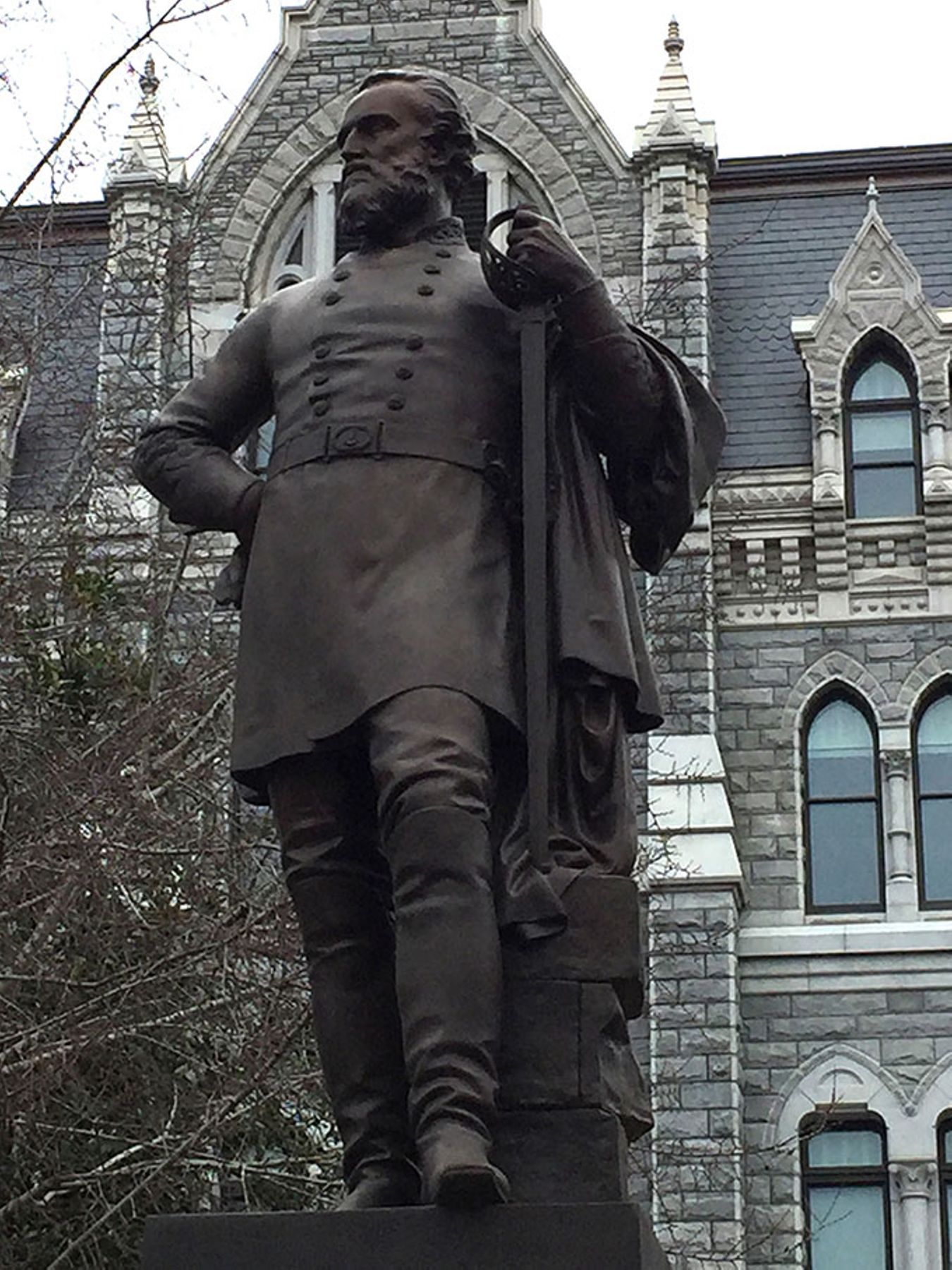
Elsewhere in the Confederacy’s onetime capital, former mayor Levar Stoney responded to the Floyd disorders by banishing a dozen Confederate memorials from Monument Avenue and other River City sites in alliance with Virginia’s then-governor Ralph Northam—a.k.a. “Governor Blackface,” thanks to a medical college yearbook photo scandal. The city’s cultural heritage has been seriously impoverished as a result. And shortly after the January gubernatorial inauguration of a Democratic governor and legislature, the Senate passed a bill mandating removal of the three Capitol Square Confederates, including a Virginia governor who served as a rebel general and the extraordinarily accomplished surgeon Hunter Holmes McGuire, who saved many lives during the Civil War by initiating the automatic exchange of captured doctors by the two sides, a practice incorporated into the First Geneva Convention. McGuire also founded a medical school, a school of nursing, and a hospital in Richmond, and served as president of the American Medical Association.
The passage of time often puts critical distance between a monument and its public, without depriving it of value. Systemic expulsion of Confederate monuments is thus a foolish idea. During the Clinton administration, the National Park Service designated the architecturally distinguished, beautifully landscaped mile-long stretch of Monument Avenue, with its statues of Lee, Jackson, Jeb Stuart, and Jefferson Davis, as a National Historic Landmark. That was back when it was understood that such historic monuments serve, as a sensible commentator puts it, as “reminders of where we’ve been, not where we’re going.” They also serve as artistically consequential place-making amenities and endowed Monument Avenue with a unique character whose appeal was hardly restricted to white people. For the late Berkeley professor Allan B. Jacobs—who included the avenue in his Great Streets, a magisterial international survey published in 1993—the statuary’s Lost Cause associations were by now vestigial in a city whose political make-up had undergone dramatic change during the postwar period. Jacobs observed groups of people, blacks and whites together, taking Sunday strolls along the avenue. But the Summer of Love’s iconoclasts couldn’t leave well enough alone.
The budgetary package the legislature wraps up this spring will likely include removal of the Capitol Square Confederates, and it’s doubtful that the state’s avowedly centrist new governor, Abigail Spanberger, will object.
A more encouraging development is the planned reinstallation of the impressive monument that stood at the center of the Confederate burial section at Arlington National Cemetery for over a century—until Joe Biden’s Pentagon had it disassembled, crated, and consigned to storage in December 2023. Commissioned by the United Daughters of the Confederacy, the celebrated sculptor Moses Jacob Ezekiel designed a multitiered bronze sculpture set on a granite plinth. The monument—which the UDC now calls the Reconciliation Memorial, while the Army refers to it as the Confederate Memorial—stood over 30 feet high, with a circular frieze eight feet tall including dozens of realistic and allegorical figures in high relief portraying the war’s advent. The composition was crowned with a draped, idealized female symbolizing the New South. She presses a pruning hook to the stock of a plow in enactment of Isaiah’s words, “and they shall beat their swords into plowshares and their spears into pruning hooks,” which are inscribed on the monument, but wears a mournful expression as she gazes down on the Confederate graves below and holds out a laurel branch, symbol of valor unscathed.
In August 2024, the Army, which has jurisdiction over the cemetery, gifted Ezekiel’s banished monument to Virginia. Only the granite plinth remained at Arlington, to avoid disturbing graves. A year later, Secretary of War Pete Hegseth announced that the monument would be coming back. “We recognize our history. We don’t erase it,” he said. “We don’t follow the woke lemmings off the cliff—that want to tear down statues. We look at and learn from our history, all aspects of it.”
One might assume the UDC was overjoyed by the news. Instead, it sued the Department of War and the Army a few months after Hegseth’s announcement. There are in fact troubling aspects to the agreement between Virginia and the Army’s Center for Military History, to which the state is lending the monument for a renewable term of 50 years.
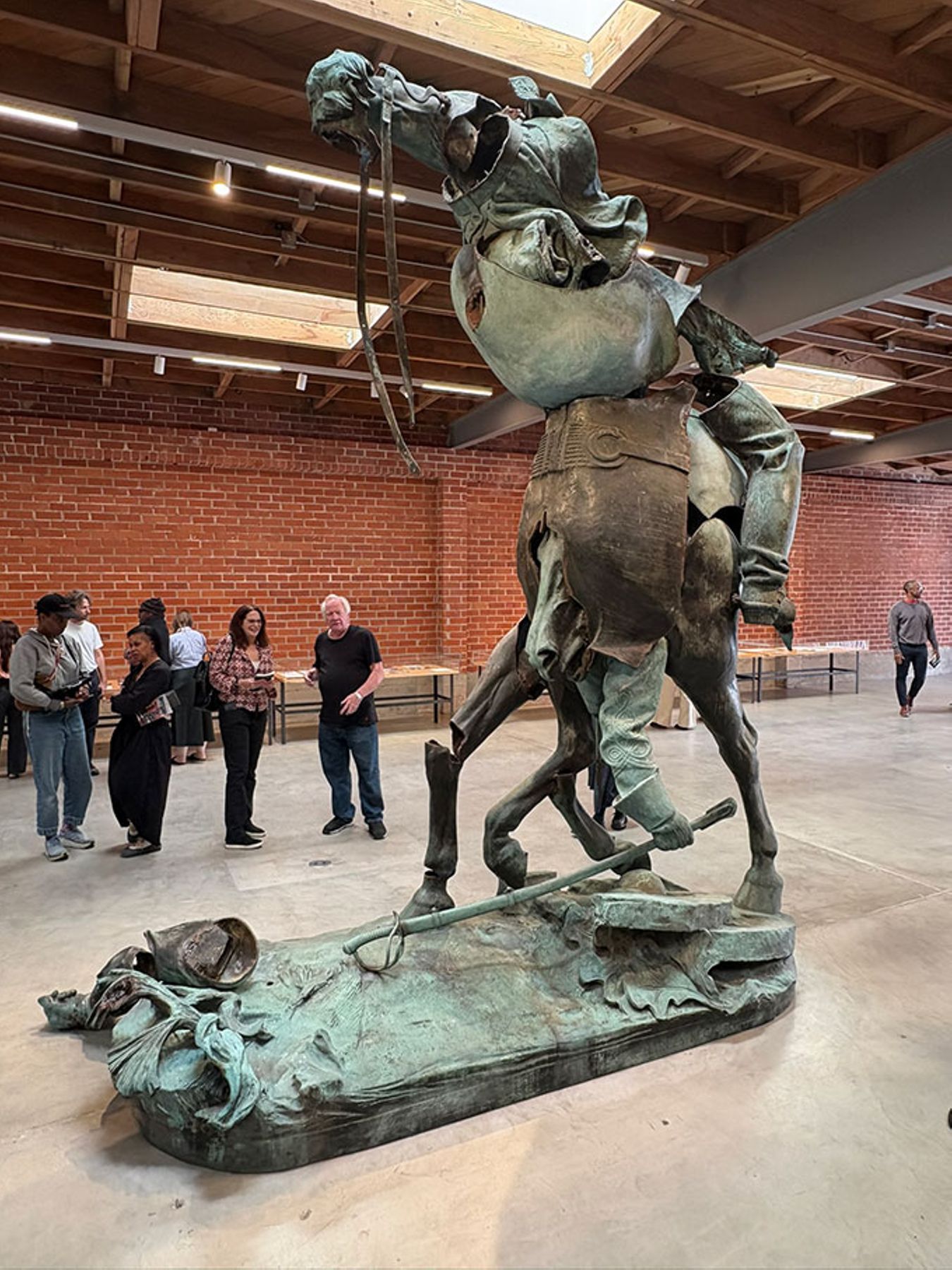
On the other side of the country, woke iconoclasm has found its ne plus ultra in a Los Angeles exhibition, entitled MONUMENTS, of ten banished commemorative artworks and the responses they’ve inspired from contemporary African-American artists. The strongest impression likely to be made on the unindoctrinated who visit this show—housed at two different venues, the Museum of Contemporary Art’s Geffen Contemporary and The Brick, and bankrolled by the Mellon, MacArthur, and Ford Foundations and other deep-pocketed donors—is the inconsequentiality of the contemporary productions compared with the “decommissioned” Confederate monuments. Those that have not been destroyed, that is. Displayed without their pedestals and still paint-splattered, the figurative bronze sculptures are worthy productions by the academic standards of their era. As its pièce de résistance, the exhibition offers a contemporary artist’s mangling of the extraordinarily fine Stonewall Jackson equestrian that stood for a century in a park alongside the county courthouse in Charlottesville, Virginia.
The butchered bronze portrayed Jackson at the time of his brilliant Shenandoah Valley campaign of 1862. His mount has now been turned upright, with its severed head protruding between its supporting legs. The general’s fragmented body now bends backward. Stonewall’s head, too, has been severed and his face cut away. His crop of hair and ears have been rammed into a relocated portion of one of his horse’s legs. The equine’s tail has been stashed between Stonewall’s legs and chest. A dislocated, gauntleted arm drags the hilt of his sword along the ground. The other arm lies apart, amputated. This registers as a sick joke playing on the amputation of one of Jackson’s arms after he was fatally shot by friendly fire at Chancellorsville.
What Kara Walker has done to this statue—the work of another prominent sculptor, Charles Keck—is obscene. To some it will call to mind the horrific spectacle of the bronze head of Confederate commander Robert E. Lee dissolving in furnace flames—“[H]is mouth seemed to widen into a scarlet scream,” a New York Times critic rapturously observed—after Charlottesville’s woke city council conveyed the equestrian monument of which it formed part to a local African American heritage center. MONUMENTS proudly displays bronze ingots, stacked on two wooden pallets, from that statuary meltdown, which took place in 2023—after both plaintiffs contesting its transfer to the center were found to lack legal standing to do so. Three postmodernist design firms are competing to recycle the bronze in what the heritage center calls “a new representation of public memory.”
Four Baltimore bronzes, all removed at the behest of the city’s mayor after the August 2017 “Unite the Right” riot in Charlottesville, figure in the Los Angeles show: a Soldier’s and Sailor’s Memorial with an angel supporting a standing wounded warrior with one arm and holding a laurel wreath aloft with another; a three-figure Confederate Women’s Memorial that includes a wounded soldier in the arms of a kneeling female; a seated statue of Roger B. Taney, the Maryland born-and-bred Supreme Court chief justice who issued the disastrous Dred Scott opinion of 1857 that denied any possibility of citizenship for black Americans; and finally an equestrian duo, Lee and Jackson, portrayed as they part ways at Chancellorsville—where the latter secured a major Confederate victory before being mortally wounded.
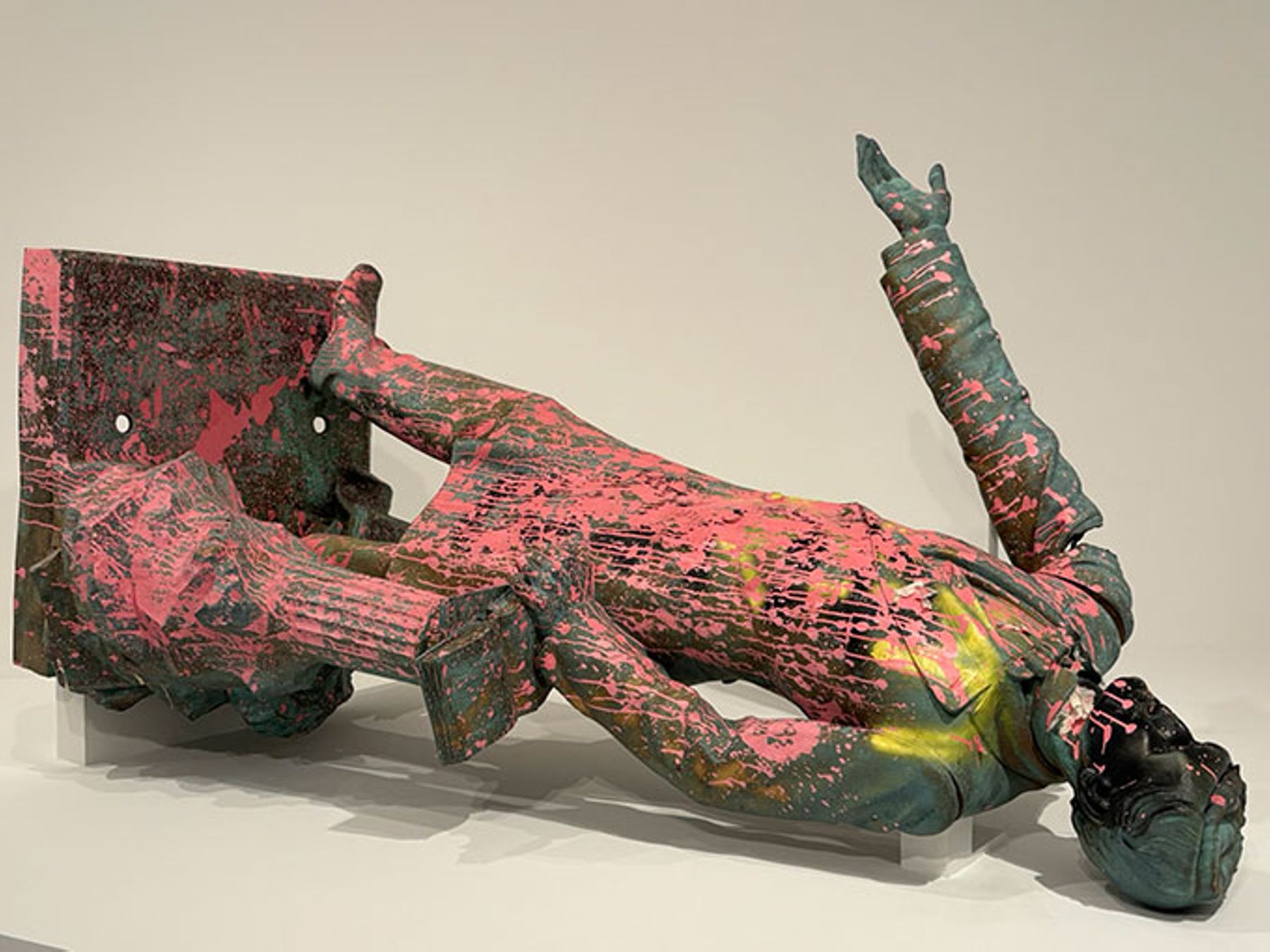
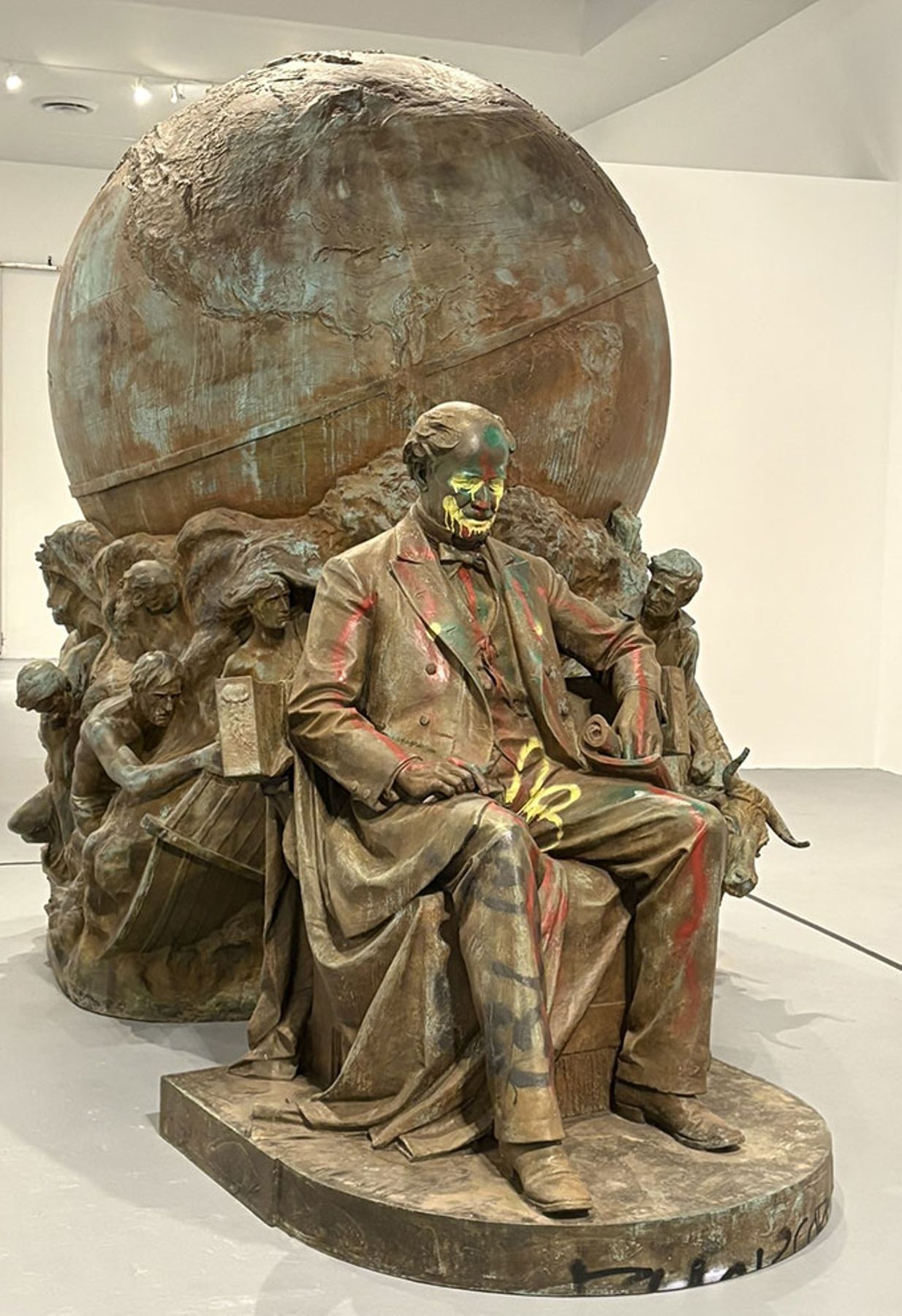
A vandalized Jefferson Davis figure, from the bombastically elaborate Monument Avenue tribute to the Confederate president, is also exhibited. He lies flat on his back, with his head stoved in, one leg stained with urine, and the remnant of a Kleenex noose around his neck. The draped, idealized, and undamaged “Miss Confederacy” figure that loomed high above him stands in another chamber, weirdly lit and set against reflective black panels, with a CCTV surveillance camera pointing down at her. Another “decommissioned” Monument Avenue work is the Matthew Fontaine Maury Monument, with the internationally renowned author of the treatise considered the first masterwork of modern oceanography, The Physical Geography of the Sea (1855), seated in mufti, clasping a compass with one hand and charts with the other. Around the large globe behind him (which was formerly perched on a tall base) the forces of nature—storms and floods—buffet men, women, and domesticated animals. Maury served the Southern cause by developing a mine that proved highly effective against federal vessels. Along with Hunter McGuire—likewise portrayed in mufti at Capitol Square despite his service as a Confederate army surgeon—Maury was an eminent man of science who held benighted racial views. Biographical markers putting the two of them in historical context would be far preferable to their monuments’ removal, which only serves to dumb down the public realm.
Also featured in the Los Angeles exhibition, which remains on view until May 3, are graffitied fragments, including a lion’s head, from the powerfully rusticated, 40-foot-tall granite pedestal of the Lee equestrian (1890) that, situated on a broad turfed circle, held pride of place on Monument Avenue. Dismembered and removed in 2021 after a prolonged court battle, this was probably the South’s best-known Confederate statue.
The exhibition’s contemporary responses to the banished monuments include large photographs of individuals sporting KKK garb in the room with the supine Davis figure; more than a dozen photographs of Pietà-like scenes—playing off the Baltimore Confederate women’s memorial—of black mothers mourning their dead sons in reference to police shootings; a ghostly white life-cast of a dreadlocked black boy holding a miniature Confederate equestrian by the horse’s tail; a rectilinear, 9 ½ by 11 ½ foot mass of cotton, a synecdoche for capitalist exploitation of slave labor; another weirdly lit display featuring charred old wooden cabinets referencing the fiery ravages of war, including the torching of Richmond’s downtown by retreating Confederate troops in April 1865; and a Dukes of Hazzard-style Dodge Charger planted on its front end, its roof emblazoned with the Stars and Bars and Robert E. Lee’s name. The latter is the work of the creative who gave us the bizarre “intertwining of disembodied arms” that is Boston’s 20-ton, 20-foot-tall memorial to the Rev. Martin Luther King and his wife, Coretta Scott King. Much of the Charlottesville Stonewall’s beautiful granite pedestal, which featured allegorical figures of Valor and Faith in high relief, has been cut into little fragments supposed to represent rose petals strewn on Union soldiers’ graves by Charleston freedwomen after the end of hostilities. Kara Walker, on the other hand, has decorated the pedestal’s severed top with the silhouette of a strange serpentine creature with a human head sporting a kepi—an apparent reference to Jackson. The creature sprouts a hand, a booted leg, hooves, and tails. It reads like an adolescent’s supersized doodle.
The leftist Southern Poverty Law Center has pronounced Confederate monuments “symbols of hate and white supremacy.” But isn’t Walker’s ravaged Stonewall an obvious manifestation of hatred? And wasn't the statue quite obviously not a tribute to white supremacy but to martial valor grounded in religious faith, precisely as the now-destroyed pedestal's beautiful relief figures indicated? It should also be noted that the MONUMENTS show, with its sundry manifestations of latter-day artistic disability, reflects complete indifference, if not outright hostility, to aesthetic achievement and its higher aims. Keck, Walker observed last year, “was the consummate sculptor of statuary. There were only noble feelings and we haven’t got many of those.”
“We” certainly don’t.
Like the adherents of far-right groupuscules, leftist iconoclasts inhabit an ideologically infantilized universe. Many Americans, on the other hand, have found reason to admire the South’s paladins without subscribing to the Confederate cause. Keck presumably ranks among them. A former assistant of the illustrious Augustus Saint-Gaudens, he also created a memorial to Booker T. Washington for the Tuskekegee Institute in Alabama, showing a standing Washington lifting the veil of ignorance from a kneeling black youth. (A copy of this sculpture is spectacularly situated in front of Booker T. Washington High School in Atlanta.) The principal sculptor of the now smelted Charlottesville Lee—Henry Merwyn Shrady, another onetime Saint-Gaudens understudy—was also responsible for the Grant Memorial (1922) at the opposite end of the National Mall from the Lincoln Memorial.
Northern artists like Keck and Shrady subscribed to—and thrived on—the Progressive consensus that the Confederacy should be woven into the national story. This consensus entailed recognition, not least among those who fought against them, of the bravery of the South’s often ragged and ill-fed soldiers. The Confederate Memorial at Arlington Cemetery bore witness to that Progressive consensus. But the sculptor who created it was no Yankee. Moses Ezekiel was a unique American cultural figure: born and raised in Richmond; the first Jewish alumnus of the Virginia Military Institute, where he was Stonewall’s pupil; a veteran of the only battle in American history in which cadets have fought, the 1864 Battle of New Market, Virginia; and just as remarkably, a product of the Royal Prussian Academy in Berlin who went on to take up quarters in the picturesque ruins of Rome’s Baths of Diocletian. There his many American visitors included Ulysses S. Grant, who called on the sculptor during the world tour that followed his presidency.
Most unusually for a Confederate monument, Ezekiel’s frieze includes two black figures: a body servant in military uniform proudly setting off for war with his master in one scene, and in another a “mammy” holding up an infant for its also uniformed father to kiss as he takes his departure. A small child tugs at the mammy’s apron. Ezekiel’s frieze is centered on the figure of Athena supporting the fainting female representing the Old South, whose shield bears the words “The Constitution”—meaning (for Ezekiel and Southerners of like mind) the Constitution that supported states’ rights and free trade. She symbolizes the “Lost Cause”—a phrase that originated with the vanquished Roman Republican Cato the Younger, whose laconic lament is inscribed in Latin—and the South that was no more. Another inscription is attributed to a former Confederate chaplain:
Not for fame or reward/Not for place or rank/Not lured by ambition/Or goaded by necessity/But in simple/Obedience to duty/As they understood it/These men suffered all/Sacrificed all/Dared all—and died.
The nearly 500 Confederate graves were laid out in concentric circles—in contrast to the cemetery’s norm of straight rows—with the monument at the center. Ezekiel himself was eventually interred, at his own request, at the foot of his creation, which Woodrow Wilson accepted on the nation’s behalf in 1914. Past and present national commanders of the Grand Army of the Republic, the fraternal association of Union Army veterans, spoke at both the laying of the monument’s cornerstone and its dedication two years later. Despite its defiant vindication of the Confederacy, this was an essentially elegiac funerary monument. It also served as a landmark for visitors seeking the Confederate burial section.
Late in 2020, amid the Floyd aftershocks, Congress created a “Naming Commission” to “remove all names, symbols, displays, monuments and paraphernalia that honor or commemorate the Confederate States of America . . . or any person who served voluntarily with the Confederate States of America from all assets of the Department of Defense.” The mandate exempted grave markers, but also left it to the commission to define the term. Even though three Confederate officers as well as Ezekiel are buried at the foot of his monument, the structure didn’t conform to the commission’s narrow definition. Biden’s Defense Secretary, Lloyd Austin, accepted the commission’s removal recommendation.
Needless to say, Ezekiel’s evocation of slavery is highly selective, but monuments have always involved selective memory. The MONUMENTS exhibit’s “Pietà” photographs are certainly highly selective, considering that the number of blacks fatally shot by police has been exceeded in recent years by the number of blacks homicidally shot not by cops but by other blacks by a factor of more than 25. But monuments, as cultural and political landmarks, also mirror societal change and the interplay between different eras. It looks like such interplay is about to be lost at Richmond’s Capitol Square. It was lost at the Virginia Military Institute in 2020 when Ezekiel’s fine statue of Stonewall, which stood in front of VMI’s historic Barracks, was exiled to the parking lot in front of the institute’s museum at the New Market battlefield, 75 miles to the north. During the 1950s a dignified statue of VMI graduate General George C. Marshall was erected alongside Ezekiel’s Stonewall. Best known as the author of the eponymous plan for Europe’s postwar reconstruction, Marshall was also a force for progress in the army’s accommodation of African American servicemen. Like countless American soldiers who have served the nation, Marshall revered Stonewall.
At the time of Hegseth’s August announcement, the Associated Press reported that the Confederate Memorial’s reassembly and refurbishment, which will involve the granite plinth’s replacement, was expected to take two years and cost $10 million. To some, the Pentagon’s extended time frame for restoration indicates wariness of the monument’s return to Arlington being exploited by Democrats during this year’s midterm election campaign. There’s no question that historical complexities present a challenge for many conservative politicians. It’s a lot easier to campaign against clear progressive abuses like critical race theory, DEI, transgender ideology, and open borders than to defend retention of Confederate monuments. True, the Republican caucus in Virginia’s closely divided Senate unanimously voted against removing the three Capitol Square statues in February. But Spanberger’s gubernatorial predecessor, Republican Glenn Youngkin, a capable retail politician with national ambitions, consistently avoided expending political capital in defense of such monuments.
Under the Virginia–Center for Military History loan agreement, Ezekiel’s memorial will be returned to the Commonwealth after 50 years unless the two parties agree to an extension. In the meantime, the agreement can also be amended by those parties, so that a Democratic administration in Washington and a Democratic governor of Virginia could agree to again banish the monument from the cemetery at any time. The UDC lawsuit, filed in the U.S. Court of Federal Claims last fall, contends that the Confederate Memorial’s 2023 removal and subsequent gifting to Virginia violated an “implicit” but “enforceable” contract between the federal government and the UDC, which took responsibility for the monument’s funding, design, and construction in return for its placement at the heart of the cemetery’s Confederate section. The UDC is seeking ownership and permanent reinstallation of the Ezekiel monument at that site or, alternatively, $1.8 million in damages. Like Defend Arlington, the organization that has played the leading role in advocating for the retention of Ezekiel’s monument at the cemetery, the UDC regards it as a grave marker.
Apart from the battered Davis statue, which will presumably return to Richmond’s now-woke Valentine Museum, no future plans for the bronzes from Baltimore and Richmond in the MONUMENTS exhibit have been announced. The Baltimore sculptures were relegated to the city impound lot upon their removal in 2017. Richmond’s transfer of ownership, at Stoney’s behest, of its banished monuments to the city’s Black History Museum in May 2022 was almost certainly illegal. For one thing, Stoney ignored state and municipal public procurement ordinances. The BHM never submitted a bid for the statues as part of the legally required process the city itself initiated in August 2020. The city has been sued by the Shenandoah Valley Battlefields Foundation, which submitted bids for three monuments—the Monument Avenue Stonewall equestrian (not to be confused with the butchered Charlottesville statue), a statue of Confederate cavalry commander Williams Carter Wickham, and a Soldiers and Sailors monument with a Confederate sentinel perched atop a lofty column. The artifacts would serve as landmarks at battle sites that the congressionally recognized nonprofit manages in the Valley.
The 2022 contract between the city and the Black History Museum required the latter to take possession of the monuments—including the originally state-owned Monument Avenue Lee equestrian, which Northam handed over to the city. Nearly four years later, the museum has yet to do so. BHM officials have said it lacks the physical capacity to house them. Apart from the artifacts sent to Los Angeles, the disassembled, shrink-wrapped and tarp-covered monuments still languish on the grounds of Richmond’s wastewater treatment plant. In a December Richmond Times-Dispatch op-ed lauding the MONUMENTS exhibit, the museum’s executive director showed no interest in restoration of what she called “symbols of hate”—regurgitating the Southern Poverty Law Center meme—and noted that the BHM is working on “a long-term stewardship plan” with a woke, Mellon-funded Philadelphia public-art think tank, Monument Lab. The entire episode has made a mockery of the law. After ruling against Richmond’s motion to have the battlefields foundation suit dismissed during a March 6 hearing, a Shenandoah County circuit court judge urged the city to reach a settlement with the foundation.
The monuments would surely be better off in its hands than the BHM’s.
One gets little idea from the MONUMENTS exhibit—which is, as much as anything, a monumental publicity stunt—of the unsavory tactics employed by leftist agitators during the Summer of Love, which culminated in the degradation of one of America’s finest boulevards. Kimberly Gray, a courageously outspoken black former city councilmember whose district included Monument Avenue, witnessed the noisy nightly congregations at Lee Circle, site of the equestrian and its hideously spray-painted pedestal. “It was mainly white kids, lots of them from out of town,” she says. The spectacle bore the logistical imprint of the far-left Antifa movement, which worked hand-in-glove with Black Lives Matter during the River City’s 2020 disorders. Gray watched “bike marshals” disembark from vans, while vehicles were parked nearby to serve as dispensaries of bottled water and snacks. Even medics were on hand in case of altercations with the police (which, in the event, were few). Armed white militants wearing body armor and gasmasks repeatedly stood watch at the circle. These men did not tangle with the cops. They served the Antifa-BLM cause by reinforcing the atmosphere of revolutionary autarky.
It so happens Gray, whose childhood was seriously impacted by racial hostility, herself supported removal of the Confederate monuments, as did most of her constituents—some of them, she acknowledges, out of fear. But for insistently remonstrating with the agitators, she was subjected to a raucous demonstration outside her house after a Charlottesville activist, a white software developer, posted her address online. Potentially eye-damaging laser beams flashed through the windows, terrifying her two youngsters.
No one knows better than Gray that the notion the Summer of Love advanced the cause of racial justice is ridiculous. She is also appreciative of the banished monuments’ artistry. The difficult, long-term task at hand is forging a consensus that leads to restoration and reinstallation of at least some of them, along with the erection of new monuments devoted to different themes—such as the service rendered by black Union troops during the Civil War—that emulate past artistic achievements.
That would make a lot more sense than dumbing Capitol Square down.
Top Photo: Moses Jacob Ezekiel’s Confederate Memorial, now slated for return to Arlington National Cemetery after its disassembly and removal in 2023. (Photo: Tim1965, Creative Commons)