On February 2, 2026, the board of the Boston Symphony Orchestra voted to terminate its contract with conductor Andris Nelsons. Nelsons had served as the BSO’s music director since 2014, following the retirement of James Levine. The decision had nothing to do with financial matters, according to the orchestra’s president and CEO, Chad Smith; ticket sales had risen under Nelsons. Rather, the board had concluded that “Andris was not the right leader for the entirety of our institution and our community,” Smith told Nelsons’s agents.
The termination was publicly announced on March 6, to widespread disbelief. As recently as January 2024, the board had rewritten Nelsons’s contract to renew automatically, citing its “deep confidence” in his “artistic leadership.” Now, just two years later, it had decided that the BSO and Nelsons were “not aligned on future vision,” as the March 6 press release put it.
Finally, a reason to check your email.
Sign up for our free newsletter today.
Orchestra members were not consulted on the decision to oust their beloved maestro. They were as surprised as Nelsons and the public were. A protest movement sprang up within days. BSO musicians started wearing red boutonnieres on stage, in honor of the red-and-white flag of Nelsons’s homeland, Latvia. Patrons distributed the flowers before BSO concerts.
The situation apparently grew intolerable to management. In late July at Tanglewood, the BSO’s summer home in Lenox, Massachusetts, the orchestra announced that the #RedFlowerCampaign violated its rules against the unauthorized distribution of materials. Local businesses in Stockbridge and Lenox took up the slack, handing out the flowers on their own premises.
BSO leadership had hoped to deflect responsibility for the prospective firing. “We want . . . this to be his decision and message,” Smith wrote to Nelsons’s representatives. Nelsons wouldn’t play along. This “was not the decision I anticipated or wanted,” he said in a statement after the March press release.
If one wanted to understand the ills plaguing classical music today, the firing of Andris Nelsons is a good place to start. The industry’s identity-obsessed administrators and its misguided struggle for “relevance” are both prominent in the BSO-Nelsons saga. The episode epitomizes the loss of core purpose not just in classical music but in the Western art tradition writ large.
Smith and the BSO board have been tight-lipped about the concrete grounds for firing Nelsons. Instead, they intone that he was not “in alignment” with the direction that management wanted to take the BSO, without specifying what that direction was. This lack of clarity has led to speculation that management wanted to embrace more pop music. There is little evidence for that proposition, however. What was unfolding was a power struggle over diversity ideology and organizational control.
Chad Smith is the pure Platonic form of a modern arts administrator, equally fluent in the academic mannerisms of diversity, equity, and inclusion and in the clichés of management consulting. After a prolonged silence about the Nelsons case, Smith gave an interview on June 30, 2026, to Boston public radio station WGBH. His performance was a masterpiece of coded obfuscation. Smith told the host that, after a two-year strategic-planning process, the BSO board had “landed at a place where we felt that the organization, that the orchestra, must serve Boston, must serve our communities more expansively and inclusively.” Nelsons, however, was not “supportive of the direction that the BSO was going,” Smith said, “particularly as it related to how we think about expansively serving our communities.”
A reference to “inclusivity” and “communities” means that a reference to “voices” and “stories” is cued up and ready to go. Sure enough: the “only way for us to move forward was to think differently about what it is that we put on our stages, whose voices get to be heard, whose stories get to be told,” Smith continued.
Two crucial elements were still missing from this diversity boilerplate, however: the phrases “seeing oneself reflected in” and “systemic,” the latter inevitably conjuring up “systemic racism.” But not for long. “We exist to serve young people who might not yet see themselves in classical music,” Smith said, adding that the BSO needed to address “systemic” issues.
Smith adopts the affectation, ubiquitous in the liberal nonprofit sector, of glorifying ordinary activity as “the work,” as if the well-paid bureaucrat were a proletarian factory hand. “I always say that rebuilding trust, you have to rebuild the shared work together. . . . The first step will be for management and the board and the musicians to lay out a shared work going forward. And then trust comes from being able to execute against that work.”
A stranger to the last three decades of identitarian discourse might ask: What does classical music have to do with “seeing oneself reflected,” or with telling the “stories” and hearing the “voices” of an allegedly silenced “community”? Isn’t classical music about hearing composers’ “voices,” capable of communicating feelings that the average mortal could not hope to express? Music itself tells a story: that of the restless movement of the composer’s soul. If a listener needs to see himself “reflected,” it would be more efficient to take a selfie than to attend a performance of a Mozart piano concerto. One listens to Mozart to lose oneself in a bygone world of grandeur and beauty, now available to us only through art. As for “who gets to help us tell the story,” as Smith cryptically put it, that same naive observer might also think that the choice would be based on the caliber of the musician, not on his identity.
But the canning of Nelsons was never about his musical talents. The quality of the orchestra under his leadership never came up in the correspondence between BSO managers and Nelsons’s representatives. Indeed, it would have been difficult to make a case against Nelsons’s musicianship, given his standing in the classical music world. In 2025, the Leipzig Gewandhaus orchestra voted another extension of his contract as Kapellmeister (chief conductor), which will now run through 2032. He is an honorary member of the Vienna Philharmonic. In June, Opus Klassik, Germany’s most prestigious classical music awards program, named him conductor of the year. Conductor Sir Simon Rattle, pianists Evgeny Kissin and Lang Lang, and ensembles including the Berlin Philharmonic and the Bavarian Radio Symphony Orchestra have expressed their support for Nelsons and denounced his firing.
The Latest Casualty in the War Against Greatness
The cancellation of a respected conductor who enjoys fervent support from his musicians and is accused of no misconduct is without precedent. Equally unprecedented is the cancellation of a successful conductor for not sufficiently supporting an “inclusivity” agenda.
The same cannot be said for actual works of music. The latest casualty in the ongoing war of mediocrity against greatness is Léo Delibes’s Lakmé. The opera, set in nineteenth-century India, recounts a doomed romance between the daughter of a Hindu priest and a British army officer. Its meltingly sinuous “Flower Duet,” for soprano and mezzo-soprano, is justly famous, but the opera is not regularly performed in its entirety, making any production a welcome addition to the global music calendar.
Surrey Opera is a hybrid professional/amateur company in Britain that provides valuable opportunities for young musicians. It was set to mount Lakmé this September, in an outdoor amphitheater in Cornwall overlooking the Atlantic. But any company that even thinks about producing Lakmé paints a target on its back. A one-man wrecking ball that goes under the name “Universal Society of Hinduism” is singularly focused on preventing the opera from ever again seeing the light of day. Its founder, president, and sole employee, Rajan Zed, has acquired a fearsome armamentarium of postcolonial-studies clichés, which he unleashes against any offending company until it backs down.
The press release assembling those clichés reads like the collected works of Edward Said, assembled into one endless, ungrammatical sentence. Lakmé, announces the oft-recycled statement, has been “blamed for caricaturing, appearance of mocking of ‘other’ cultures, colonial terminology, degrading and offensive elements, dehumanizing portrayal, essentialism, narratives often failing to represent ‘other’ cultures with dignity and humanity, imperialistic outlook, justifying ideas of superiority, looking down on people and customs, misrepresentation, considerably wrong about the culture it was supposed to be portraying, needless appropriation of cultural motifs, patronizing flawed mishmash of centuries-old orientalist stereotypes”—and so it continues for another several lines.
Despite the cookie-cutter nature of the attack, it works. Minack Theatre, which was hosting the Surrey Opera production, canceled the run and apologized. As an “inclusive venue,” the theater knew all along that Lakmé was unacceptable in today’s world, it said. It had already posted a trigger warning stating that the opera contained “cultural bias” and “stereotyping or negative depictions of people/cultures.” It had been pressuring Surrey Opera to present Lakmé through a postcolonial lens. The Minack was undoubtedly delighted, therefore, when the Universal Society of Hinduism’s denunciation came across its desk. Here was definitive justification for pulling the plug entirely. “We are happy that we have been able to resolve this matter,” the theater announced.
Rajan Zed is never satisfied with a mere cancellation, however. He inevitably demands that the leaders of the offending opera company undergo sensitivity training and issue their own apology. So far, Surrey Opera has not acquiesced, but it has axed its Lakmé performances in Croydon as well.
In 2025, the Opéra National de Bordeaux got the Zed treatment. It regrouped and in 2026 came up with a production called Lakmé Revisited that replaced the “exoticism” of the original with psychological “imprisonment, the not-sayable . . . interior silence, emotional repression.”
Washington Concert Opera, to its credit, did not back down under its own Zed fusillade. In 2022, it went on to mount a concert version of Lakmé to critical acclaim.
It is not known whether Zed, who lives in Reno, Nevada, knows anything about opera besides the color of a work’s characters. But he is determined to ensure that no one else does, either. It is also unknown whether he has denounced the Hindu epic Mahābhārata for “othering” foreign peoples as barbarians.
People do not attend opera for scholarly presentations of history (though, in the current age of ignorance, an opera such as Andrea Chénier or Tosca can provide a greater sense of historical drama than your average teenager will ever pick up in school). We are supposed to deplore the fact that earlier generations lacked access to gender and postcolonial studies and thus failed to anticipate our superior understanding of the patriarchy and the West’s allegedly unique predilection for conquest. But respect for our forefathers, even if, by current standards, undeserved, calls for a generosity of spirit toward such unfortunate failings. They did, after all, bequeath us a civilization. Anyone who feels unsafe because a nineteenth-century opera does not conform to his worldview has fallen deep into the abyss of narcissism and hysteria. And anyone who capitulates to such narcissism belongs nowhere near music or art.
The main point of contention between the board and Nelsons, based on the WGBH interview, seems to have been the conductor’s allegedly inadequate enthusiasm for the race- and gender-based programming and hiring that became so dominant in the classical music world after the George Floyd riots. By contrast, Smith went all-out on “inclusion” when he was CEO of the Los Angeles Philharmonic, from 2019 to late 2023. In 2020, Smith noted to a reporter that classical music had historically been “European and largely male.” He asked: “How do we, over time, change that?”
The LA Phil’s 2020–21 season gave part of the answer. About half of the featured performers were women or “people of color.” Female composers “of color” received a disproportionate share of commissions for new work. A series called “America: The Stories We Tell” was to culminate in a multimedia concert by soprano Julia Bullock. The concert, “History’s Persistent Voice,” was to include slave narratives, Jim Crow–era stories, and accounts of modern-day incarceration, according to the Los Angeles Times. The LA Phil ultimately canceled the 2020–21 season because of Covid. The following year, Smith returned to social-justice themes with a Power to the People! festival.
But the BSO had also paid obeisance to “diversity” before the Smith regime. In March 2023, the orchestra offered a three-week festival called “Voices of Loss, Reckoning, and Hope.” The festival “explored critical themes of discrimination, gender disparities, and identity in historical and contemporary works,” according to the BSO’s 2022–23 annual report. It included Anthony Davis’s 2007 “You Have the Right to Remain Silent,” a clarinet concerto based on a police traffic stop that Davis had experienced in the late 1970s. The program notes, written by composer George E. Lewis, observed that blacks in the U.S. and Europe learn to “accept the near-certainty of being accosted by public authority in one form or another; the spurious motivation for many of these encounters is impossible to deny despite the strenuous efforts made in some circles to do so.”
Nelsons did not conduct the “Voices of Loss” festival, but he conducted many “diverse” composers, living and dead, as well as contemporary music more generally. He conducted the world premiere of Carlos Simon’s “Four Black American Dances,” a BSO commission, in February 2023. He subsequently programmed the piece repeatedly—unlike most commissions, which get shelved after their first outing. He took it on tour and opened the 2023–24 season with it, along with other works by black composers.
So why did Smith and the board conclude that Nelsons was not aligned with the “direction that the BSO was going,” as Smith told Boston public radio? There appear to be two reasons. First, BSO management wanted to overturn the traditional repertoire more thoroughly than Nelsons could accept. Second, management wanted to accelerate a revolution in how classical music is presented—and in who decides how it is presented.
Smith champions a model of orchestral programming in which concerts are embedded within a larger framework of ideas and a broader range of art forms. While at the Los Angeles Philharmonic, he created the LA Phil Humanities program, which supported speaker series, art installations, and projects organized by individuals outside the institution. It created festivals around conceptual themes.
Here, too, it is not as if the BSO had not already been presenting thematic festivals, as the 2023 “Voices of Loss, Reckoning, and Hope” festival demonstrates. But the board anticipated from Smith an even greater emphasis on extra-musical, “cutting-edge” programming, as it put it in the announcement of his hiring.
Smith did not disappoint. On taking the helm at the BSO, he replicated the LA Phil Humanities program and proceeded to channel many BSO offerings through it. The 2025–26 orchestral season was one of the most “idea-driven” ever, according to publicity materials. Its themes included faith, spirituality, and the natural environment. The 2026–27 season wrapped a Tchaikovsky series in humanities programming addressing questions of “visibility, belonging, and emotional honesty,” in the cloying academese of the BSO’s press office.
Other themed events this year and next include “Technology & Our Humanity” and a “Creation” festival pairing Haydn’s 1798 oratorio with a new work by Osvaldo Golijov and David Henry Hwang, commissioned by the BSO. Golijov’s Creation approaches the theme through a “multicultural and multidisciplinary lens,” combining Arabic and Brazilian music with Darwinian and cosmological ideas, according to the press office. Two weeks of talks and multidisciplinary events will accompany the performances.
Nothing is inherently inappropriate about nonmusical programming. Lectures have supplemented concerts for decades, sometimes to the great illumination of the works themselves. The BSO’s recent Beethoven and Shostakovich festivals featured historical and musicological talks consonant with the musical content.
But thematic programming can range far afield from the music, as a weeklong project at Tanglewood this August demonstrated. The “We the People” festival featured, on its penultimate day, a conversation between progressive historian Heather Cox Richardson and racial-justice advocate Bryan Stevenson concerning structural barriers to achieving equity in the United States. Stevenson discussed his work fighting racial bias and what activists call “mass incarceration”—i.e., the alleged over-incarceration of blacks. The connection to classical music? Tenuous, at best, despite Stevenson’s preposterous claim to New England Public Media that classical musicians had been especially blind to the past century of injustices and presumably now needed to atone.
“We the People” was “curated” by cellist Yo-Yo Ma. Curation is the fad of the moment. An art museum may bring in an artist or public figure to reconfigure part of its collection in the service of an extramural idea of the temporary curator’s choosing; an orchestra may bring in a musician or public intellectual to choose concert repertoire and performers, also around an idea of the curator’s choosing. Curation is another plank in the effort at greater “inclusivity.”
“We the People” contained a gallimaufry of offerings: spiritual gatherings led by Native American educators, a Latino block party featuring feather-clad dancers parading various national flags, square dancing, storytelling, pop, world music, and, yes, Western classical music. The last came with a nonmusical gloss. A recital with Ma and BSO cellists modeled “collaboration, democracy, and balance between the individual and the community”—a trendy way of describing what chamber music has always been.
A composer in the festival captured its essence. There is “much more willingness to have these types of discussions that maybe aren’t directly about music or the tradition, but more about the responsibility of just being a citizen,” Allison Loggins-Hull told New England Public Media.
Such “idea-driven” programming shifts the balance of power in an orchestra from the music director toward the administration. The music is now swaddled in Big Think. One might even suppose that the music is illustrating the themes, rather than vice versa.
Nelsons was well aware of this shift.Throughout 2024 and 2025, the board had sought to develop a “strategic plan” for the BSO. The process was an MBA’s dream, generating endless variants of nearly identical “planks” and “priorities,” none speaking directly to what was once the orchestra’s primary function.
On September 2, 2025, Nelsons intervened. As the orchestra pursued a stronger emphasis on community and audience connection, the conductor wanted an “explicit and non-negotiable” affirmation of the orchestra’s “core values,” his representative, Karen McDonald, wrote to Smith. “Humanities and community lenses” should be “amplifiers of the BSO’s musical work”—not, in other words, the main focus—with “core repertoire and cultivation of the orchestra’s sound at the heart.”
Nelsons made two other demands. First, he sought an affirmation of his role as the BSO’s artistic leader. At present, the plan reduces the orchestra to “only one of several parallel strands,” wrote McDonald. Second, and most remarkably, the conductor asked that a reference to “artistic excellence,” deleted from an early draft of the “strategic plan,” be restored, because excellence is the “indispensable engine for everything the BSO does.”
McDonald concluded her email to Smith by affirming Nelsons’s “alignment” with the plan’s “intent to deepen relevance and welcome more people” into the orchestra’s concert hall. Doing so was a “passion point” for him, she stated. He merely wanted to anchor that growth “unmistakably” in the BSO’s “world class artistry.”
Despite the olive branch regarding inclusivity, these were fighting words. The stakes were existential. Diversity was about more than subjecting classical music to tests of color and other forms of identity. It was about transforming not just artistic standards but the entire enterprise. Nelsons’s opposition to that transformation meant that he had to go.
If orchestra management cannot accommodate a conductor of Nelsons’s caliber, one who enjoys the enthusiastic support of his musicians and who is accused of no wrongdoing, classical music is in even greater trouble than one had suspected. Smith repeatedly asserts that the BSO’s primary obligation is to “serve audiences.” One might respond: no, its obligation is to serve music and, in so doing, to serve audiences.
To be sure, the problem of audience attrition is real. Though BSO attendance rebounded under Nelsons, over two decades it has fallen, according to Smith, by 40 percent. One reason that attrition feels so catastrophic, however, is the costly growth of the management class. In 1965, the BSO had about half a dozen managerial staff serving 100 musicians—a ratio of roughly 14 instrumentalists to every administrator. By 2025, while the orchestra still consisted of about 100 musicians, the ratio of musicians to administrators was close to parity. Feeding that bureaucracy means greater pressure on budgets and endowments—and higher ticket prices.
Administrators and the League of American Orchestras blame audience attrition on the perception that classical music is insufficiently attuned to “diverse identities.” The establishment validates that perception by promoting race-based programming as the antidote to a suspect canon of dead white males and too-white, too-Asian living performers. But that diagnosis gives stay-away audiences too much credit. Classical music is not so much rejected as absent from their consciousness entirely. Moreover, many people, especially the young, cannot process the sound of a symphony, whose complexity far exceeds that of pop music.
The one place in popular culture where the orchestra has maintained a foothold is in film and video-game scores, which, not coincidentally, are the last redoubt of traditional harmony and melody in contemporary classical composition. The persistence of the orchestral sound in those popular entertainments offers some hope that it could be restored to the foreground of public consciousness.
Every performing institution should be begging for access to schools and inviting students to its rehearsals, in order to expose children more deliberately to this now-alien idiom. But to gain entrée, orchestral spokesmen must change their message. Not: come to a concert to see yourself reflected, but: come to a concert to hear life-changing beauty. A willingness to speak with such urgency should be a precondition for any management job.
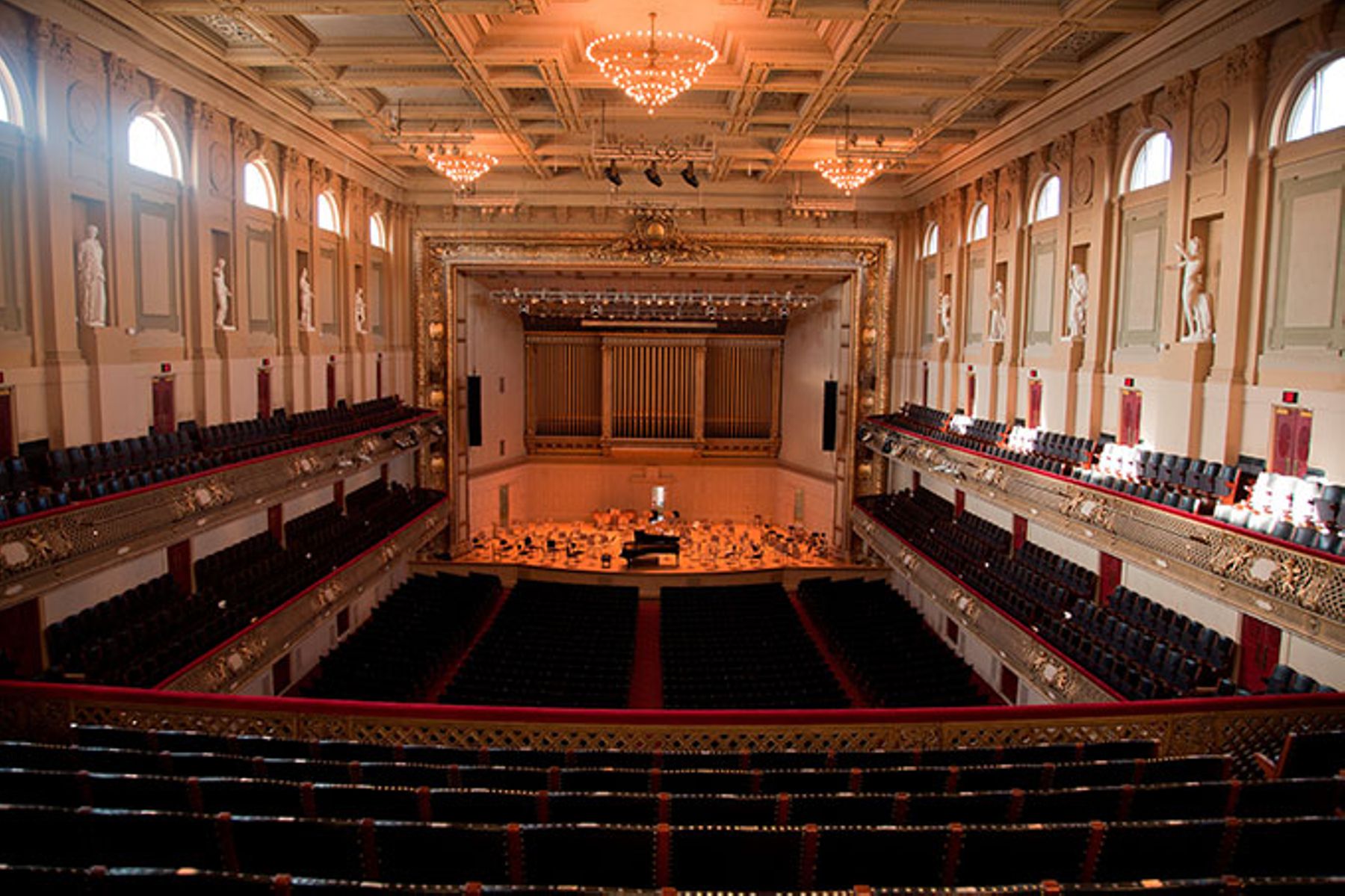
Smith and the BSO board do not feel that urgency, according to the orchestra’s furious musicians. “Chad and Barbara [Hostetter, board chair] do not love the BSO, and every player on stage knows that, feels that, sees that, and hears that,” a violist wrote to the orchestra’s chief financial officer in June 2026. The removal of displays documenting the BSO’s history during a 2025 renovation of Boston’s Symphony Hall seemed to validate that perception.
The would-be guardians of Western civilization betray their duty every time they fail to defend that civilization against specious charges of exclusion and every time they stay silent about its glories. Smith and the BSO board have made their priorities clear: chasing nonmusical programming trends rather than cultivating and promoting their inheritance at the highest level of excellence. They, not Nelsons, have disqualified themselves from power.