|
Forwarded this email? Sign up for free to have it sent directly to your inbox. |
|
|
|
Good morning,
Today, we’re looking at efforts to protect New York City from terror, New York’s post-9/11 rebuilding efforts, what the nation has forgotten 25 years after September 11, state psychiatric hospitals, higher education reform in Iowa, and American universities’ uncertain future.
Write to us at editors@city-journal.org with questions or comments. |
| |
|
Photo credit: Gary Hershorn / Contributor / Corbis News via Getty Images |
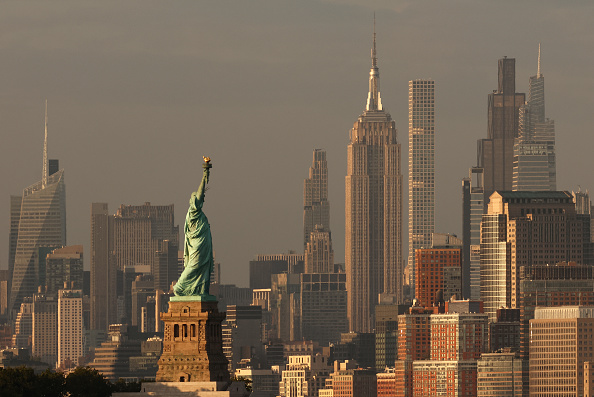
Twenty-five years after the September 11 attacks, New York City faces a plethora of terror threats. The NYPD has thwarted about 20 known plots, along with dozens of others that have never been made public. Indeed, the city is still the world’s top terrorist target; protecting it requires coordination among local law enforcement, federal homeland security agencies, and nonprofit groups like the Community Security Initiative.
Created in 2019, CSI is a community-based counterterrorism organization that helps protect New York’s Jewish population as well as the city’s thousands of Jewish institutions. Judith Miller recently spoke with Mitchell Silber, who leads CSI, about what groups like his are doing to help prevent another mass attack and protect New York Jews.
“While most people agreed after 9/11 that terrorism was evil and civilians were innocent victims, now terrorism’s evil seems up for debate and Jews are often seen as legitimate targets,” he told Miller. “On the internet and even from some politicians, you hear that Jewish terror victims are fair game.”
Read more from her conversations with Silber about the city’s counterterrorism efforts, and why Jews, in particular, are increasingly under threat. |
|
|
Twenty-five years after 9/11, Steven Malanga reflects on New York’s experience following the attacks. While political infighting and government-led planning delayed the rebuilding of Lower Manhattan, private developer Larry Silverstein’s determination to rebuild 7 World Trade Center helped break the stalemate and ultimately drove much of the site’s redevelopment. The anniversary is therefore both a commemoration of those lost and a reminder of the policies that helped New York recover.
“Today, many of the lessons of 9/11 and its aftermath have been forgotten or were never learned,” Malanga says. But two and a half decades later, Americans have the “opportunity not only to remember the dead and honor those who sacrificed their lives doing their duty that day—but also to admonish the living.”
Read more here. |
|
|
“It was once commonplace to hear President George W. Bush declare that you were either part of the free world or aligned with the terrorists,” Tal Fortgang writes. “Yet 25 years later, that ultimatum seems far less self-evident.”
Indeed, look at where we are today. Despite his claim that “America deserved 9/11,” Hasan Piker has entered the Democratic mainstream. Many Democratic Socialists of America candidates have acted disturbingly conciliatory toward al-Qaeda. Progressive politicians now often draw a moral equivalence between the U.S. and its enemies.
“We have not forgotten 9/11,” Fortgang observes, “but we have forgotten that a real difference exists between us and our enemies—and that Americans are right to insist that their nation belongs to those who believe in Americanism, not those who aid and abet its enemies.” |
|
|
The Lindsay Clancy murder trial, which ended in a mistrial last week, has highlighted a cultural shift toward treating criminal offenders as victims of mental illness or trauma. Tewksbury Hospital, the Massachusetts facility where Clancy has been confined for the past three years, is one of many mental-health institutions struggling with the consequences of this change.
“Today, a large share of [Tewksbury’s] psychiatric population comes through the criminal-justice system,” writes Christina Buttons. These new patients are creating persistent violence and security problems, as well as unsafe working conditions for hospital staff.
Read here to see why investing in psychiatric care inside jails, rather than overtaxing the nation’s already-strained state-hospital system, would be a better option. |
|
|
“Racism in American Popular Culture”; “French and Francophone Animation”; “Black Television Culture”; “Native American Foods and Foodways”; “Introduction to LGBTQ+ Studies”—these are just some of the many courses university students in Iowa have been able to take to fulfill general education requirements.
Come 2028, topics like these will no longer count for credit. That’s thanks to state legislation passed in June that requires all college students to take a U.S. history course and a government course—and these classes must be broad enough to count as introductory surveys.
“Iowa’s higher-education reforms show that a hands-on approach to general education can work,” Mark Bauerlein writes. Read about how the new law came to be. |
|
|
Since the 1980s, tuition at U.S. universities has skyrocketed 438 percent—about three times the rate of inflation. Only about a third of Americans think a college education is worth the high cost. Only 38 percent say they feel confident in higher education.
Now, more than 440 colleges are at risk of financial failure over the coming decade. Some won’t make it. Those that do survive have an opportunity to rethink curriculum, governance, and credentials. “University boards must stop assuming that yesterday’s business model can be preserved through incremental reform,” Pano Kanelos and Thomas E. Beach write. “Faculty need to recognize that defending higher learning is not the same thing as defending existing structures. Struggling colleges may want to prepare for policymakers or philanthropists to stage takeovers of their campuses, remaking them to ensure their survival.”
Read more. |
|
|
“The climate change religion lives on as a means to tax us to death!” |
|
|
|
A quarterly magazine of urban affairs, published by the Manhattan Institute, edited by Brian C. Anderson. |
|
|
|
Copyright © 2026 Manhattan Institute, All rights reserved. |
|
|
|
|