|
Forwarded this email? Sign up for free to have it sent directly to your inbox. |
|
|
|
Good morning,
Today, we’re looking at the Supreme Court’s legitimacy, America’s urban challenge, Flock cameras, and pass rates for AP tests.
Write to us at editors@city-journal.org with questions or comments. |
| |
|
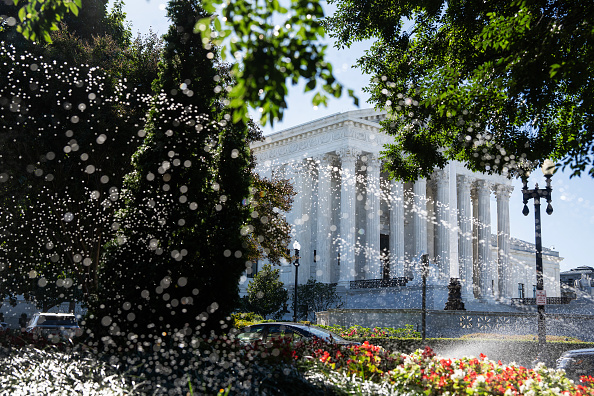
Photo credit: Tom Williams / Contributor / CQ-Roll Call, Inc. via Getty Images |
A recent Gallup poll found that just 33 percent of Americans approve of the job the Supreme Court is doing, a record low. Marquette Law School found that 47 percent approve. This must mean that the institution is in dire need of structural repair, right?
Not so fast, Ilya Shapiro argues. In the Gallup poll, the decline was driven by Republicans, whose approval dropped to 58 percent from 79 percent. Democratic approval stayed at 12 percent and independent approval at 35 percent. In the Marquette poll, Republican approval was 74 percent, while Democratic approval was 22 percent and independent approval 35 percent.
“That’s an unhealthy picture, but it looks more like polarization than a broader crisis of legitimacy,” Shapiro writes. “A dip in approval—especially one produced by historically polarized voters during an era of collapsing trust—provides little reason to redesign the Constitution.”
Read more about why polls are a bad test of judicial legitimacy. |
|
|
Up until the 2010s, cities were long able to lean in to their cultural appeal and abundant jobs to attract young creatives and top talent. But as costs rose and America fractured more deeply politically, previously successful urban models fell out of favor, whether for being too homogenous or too expensive. The Covid-19 pandemic sent the urban exodus soaring.
America’s city leaders need a new strategy, Aaron M. Renn argues. “Expanding housing supply will be essential to bringing costs down, which in turn will require significant reforms to zoning and building codes,” he writes. “Cities will also need to generate leadership capacity in both the public and private sectors. Business leadership has been in decline for some time. Too many mayors and city councils are failing to deal with their cities’ difficulties.” Read more about urban America’s challenges and what it will take to reinvigorate cities. |
|
|
Automatic license plate readers, like the cameras Flock makes, have caused an uproar in recent months. Critics claim that ALPRs create a system of “mass surveillance” and impede individual liberty.
Not so, Sam Raus argues. The cameras have helped catch kidnappers, prevent traffic accidents, and investigate crimes. And public order underpins a free society. “Functioning governments that protect property rights, personal security, and orderly public spaces are fundamental to liberty,” he writes. “Without them, liberty becomes merely theoretical.”
Read more. |
|
|
Only a few years ago, national pass rates on Advance Placement tests for English Literature and Composition, U.S. History, and Chemistry hovered around 40 percent to 50 percent. Today, that number is more than 70 percent. How?
Neetu Arnold reached out to the College Board to find out, but she couldn’t get clear answers. The Board began changing its scoring system for nine exams in 2022, and it maintains that the new methodology is more accurate. Arnold is skeptical. “In my outreach, the organization sidestepped key questions about the changes to its scoring methodology,” she writes. “And often when it provided information in response to one question, the answer introduced more inconsistencies and unresolved tensions.”
Read more here. |
|
|
“A good 99% of the comments here prove Percy’s point. Political ideology has become the focal point of the American experience. Religion is to be understood solely through the political lens while politicians are our prophets, if not our actual gods.
Mercy, forgiveness and charity are considered weakness while gotcha points, demonization, and bullets are prized as strength. These are serious times. Unfortunately, we are no longer a serious people.” |
|
|
| A quarterly magazine of urban affairs, published by the Manhattan Institute, edited by Brian C. Anderson. |
|
|
|
Copyright © 2026 Manhattan Institute, All rights reserved. |
|
|
|
|