|
Forwarded this email? Sign up for free to have it sent directly to your inbox. |
|
|
|
Good morning,
Today, we’re looking at Mayor Zohran Mamdani’s influencer network, the failure of the anti-bullying movement, new federal guidance on school discipline, a win for religious freedom, and September 11 commemoration ceremonies at Ground Zero.
Write to us at editors@city-journal.org with questions or comments. |
| |
|
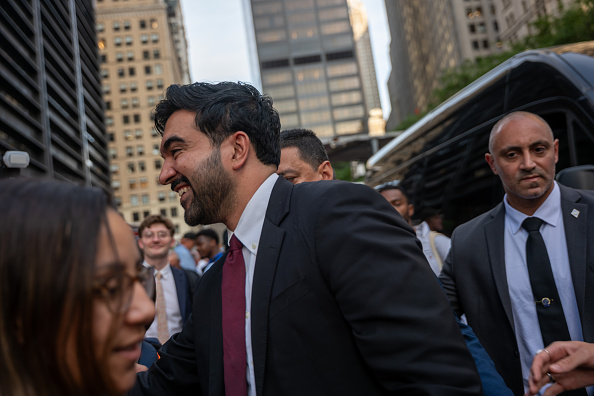
Photo credit: Spencer Platt / Staff / Getty Images News via Getty Images |
Christina Brown has 282,000 Instagram followers. On the platform, she has suggested that ICE agents should be poisoned, that Charlie Kirk’s assassination was justified, that she hates the United States, and that Christianity is a “religion of white supremacy.”
Megan Kilnk co-runs @prettyinformedgirls, which has 223,000 followers. Kilnk recently claimed that “America has mass concentration camps,” and, referring to ICE, that “there is no reforming a f***ing Gestapo.” Matt Bernstein has more than 2.4 million followers. He recently blocked New York traffic “in protest of our senators continuing to fund Israel’s genocide.”
Brown, Kilnk, and Bernstein are just a few of the dozens of influencers that New York City Mayor Zohran Mamdani has gathered to help boost his administration. The Columbia Journalism Review recently reported that the influencers receive talking points through the “NYC Creators Announcements” group chat on Signal. But the content they post on social media “belies the mayor’s polished image as a moderate and offers more evidence that his social and professional circles are more radical than he lets on,” Adam Lehodey writes.
Read more about Mamdani’s influencer army. |
|
|
Bullies are nothing new. They typically use their status or power to intimidate or humiliate someone weaker. They aren’t necessarily evil, though they can be criminals, and jerks at the very least.
Today’s anti-bullying movement, though, frames bullies as inherently evil. Ever since the 1999 Columbine High School massacre, every state and Washington, D.C. has enacted some form of anti-bullying legislation. That means that almost every U.S. school is required to adopt anti-bullying policies and investigation procedures.
“These widespread mandates spawned a lucrative anti-bullying industry,” Carolyn D. Gorman writes. “Consultants, law firms, curriculum developers, mental-health organizations, and nonprofits proliferated to manage liability and capture public funding.” But despite these extensive resources, the movement, thus far, hasn’t worked. “Bullying persists,” Gorman observes, “and empirical evidence that these approaches can even meaningfully reduce it is mixed, at best.” Read more about how the anti-bullying movement may be doing more harm than good. |
|
|
In July, the Department of Education removed disparate-impact provisions from its Title VI regulations. And last month, it issued new guidance on school discipline, charging schools with creating ordered learning environments and ensuring students aren’t disciplined differently because of their race.
“This is the right approach,” Jennifer Weber writes. “A student’s race should not change the consequences he faces. Schools should not discipline a student more or less to keep their numbers racially balanced.” Read more about what teachers can do to help improve student behavior. |
|
|
Last month, the Department of Justice’s Office of Legal Counsel directed federal agencies to stop enforcing rules that require providers not to engage in religious conduct if they want to participate in federal programs.
“The Supreme Court has made it clear that such rules are unconstitutional,” Nicole Stelle Garnett, Michael A. Helfand, and John Meiser write. “When the government extends public support to private organizations, the First Amendment’s Free Exercise Clause prohibits it from denying such support to groups that engage in religious activity. Yet federal agencies have continued to enforce these rules in dozens upon dozens of federal programs.” States and all levels of government should follow the DOJ’s lead and end religious discrimination. Religious institutions should be able to serve vulnerable citizens without losing access to resources while remaining true to their religious commitments. Read more. |
|
|
“The sky is now fully blue against the new One World Trade Center above in the background, as trumpeters sound out Taps and grandchildren, children, nieces, nephews, wives, husbands, sisters, brothers, and parents continue to unsheathe their flowers to place on one of the 2,983 names carved along the border of the flowing dark waters where two once-glinting Twin Towers stood.”
Nicole Gelinas reports from the ceremony last week commemorating the lives of those lost on September 11, 2001. Read about it here. |
|
|
“Economists from every ideology almost universally agree this policy does more harm than good. But hey, it sounds good on TikTok!”
|
|
|
|
A quarterly magazine of urban affairs, published by the Manhattan Institute, edited by Brian C. Anderson. |
|
|
|
Copyright © 2026 Manhattan Institute, All rights reserved. |
|
|
|
|