|
Forwarded this email? Sign up for free to have it sent directly to your inbox. |
|
|
|
Good morning,
Today, we’re looking at increasing executive power since 9/11, California Home Health Agency’s questionable profits, and North Korea’s apologists in the U.S.
Write to us at editors@city-journal.org with questions or comments. |
| |
|
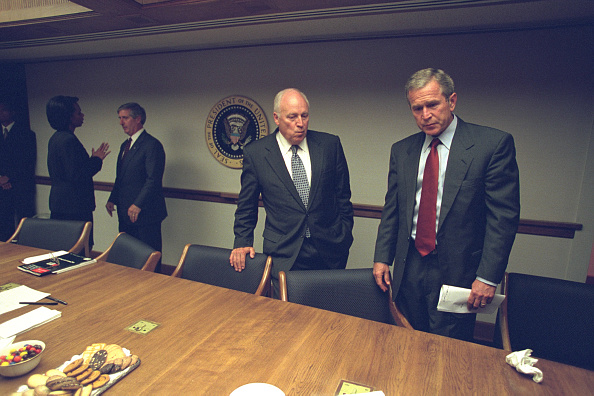
Photo credit: Handout / Handout / Getty Images News via Getty Images |
Twenty-five years ago, after the September 11 terrorist attacks, then-President George W. Bush declared a national emergency, stating that the dangers were “immediate” and “continuing.”
Every president since Bush has invoked those same extraordinary powers—for the 2008 financial crisis, the Covid-19 pandemic, and tariffs, among many other scenarios. “Not surprisingly, each pitted emergency response against civil liberties, and each left the White House playing a more dominant role in the American republic,” Michael W. McConnell writes. “The president’s ability to seize power by declaring emergencies has become a grave danger to our constitutional system of checks and balances.”
Read more. |
|
|
Since at least 2013, California Home Health Agency (CHHA), a taxpayer-funded company, has provided in-home medical care and specialty treatments. CHHA’s profits from Medicaid between 2018 and 2021 were just shy of $2 million. Over the next three years, that number skyrocketed to more than $34 million.
Chief Nathan Ogbatue, CHHA’s CEO, holds a massive real-estate portfolio that shows a similar trajectory. In 2000, he bought a home in Riverside for $330,000. In 2023, he and his wife bought a $2.7 million mansion, then a $1.9 million beach house later that year, then $2.8 million in other Riverside properties in 2024. How did Ogbatue acquire so much wealth?
“No officials have publicly accused CHHA of wrongdoing,” Christopher F. Rufo and Madeleine Rowley write. “Two experts we spoke with, however, suggested that the company’s billing patterns raise questions. Haywood Talcove, CEO of LexisNexis Risk Solutions for Government, reviewed CHHA’s Medicaid data and noted several potential issues.”
Read more from their investigation. |
|
|
In recent years, a number of pro-North Korea groups have cropped up in the U.S., gaining both acceptance among the political Left and influence across South Korea, Japan, and Canada. They “portray totalitarian North Korea as one of the world’s most democratic countries,” Stu Smith explains, and they push for South Korea’s “liberation” from the U.S.
Nodutdol, a 501(c)(3) organization, sits at the center of the network. The group advocates for a Marxist future on the Korean Peninsula and for “a world free of imperialism.”
“The pro-North Korean network’s growing reach among American activists and transnational organizations poses threats to regional security and could weaken U.S. alliances in East Asia—often in ways that align with the strategic interests of the Chinese Communist Party,” Smith writes. “Nodutdol and its allies offer a unique opportunity for American, Japanese, Filipino, and South Korean intelligence to cooperate and share intelligence.”
Read more about the expanding network. |
|
|
|
How should we think about automated license-plate readers, surveillance cameras, drones, and other public safety tools? Rafael Mangual sits down with Rahul Sidhu of Flock Safety to discuss the backlash against ALPR technology, the legal and privacy concerns surrounding surveillance, and the safeguards meant to prevent misuse. They also explore the real-world benefits of these tools in helping police solve crimes, recover stolen vehicles, and respond faster in emergencies.
|
|
|
|
“Why hasn’t that been done as a general education requirement of a high school diploma?”
|
|
|
|
A quarterly magazine of urban affairs, published by the Manhattan Institute, edited by Brian C. Anderson. |
|
|
|
Copyright © 2026 Manhattan Institute, All rights reserved. |
|
|
|
|