|
Forwarded this email? Sign up for free to have it sent directly to your inbox. |
|
|
|
Good morning,
Today, we’re looking at why Students for Justice in Palestine is celebrating October 7, Los Angeles’s lawless public-transit system, and New York’s counterfeit street vendors.
Write to us at editors@city-journal.org with questions or comments. |
|
|
|
Photo credit: Pacific Press / Contributor / LightRocket via Getty Images |
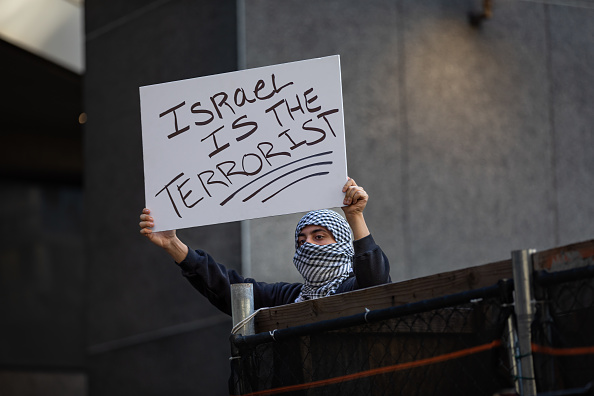
Students for Justice in Palestine (SJP) chapters across the U.S. are commemorating the lives lost among the perpetrators of the October 7 massacre against Israel. For instance, in advertisements for SJP gatherings at NYU Law, the group said that it would “challeng[e] myths around Al-Aqsa Flood,” the term Hamas uses to refer to the attack. Ads at SUNY-Oswego referred to “our great leader—Yah Yah [sic] Sinwar,” the mastermind behind the day. And ads at CUNY stated, in Arabic, “What is coming will be even worse.”
Contrary to what Western media says, these groups are not antiviolence. “Nor are they even meaningfully pro-Palestinian,” Tal Fortgang writes. “When they reflect on the tens of thousands of Palestinians who have died because of Hamas’s cowardice, they do so in celebration. Theirs is a pro-war, anti-Israel stance: murder is good if the victim is, say, an Israeli baby.”
There’s no excuse for universities not to know what SJP really stands for. Read more about the group. |
|
|
Five months ago, the Manhattan Institute filed a public records request about the murder of Mirna Arauz Soza. The 67-year-old mother of three was stabbed on the L.A. Metro in 2024 by a homeless offender, Elliot Tramel Nowden. Nowden, who had been banned from Metro after stabbing a college student on a train back in 2019, grabbed Soza’s bag and ran.
Metro refused MI’s public records request, citing family privacy concerns. Then it claimed that releasing the footage was not in the “public interest.” MI replied with a letter from Soza’s three surviving children authorizing the footage and information to be released. Metro still refused.
“Anyone who uses public transportation in the United States knows that evidence of an innocent bystander’s unprovoked, violent murder on a train is of undeniable public interest,” Christopher Rufo and Haley Strack write. “Mirna’s family deserves to know what happened to their mother. And Californians deserve to know what kind of monsters await them on the city’s public trains.”
So now, MI is suing. Read more about it here. |
|
|
New York City’s Canal Street is filled with counterfeit product—fake Gucci wallets, Louis Vuitton bags, Prada sunglasses, the list goes on. When police officers approach, vendors roll up the merchandise and flee, but only until the cops leave. Soon enough, they’re back on the street selling again.
Officers do make arrests. Last year alone, cops covering Canal Street made 908 arrests for trademark counterfeiting. But even though more than 92 percent of them were booked as felonies, in almost all those cases, the felonies later disappeared. Why?
To sustain a felony charge, prosecutors have to verify that the retail value of the genuine goods exceeds either $1,000 (for second-degree counterfeiting) or $100,000 (for first-degree counterfeiting). “Those thresholds help explain why felony arrests on Canal Street so rarely become felony prosecutions,” Daniel Edward Rosen writes. And misdemeanor counterfeiting cases, meantime, rarely bring about serious consequences. From 2022 through 2025, for instance, 68 percent of Manhattan’s counterfeiting cases ended in adjournments in contemplation of dismissal, compared with 17 percent of other misdemeanor cases.
“For vendors, then, an arrest can mean losing a day, and perhaps thousands of dollars’ worth of merchandise, but little more,” Rosen writes. Read more about why the counterfeit market is so difficult to rein in. |
|
|
“The replication crisis is one thing. Outright fraud, corruption, and gross incompetence are each separate and distinct issues.”
|
|
|
|
A quarterly magazine of urban affairs, published by the Manhattan Institute, edited by Brian C. Anderson. |
|
|
|
Copyright © 2026 Manhattan Institute, All rights reserved. |
|
|
|
|