|
Forwarded this email? Sign up for free to have it sent directly to your inbox. |
|
|
Good morning,
Today, we’re looking at mayoral candidate Zohran Mamdani’s plans for New York City, the Supreme Court’s new term, President Trump’s tariff power, gifted-and-talented programs in schools, and Democrats’ embrace of anti-Zionism.
Don’t forget to write to us at editors@city-journal.org with questions or comments. |
|
|
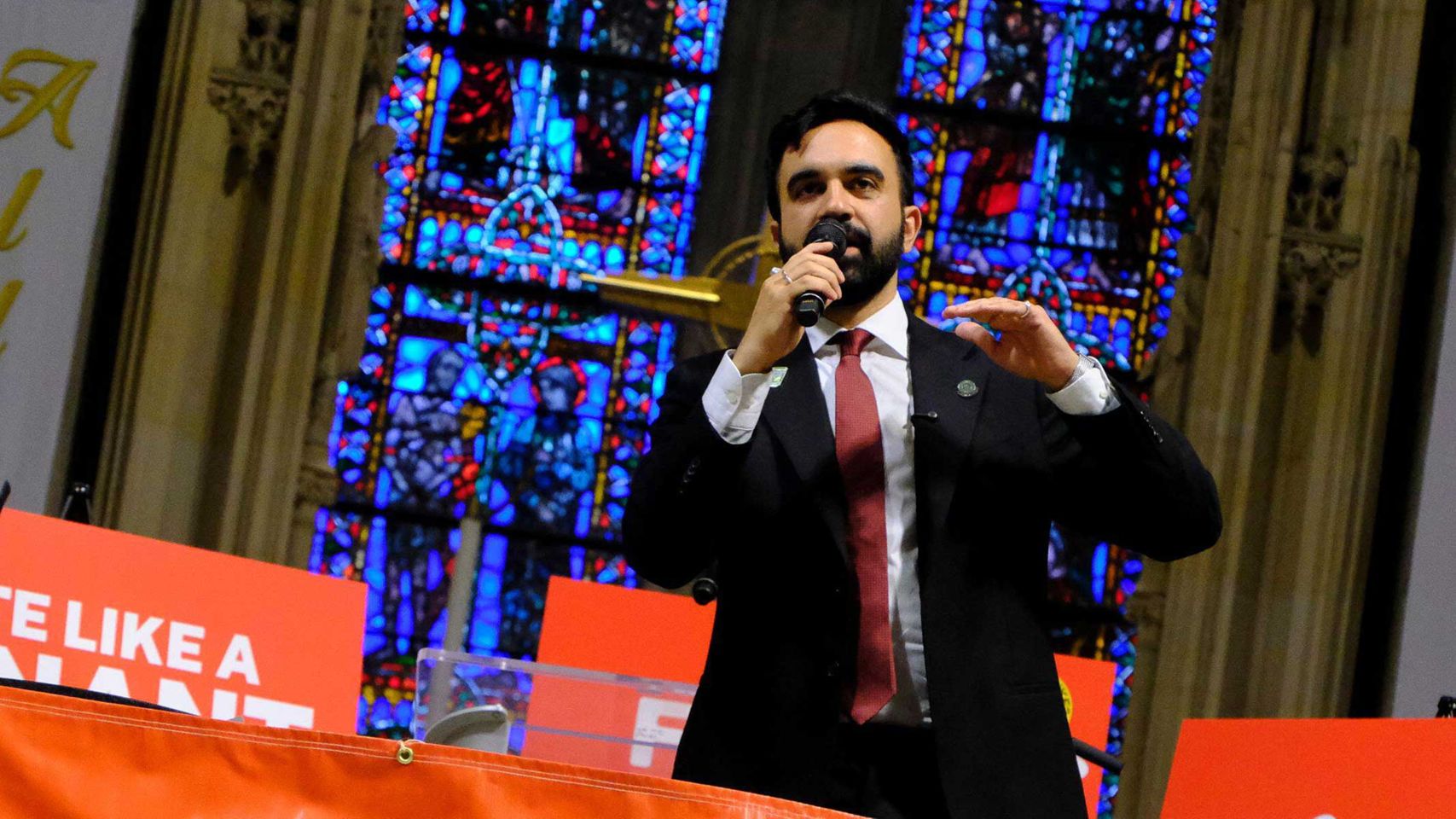
New York City mayoral candidate Zohran Mamdani will face Curtis Sliwa and former governor Andrew Cuomo in next month’s election. With a fractured opposition and an eroding political center, his victory appears inevitable. What would it mean for the city?
The answer depends considerably on Governor Kathy Hochul, who will have power over Mamdani’s intention to raise taxes on the wealthy and corporations to help fund some of his most expensive proposals. “Will she fear another close call with Republicans, as in 2022, and move to check Mamdani,” Nicole Gelinas asks of Hochul, “or worry more about a primary challenge from her left and yield to his demands?”
Read about some of those demands, and how they could affect everyday life for New Yorkers, in Gelinas’s feature story from our upcoming Autumn issue. |
|
|
The Supreme Court’s 2025–2026 term will be a busy one, with cases ranging from gender identity to executive power to politics.
In Chiles v. Salazar, the Court will consider whether banning certain forms of talk therapy for gender dysphoria is constitutional. “The facts here appear to be the inverse of those in last term’s United States v. Skrmetti case, which involved a state ban on certain medical procedures used to treat gender dysphoria,” Ilya Shapiro writes. “But unlike Skrmetti, the Court in Chiles will rule on First Amendment grounds and won’t examine whether the law discriminates based on sex or sexual orientation.”
In Little v. Hecox and West Virginia v. B.P.J., the Court will look at state laws that restrict girls’ sports to biological females. “Both cases involve the Fourteenth Amendment’s Equal Protection Clause and Title IX, the federal law ensuring equal educational opportunities for women and girls,” Shapiro explains.
Read more about these and other cases on the docket here. |
|
|
President Trump has relied on the International Emergency Economic Powers Act of 1977 to impose tariffs on dozens of countries. The IEEPA gives presidents broad authority to block transactions between U.S. residents and foreigners, but Trump is the first president to use it for tariffs.
Now, two legal cases concerning his strategy have reached the Supreme Court, which “should continue paring back the executive authority that has expanded over decades,” Brent Skorup writes, “and side with importers who argue that Trump has usurped Congress’s exclusive power over tariffs.” Read his take. |
|
|
New York City mayoral candidate Zohran Mamdani has proposed phasing out the city’s Gifted and Talented program in elementary schools. “Groups advancing diversity, equity, and inclusion, such as the School Diversity Advisory Group that Mamdani pledges to support, have long called G&T racist and sought to terminate it because its students are disproportionately white and Asian relative to the overall school system,” Wai Wah Chin explains. But claiming racism “merely diverts attention from New York public schools’ critical problems,” she writes. And removing the program will likely widen the inequities that Mamdani wants to combat.
Read her analysis here. |
|
|
Fifty years ago, Daniel Patrick Moynihan, America’s ambassador to the United Nations, tirelessly defended Israel and led the fight against the UN’s “Zionism is Racism” resolution. In 1976, he won the Democratic nomination for New York’s Senate seat and went on to serve four terms.
Back then, New York Democrats were some of Israel’s biggest supporters. “How times have changed,” Joseph Burns and Susan Greene write. “This may be remembered as the year Moynihan’s Democratic Party finally died in the Empire State—when an older political order was vanquished by a radical new elite, one that sees Israel as an enemy.”
Read more about what has driven this shift. |
|
|
“Just like the ‘net neutrality’ controversy faded away with the advent of significantly faster Internet speeds, so, too, will this one, as ‘broadcasting’ becomes a sentimental relic of the past, supplanted by streaming video and podcasts outside the FCC’s regulatory jurisdiction.”
|
|
|
Photo credit: Katie Godowski/MediaPunch/Alamy Stock Photo |
|
|
A quarterly magazine of urban affairs, published by the Manhattan Institute, edited by Brian C. Anderson. |
|
|
Copyright © 2025 Manhattan Institute, All rights reserved. |
|
|
|