|
Forwarded this email? Sign up for free to have it sent directly to your inbox. |
|
|
|
Good morning,
Today, we’re looking at an opportunity for school choice in New York, medicine’s replication crisis, the National Book Foundation’s woes, and the downfall of the Telluride Association Summer Program.
Write to us at editors@city-journal.org with questions or comments. |
|
|
|
Photo credit: Michael M. Santiago / Staff / Getty Images News via Getty Images |
The Federal Scholarship Tax Credit program gives taxpayers a credit for donating to scholarship granting organizations (SGOs). The SGOs can then use the money to fund tuitions for private school or expenses for public school students.
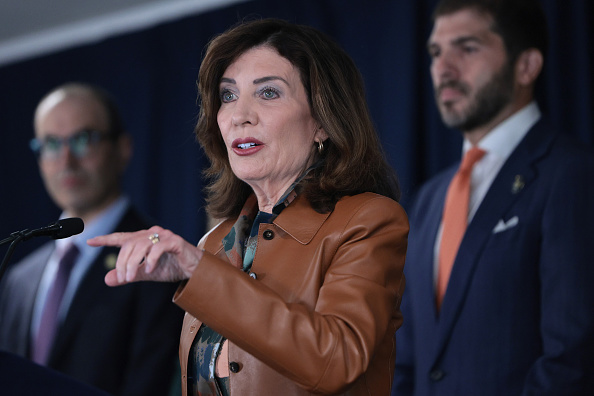
New York Governor Kathy Hochul has said that she intends to opt in to the program. Now’s the time to do so, Danyela Souza Egorov argues. The regulations are now available, and the terms are encouraging for parents. Married couples filing jointly can redirect up to $3,400 of their federal tax liability to SGOs. Students are eligible as long as their household’s income is below 300 percent of the area’s median gross income. For New Yorkers in Bronx County, that means the income cutoff would be $309,000; and for those in Westchester County, it would be $510,000.
“For New York, the SGO credit could be a lifeline for students struggling to receive a basic education in their current schools,” Egorov writes. “The program will allow the families of these children either to apply for a scholarship to a different school or use the funds to supplement schooling with additional educational opportunities.”
Read more about the program. |
| |
National Institutes of Health Director Jay Bhattacharya recently spoke at Hillsdale College about medicine’s replication crisis—the dearth of studies conducted for the purpose of reproducing the same results as original research, an essential step for any study to be validated.
“Bhattacharya’s Hillsdale address was a damning indictment of the state of science research, especially medical research,” Richard Bosshardt writes. “In particular, he focused on a lamentable shift in the field—from establishing truth in science through reliance on the reproducible results of objective research to acceding to whatever authority figures declared that truth to be.” Research intended to find a predetermined conclusion isn’t research, after all. It is propaganda.
Read more here. |
|
|
Next month, the National Book Foundation will host a gala awards ceremony where it will announce the winner of the National Book Award for Nonfiction. Among the finalists are Wendy Walters for A Dead White: An Argument Against White Paint, along with authors of books about “queer parenthood,” “the rise of Islamophobia in America,” and “black radical poetic traditions,” among other woke topics.
It’s no wonder reading is in such sharp decline, Paul du Quenoy writes. In 2023, just 16 percent of Americans read for pleasure, compared to 28 percent in 2004. “If the National Book Foundation and its well-mocked awards continue to valorize woke absurdity,” du Quenoy argues, “those numbers will not improve.”
Read more. |
|
|
Started in 1954, the Telluride Association Summer Program gathers some of the nation’s best high school students each year for college-level seminars in Ithaca, New York. Mark Gimein calls it “the ultimate nerd camp.” An attendee himself, Gimein says Telluride was one of the formative experiences of his life.
But the Telluride Association has since lost its way, he writes. Amid 2020’s “racial reckoning,” the group gave members Ibram X. Kendi’s How to Be an Antiracist. The following year, it claimed that its own programs “perpetuate white supremacy and anti-Black racism,” and that it would offer programs in “Critical Black Studies” and “Anti-Oppressive Studies.” Students were subjected to daily antiracism workshops, and basic competence began to decline. Now, for the first time, the summer programs have been canceled.
“The Telluride summer programs were once a place where some of the country’s top students could discuss deep questions about knowledge and justice without worrying about their academic transcripts,” Gimein writes. “Somewhere along the line, though, a liberal devotion to debate turned into a progressive devotion to preapproved answers.”
Read more about the organization’s decline. |
|
|
“This is great news for higher ed. A slide back toward sanity perhaps.” |
|
|
|
A quarterly magazine of urban affairs, published by the Manhattan Institute, edited by Brian C. Anderson. |
|
|
|
Copyright © 2026 Manhattan Institute, All rights reserved. |
|
|
|
|