|
Forwarded this email? Sign up for free to have it sent directly to your inbox. |
|
|
|
Good morning,
Today, we’re looking at another subway killing in New York City, the backlash against two Columbia University students who questioned the Cornell Seven case, the argument for a flat tax, and a Supreme Court case about material support for terrorism.
Write to us at editors@city-journal.org with questions or comments. |
|
|
|
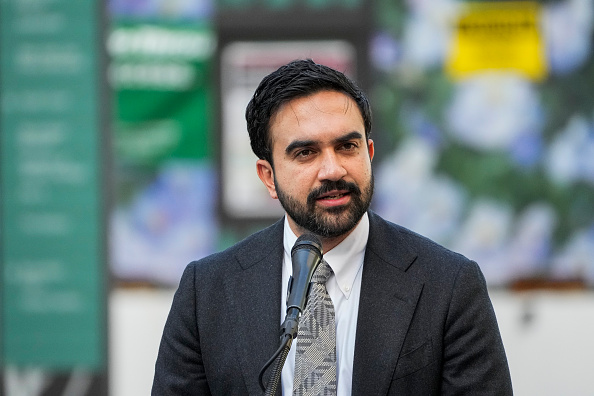
Photo credit: Global Visual Network / Contributor / Getty Images News via Getty Images |
Over the weekend, 26-year-old Darrel Rodriguez was shot and killed in Manhattan during his commute home from work. The hooded, masked gunman remains at large. On Monday, New York City Mayor Zohran Mamdani convened reporters and members of the public for a press conference—not to address the horrific shooting but to announce new childcare slots for two-year olds, beginning almost a year from now.
“Typically, a mayor would have prefaced an unrelated press conference with a few sober words about the Midtown shooting and a plea for New Yorkers to keep a lookout for the gunman, whom the police warn is ‘armed and dangerous,’ before launching into his preplanned topic,” Nicole Gelinas writes. “In addition to using his visibility to bring public attention to the suspect’s surveillance photo, Mamdani might have laid out what he is doing to prevent such killings.” But the mayor didn’t address the murder until a reporter asked him about it, stating that he was “heartbroken and outraged.” Mamdani’s response fits into his political strategy, Gelinas observes. “He sticks relentlessly to the message and the marketing—and both are almost always about affordability,” she writes.
But what has worked thus far may not work forever, given still-elevated felony crime and how voters are feeling about public safety. Read more. |
|
|
Last week, Columbia University students Nikos Mohammadi and Christina Ma published an opinion piece in Sundial on the Cornell rape case. They argued that the incident is complicated by legal and moral nuance, that it’s “worth taking a pause before jumping to wide-sweeping conclusions,” and that freedom includes the possibility of making bad decisions.
The blowback has been fierce. The Columbia Open Discourse Alliance, supposedly a “coalition for free speech and open discourse,” said that Sundial “promotes rape culture.” The Columbia Political Review said that such opinions shouldn’t be permitted. Ma, one of the authors, said some readers had taken aim at her friends simply for associating with her. One response read, “Brother you gotta go kill yourself.”
“That the piece was published, and that Sundial is standing its ground, is a good sign for free speech on campus,” Adam Lehodey writes. “But as the backlash demonstrates, conformity to an apparent socially acceptable position continues to take precedence for many students at America’s most prestigious schools.”
Read more. |
|
|
Next month, California will vote on whether to implement a 5 percent tax on wealth that exceeds $1 billion. If voters pass the measure, it will be bad news for investment and economic growth, given that wealth taxes reduce the incentive to build wealth. Economist Robert E. Hall, who won the Nobel Prize in Economics earlier this month, has a better proposal: a single flat tax.
With a flat tax, every household and business would pay a 19 percent rate. Businesses would pay 19 percent on profits, while households would pay 19 percent on wages above an adjustable exemption threshold, below which they pay nothing. As income increases, a larger share becomes taxable.
This is the right approach, Dario Marino argues. “First, it does not discourage savings and investment: interest, dividends, and capital gains are not taxed again since they were already taxed at the business level, where businesses pay 19 percent on their profits,” he explains. “All income is taxed at the same rate, and only once, thus acting as a consumption tax rather than an income tax.”
Read more about the advantages. |
|
|
Last year, a federal appeals court ruled that Izuchukwu Ozurumba did not provide material support for a Nigerian terrorist group by cooking for them three days a week. Ozurumba had testified that he didn’t know who he was working for, but that when he found out, he tried to leave, but the guards wouldn’t let him. He eventually escaped, reaching the U.S. in 2023 and seeking asylum. He was denied asylum under the material-support bar and deported to Nigeria when the case was sent back for further proceedings. The appeals court later ruled that the support must be “sufficiently substantial standing alone to help the terrorist organization accomplish its terrorist activities,” and that Ozurumba’s cooking did not meet the standard.
Now, the Supreme Court has agreed to review the decision in Blanche v. Ozurumba. The Court shouldn’t allow an asylum case to weaken the law, Mark Goldfeder argues. “Without a cook, the leaders would have to prepare their own meals, assign someone else to the task, or obtain prepared food elsewhere,” he writes. “The work is no different from money in terms of its fungibility.”
Read more about the case. |
|
|
“I don’t think I have ever spent a moment of my life imagining that I was in some way culpable in creating a society based on slavery. And I don’t intend to start.”
|
|
|
|
A quarterly magazine of urban affairs, published by the Manhattan Institute, edited by Brian C. Anderson. |
|
|
|
Copyright © 2026 Manhattan Institute, All rights reserved. |
|
|
|
|