|
Forwarded this email? Sign up for free to have it sent directly to your inbox. |
|
|
|
Good morning,
Today, we’re looking at New York City Mayor Zohran Mamdani’s forthcoming “peacemaker” award, the new Supreme Court term, and Miami’s economic challenges.
Write to us at editors@city-journal.org with questions or comments. |
|
|
|
Photo credit: Spencer Platt / Staff / Getty Images News via Getty Images |
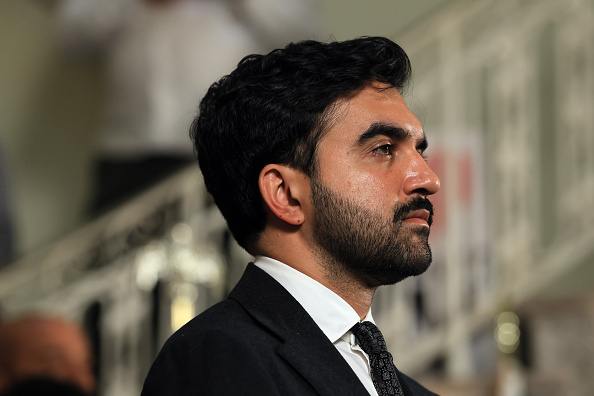
Next week, New York City Mayor Zohran Mamdani will receive the William Sloane Coffin Jr. Peacemaker Award “as a former student activist and voice for Palestinian rights on the national stage.” He will be honored alongside the National Iranian American Council (NIAC), a suspected lobbying group for the Iranian government.
Whether Mamdani plans to attend the event remains to be seen. But his proximity to NIAC “raises yet more uncomfortable questions about the mayor’s broader social and professional circles,” Adam Lehodey and Daniel Edward Rosen write. Launched in 2002, the group has pushed for a “friendlier U.S. policy toward the Tehran regime” and has been outspoken against U.S. actions in the country.
“Knowingly or not, the Mamdani administration continues to find itself aligned with those friendlier to America’s enemies than to America itself,” Lehodey and Rosen write. Read more about NIAC, and the administration’s recent posturing on Iran, here. |
| |
After an unusually active emergency docket this summer, the Supreme Court is once again gearing up for the beginning of a new term. Reviewing the upcoming cases, Ilya Shapiro finds a common question running through many of them: “Who gets to decide?”
Suncor Energy v. Commissioners of Boulder County will test whether state and local governments can effectively set national energy policy through litigation. St. Mary Catholic Parish v. Roy will consider the boundary between government programs and religious freedom. Other cases cover parental and Second Amendment rights, election law, and the rule of law.
“From global climate policy to a minyan in an Ohio living room, this Supreme Court term’s cases repeatedly ask where one decisionmaker’s authority ends and another’s begins,” writes Shapiro. Read here for his full breakdown. |
|
|
Can Miami become the next New York?
Not at the rate things are going. Jay Newman and Erik Saelens call it “the city of mega-projects that never materialize.”
Indeed, Miami’s I-395 Signature Bridge isn’t expected to be completed until 2029, 12 years after the city awarded the contract. The price has jumped from $818 million to $866 million over that time. Meantime, the contractor is suing the designer and insurer for $400 million. Earlier this year, a worker died on the job and six others were hospitalized.
Meantime, a $30 million footbridge project remains nothing more than a hole in the ground. The developer says it cannot be built.
“Both projects failed for the same reasons: too many parties, no single owner of the outcome, and a lack of accountability,” Newman and Saelens write. Miami caters to developers while ignoring how to create an economy that produces real growth. Its cost of living is 14.1 percent higher than the national average, yet the city produces just $534 billion a year in GDP. New York’s cost of living, by contrast, is 12.5 percent higher than the national average, but the city produces $2.3 trillion in GDP.
Read their take on how Miami can start generating real growth. |
|
|
“‘We can only dismantle the machinery of anti-Semitism as part of the larger movement to fight other forms of racism, bigotry, and oppression.’
This is nonsense. Naming and shaming specific types of racism and bigotry will go a lot further than vague gestures at all types at the same time. No one would say that you cannot dismantle the machinery of white supremacy without addressing the larger movement to fight other forms of racism, bigotry, and oppression.” |
|
|
|
A quarterly magazine of urban affairs, published by the Manhattan Institute, edited by Brian C. Anderson. |
|
|
|
Copyright © 2026 Manhattan Institute, All rights reserved. |
|
|
|
|