|
Forwarded this email? Sign up for free to have it sent directly to your inbox. |
|
|
Good morning,
Today, we’re looking at election results in New Jersey, the political strength of moderates, what Zohran Mamdani’s win means for New York Governor Kathy Hochul, and lessons from eighteenth-century entrepreneur Samuel Slater.
Write to us at editors@city-journal.org with questions or comments. |
|
|
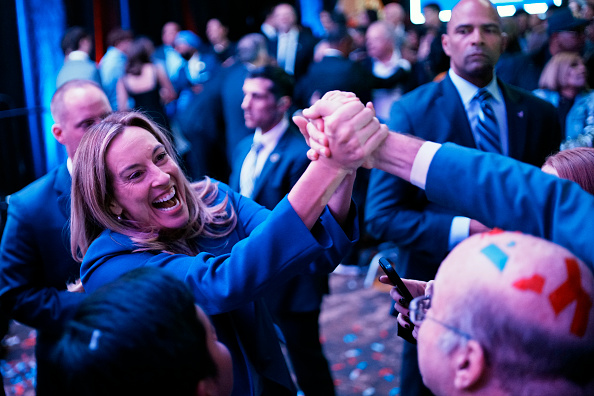
Republicans looking to read the tea leaves of this week’s elections should pay particular attention to the results in New Jersey, argues Steven Malanga. GOP gubernatorial contender Jack Ciattarelli should have had a real shot at beating Democrat Mikie Sherrill: incumbent Democratic governor Phil Murphy is deeply unpopular, electricity prices are rising statewide, and the business climate is dismal. Yet Sherrill cruised to victory on Tuesday. What happened?
The results, writes Malanga, suggest that President Trump “is doing a better job right now motivating the opposition” than he is at turning out his own supporters. Though early polling showed the GOP with an advantage among independents, exit polls on Tuesday gave a slight edge to Sherrill.
“Trump and the national Republicans might be inclined to write off New Jersey as a blue state of declining political and economic power. They should resist that temptation,” writes Malanga. |
|
|
Three marquee election victories on Tuesday—Mikie Sherrill’s in New Jersey, Abigail Spanberger’s in Virginia, and Zohran Mamdani’s in New York City—present contrasting possible futures for the Democratic Party, argues Jesse Arm.
“If Democrats were smart,” he writes, “they would make their overperforming moderates—Abigail Spanberger in Virginia and Sherrill in New Jersey—their template for the future.” Instead, the Democrats’ postelection conversations are all about the millennial socialist’s underperforming win in New York.
“On Tuesday, moderation won again,” writes Arm. “The only question is whether anyone in either party will notice.” |
|
|
For a Democratic governor in a reliably blue state, Kathy Hochul has a surprisingly low approval rating. She likely faces a challenging road to reelection. If history is any guide, Zohran Mamdani’s victory in the New York City mayoral election will only make her reelection bid tougher.
Joseph Burns reviews the recent history of disputes between Albany and Gotham, from the sanitation-strike dispute between Nelson Rockefeller and John Lindsay to the war of words between Andrew Cuomo and Bill de Blasio. Given New York State’s role in administering some city programs—and its final say in approving Gotham’s tax proposals—the state’s governors and the city’s mayors often find themselves at loggerheads. For a politically vulnerable governor like Hochul, a confrontation with an upstart like Mamdani is sure to exact a “political price.”
|
|
|
Samuel Slater grew up on a farm in England in the eighteenth century. He studied water-powered cotton spinning at the country’s first commercially successful cotton mill. Seeking to capitalize on the new technology, Slater fled to the United States, bringing with him seven years’ worth of know-how that helped inaugurate the American industrial revolution.
In his new book, The Infinite Alphabet: And the Laws of Knowledge, César A. Hidalgo profiles Slater as a great immigrant-entrepreneur. “Slater’s story is not an anomaly,” Hidalgo writes in an excerpt from the book. “For the last 40 years, scholars in the field of innovation have used data to document repeatedly what Slater intuited as a teen: knowledge travels in brains—not books—that benefit from local capacities, social networks, and related knowledge.”
|
|
|
“When considering what Mayor Mamdani can do, consider this; what has he ever done?”
|
|
|
Photo credit: Eduardo Munoz Alvarez / Stringer / Getty Images News via Getty Images |
|
|
A quarterly magazine of urban affairs, published by the Manhattan Institute, edited by Brian C. Anderson. |
|
|
Copyright © 2025 Manhattan Institute, All rights reserved. |
|
|
|