| Forwarded this email? Sign up for free to have it sent directly to your inbox. |
|
|
|
Good morning, Today, we’re looking at midterm-election implications in New York, President Trump’s foreign policy, a DSA activist’s alarming comments, and what’s behind AI anxieties. Write to us at editors@city-journal.org with questions or comments. |
|
|
|
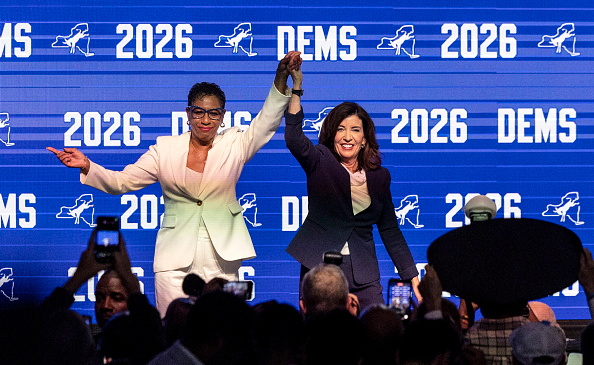
Photo by Alejandra Villa Loarca/Newsday RM via Getty Images |
New York Governor Kathy Hochul won reelection by nearly 20 points in the midterms earlier this month. Her fellow Democrats picked up a seat in the U.S. House, along with supermajorities in both houses in the state legislature and gains in Upstate counties that had long been held by Republicans. But Democrats shouldn’t celebrate too much, Joseph Burns warns. “The big win at the ballot box may create problems for their triumphant return to Albany next January,” he writes. “Potential trouble spots include a large field of politicians looking to succeed Governor Hochul in four years, ideological conflicts between centrists and socialists in Albany, and Republicans’ long history of bouncing back in the Empire State.” Read more. |
|
|
|
President Trump’s foreign policy defies easy labels. He professes his belief in “America First,” and some of his staunchest supporters endorse a kind of isolationism. When confronted with threats on the world stage, however, he often acts decisively, like his capture of Nicolas Maduro or his strikes on Iran. Christopher Rufo believes that Trump’s foreign policy is best understood as an effort to tie up the “loose ends” of the twentieth century, which left some problems unsolved: the enduring Communism of Asian nations, the Islamic theocracies of the Middle East, and the premodern ways of indigenous societies. Trump’s agenda abroad can be considered an attempt to address these challenges. Read more. |
|
|
|
Noah Suarez-Sikes serves on the Democratic Socialists of America–LA’s steering committee and claims to have influenced Los Angeles Mayor-elect Nithya Raman. Indeed, he has become an increasingly prominent activist over the years, making his recent comments that much more alarming. Just two years ago, he said he wanted to be present “when we hang” Tesla CEO Elon Musk. He has suggested using a “firing squad” to stop DOGE. He has expressed a desire “to beat Sam Altman to death” using his “bare hands.” He effectively endorsed the murder of United Health Care CEO Brian Thompson. And he has urged California Governor Gavin Newsom to “pardon Sirhan Sirhan,” the assassin of Robert F. Kennedy, “so that he can finish the job”—an apparent reference to Health and Human Services Secretary Robert F. Kennedy Jr. “Five years ago, Suarez-Sikes said that he was ‘broadly pessimistic about the ability of electoral politics to bring about the socialist revolution by the ballot box,’” Rufo and Kenneth Schrupp write. “It remains to be seen whether Raman’s election will change his analysis.” Read more. |
|
|
|
Between 2021 and 2026, the share of young adults who were more concerned than excited about artificial intelligence rose from 31 percent to 55 percent. Even so, Gallup finds that 51 percent of them used generative AI weekly in 2025 and 2026. So where is the skepticism coming from? “Social contagion may be one way that young Americans are acquiring AI anxieties,” Sean Speer and Carolyn D. Gorman write. “The effect can transform concerns—legitimate or not—into a political panic that leads to bad policy.” Indeed, narratives can spread through schools, on social media, and within peer groups, reinforcing a single prediction or talking point that causes panic to spread. Read more. |
|
|
|
“This was an excellent article. I started reading The Possessed once, years ago, after I heard Malcolm Muggeridge say that anyone who really wanted to understand liberals should read it. I got 50 or 60 pages in and stopped. I’m now going to rectify that by elevating it in my queue to the next thing to be read. Thanks to Mr. Henderson for inspiring me.” |
|
|
|
A quarterly magazine of urban affairs, published by the Manhattan Institute, edited by Brian C. Anderson. |
|
|
|
Copyright © 2026 Manhattan Institute, All rights reserved. |
/td> |
|
|
|