|
Forwarded this email? Sign up for free to have it sent directly to your inbox. |
|
|
|
Good morning,
Today, we’re looking at the LIRR strike, Carter case spending, why restaurants are still struggling, and medical schools’ pipeline problem.
Write to us at editors@city-journal.org with questions or comments. |
|
|
|
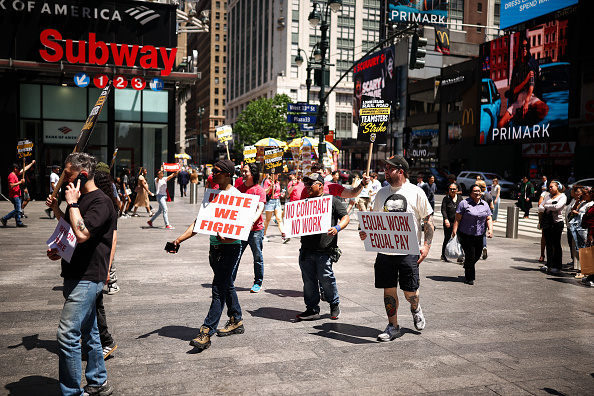
Photo credit: CHARLY TRIBALLEAU / Contributor / AFP via Getty Images |
After a breakdown in negotiations on Friday, Long Island Rail Road workers went on strike over the weekend, bringing the nation’s busiest commuter railroad to a halt.
The crisis was decades in the making, Ken Girardin writes. Public employees in New York are prohibited from striking, but the national Railway Labor Act (RLA) supersedes state law and effectively grants railroad workers the right to walk out.
This “has proved a powerful tool for the LIRR’s unions,” Girardin explains. “Each time their labor contracts come up for negotiation, these groups threaten LIRR riders, and New York governors, with stoppages. They’ve carried out the threat before, most recently in 1987 and 1994.”
Governor Kathy Hochul should file a lawsuit reasserting the state’s Tenth Amendment rights against the RLA, he argues, and empower the Public Employment Relations Board to enforce the state’s anti-strike penalties. Read more about the standoff. |
|
|
Last week, New York City Mayor Zohran Mamdani unveiled his first executive budget, claiming to have filled the spending gap without cutting services. In particular, he said the city would save $149 million on special-education due-process cases.
Even so, the city’s Department of Education will spend more than $1.4 billion on these cases. Also known as Carter cases, these matters allow parents to be reimbursed for sending disabled children to private schools when they haven’t been adequately served in public schools. But what began as a narrow court settlement has ballooned into current spending that’s more than triple what it was a decade ago.
“There are two easy ways for the city to spend less on Carter cases: it can build stronger public special-education programs so that fewer families choose to go to private schools, or it can fight harder to keep these families in public schools,” Jennifer Weber writes. “Mayor Mamdani has done neither of these things, so it’s unclear how his projected $149 million in savings will emerge.”
Read her take. |
|
|
Several years after the Covid pandemic brought restaurants to their knees, the industry is still struggling. In fact, 2024 was restaurants’ toughest year since 2020. National chains shut down hundreds of outlets, and 16 of the largest U.S. restaurant operators went bankrupt. Those still in business now run almost 1,000 fewer outlets than they did in 2019.
Steeper food costs are certainly part of the problem, but increasing state taxes, more regulations, higher minimum wages, and soaring utility costs are all adding to the pain.
“As state and local governments increasingly diverge in their approaches,” Steven Malanga writes, “the operating environment for restaurants is becoming dramatically uneven from one jurisdiction to another. Ironically, some of the cities best known as culinary centers apply the most hostile policies to the business itself.”
Read more. |
|
|
Success in AP Chemistry courses is one of the strongest indicators of students’ preparedness for rigorous medical training. And the demographic disparities in performance are striking.
For instance, black students make up about 14 percent of American high school students, but just 5 percent are AP Chemistry examinees. Meantime, Asian students make up just 5 percent of high school students, but about 27 percent are AP Chemistry examinees. Only about one in five black student earns a passing score, while about two-thirds of Asian students do.
This means that adjusting standards in university admissions—at the end of the pipeline—only obscures the problem. “If the goal is a medical profession both excellent and broadly representative, then the solution cannot consist merely of manipulating admissions outcomes,” Jukka Savolainen and April Bleske-Rechek write. “The work must begin where the disparities first emerge—not where they become politically embarrassing.”
Read more. |
|
|
“It takes a staggering level of stupidity, malevolence, or both, to believe minors possess the capacity for long-term reasoning, impulse control, and emotional maturity required to provide meaningful consent to procedures that often result in sterilization or a permanently weakened spine.”
|
|
|
| A quarterly magazine of urban affairs, published by the Manhattan Institute, edited by Brian C. Anderson. |
|
|
|
Copyright © 2026 Manhattan Institute, All rights reserved. |
|
| |
|