|
Forwarded this email? Sign up for free to have it sent directly to your inbox. |
|
|
Good morning,
Today, we’re looking at myths about homelessness, Mayor Zohran Mamdani’s Office of Community Safety, the success of four charter schools in the South Bronx, misperceptions about the American melting pot, and an Australian’s impressions of Mexico.
Write to us at editors@city-journal.org with questions or comments. |
|
|
Photo credits: Xinhua News Agency / Contributor / Xinhua News Agency via Getty Images |
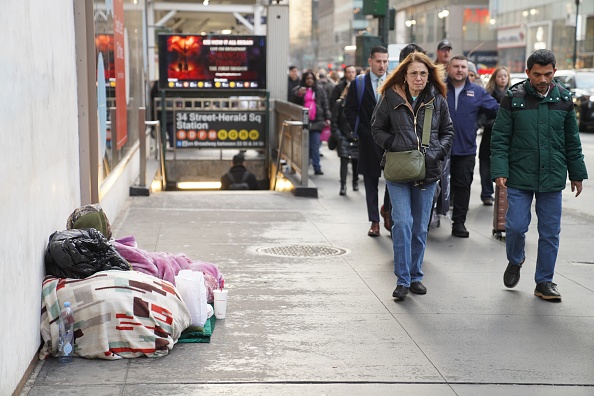
“It’s something you can’t exactly teach: how to spot the homeless New Yorkers trying to blend into the night—people resting on bus stop benches, curled up on doorsteps, tucked into the shadows of scaffolding.”
That’s one of many bizarre claims in a recent New York Times article about the city’s homeless outreach efforts. “Street vagrancy is among the most visible features of the city’s public spaces; the disheveled bodies, surrounded by filthy bedding, uneaten food, and cardboard, are unmistakable at any hour,” Heather Mac Donald writes. “New Yorkers can only wish they were camouflaged.”
Among some of the other claims: homelessness is an involuntary condition, “shelter resistance” is a myth, and neither addiction nor mental illness plays a role in homelessness. “Today, progressive governance prioritizes the antisocial, the deviant, and the alienated over the law-abiding majority,” Mac Donald observes, “which is increasingly cast in the role of a revenue source rather than a constituency to be served.”
Read her take. |
|
|
Last week, Mayor Zohran Mamdani announced a new Office of Community Safety—a step toward fulfilling his campaign promise to replace police with trained mental-health professionals in responding to mental-health calls.
“Mamdani’s community safety plan was always based in a critical view of the NYPD,” writes Rafael A. Mangual. “The plan’s purpose was to sideline a department that, until recently, Mamdani wanted to defund and dismantle.”
But “it will do little to curb the real demands on New York City’s sworn officers,” notes Mangual. Mental-health calls make up only a small fraction of calls requiring NYPD service—and a significant portion of those pose risks that require the presence of trained officers. And the city’s B-HEARD pilot program, which dispatches EMTs and mental-health professionals in lieu of police, does not respond to calls with a possibility of danger.
“The most New Yorkers can hope for from the mayor’s initiative is a modest expansion in the capacity of B-HEARD,” writes Mangual. That’s an outcome “worlds away from the radical change Mamdani promised.” |
|
|
At Classical Charter Schools’ four South Bronx academies, teachers and administrators always ask the same question before making a decision: Will it improve student outcomes? That strategy is clearly paying off. Last year, the four schools averaged a 96 percent proficiency rate for English and 98 percent for math, compared with the school district average of 41 percent for English and 42 percent for math.
Adam Lehodey recently visited one of the schools, South Bronx Classical I, and “became convinced that the excellence embodied in these schools owes to the high expectations they set for students, teachers, and parents, and to administrators’ singular focus on student outcomes,” he writes.
Read why Lehodey believes the schools could serve as a model for policymakers. |
|
|
Gil Guerra of the Niskanen Center recently made a surprising discovery: it was the Western and Deep Southern states—not those in the Northeast—that drove assimilation in the late 1800s and early 1900s. Guerra tracked marriage patterns of second-generation Americans living between 1880 and 1930 and found that those in states like Wyoming, Oregon, Georgia, and Mississippi married outside of their own ethnic groups more so than people living in states like New York, Massachusetts, and New Jersey.
“In the West, thin ethnic institutional networks and a ‘new beginnings’–oriented culture loosened communal pressures and left second-generation Americans freer to choose their spouses. In the South, the children of immigrants could assimilate into a region deeply rooted in place and history,” Guerra writes. “In both cases, the result was faster integration into the American mainstream than in the Northeast, the region most associated with the immigrant experience in American memory.” Read more about his findings and the lessons they offer for today. |
|
|
Misha Saul has been visiting Mexico for two decades and has always found it to be exhilaratingly chaotic—that is, until his most recent trip. This time, he “saw the chaos as less empowering and more dysfunctional,” he writes. “This shift says as much about my own life arc—moving from a risk-seeking young man to an early-middle-aged father—as it does about the state of the country. ‘Anything is possible’ reads very differently to a young single man compared with a father of four young kids.”
Read about his recent travels there. |
|
|
“When I was young, the Sun had competition in Baltimore, and competition always keeps you on your toes. Baltimore then became a one-newspaper town, paralleling its demise into a one-party municipal government. Accordingly, the Sun deteriorated into a left-wing propaganda organ.
Their editorials and feature stories perfectly reflected William F. Buckley’s axiom: ‘Liberals claim to be tolerant of other views but are shocked and offended to discover there are other views.’” |
|
|
A quarterly magazine of urban affairs, published by the Manhattan Institute, edited by Brian C. Anderson. |
|
|
Copyright © 2026 Manhattan Institute, All rights reserved. |
|
|
|