|
Forwarded this email? Sign up for free to have it sent directly to your inbox. |
|
|
Good morning,
Today, we’re looking at the thwarted terror attack at Gracie Mansion, whether the U.S. is vulnerable to Iranian terrorism, a conversation with Mississippi’s governor, and the ideological “studies” disciplines.
Write to us at editors@city-journal.org with questions or comments. |
|
|
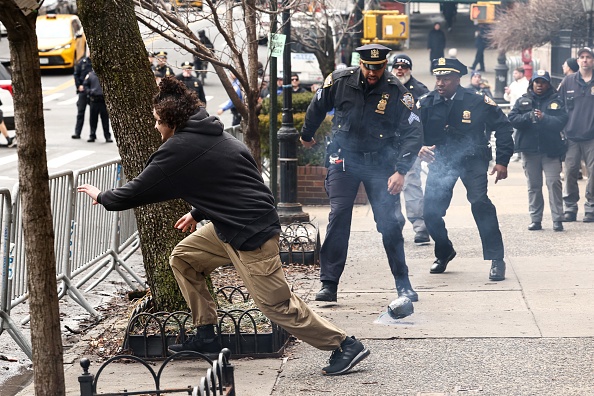
Over the weekend, two men were arrested outside Gracie Mansion in New York City for allegedly throwing two homemade bombs at an anti-Muslim protest. Thankfully, the explosives didn’t detonate. But the men were charged with attempting to provide support to ISIS—a reminder that the city remains a prime target for Islamic terror.
The attack also highlights issues with Mayor Zohran Mamdani’s approach to policing. He wants to cancel the hiring of 5,000 cops over the next two years. And he has long favored dismantling the NYPD’s Strategic Response Group (SRG), created to handle protests with special equipment and trained personnel. NYPD Commissioner Jessica Tisch said that SRG was near the protest to serve as backup. “But why weren’t they deployed earlier?” Rafael A. Mangual asks. “One suspects a connection to Mamdani’s dislike of the unit.”
Read more about the incident, Mamdani’s response, and why Mangual says the mayor should “reconsider his opposition to a robust police presence.” |
|
|
Since the Islamic Republic’s founding in 1979, Iran has attempted to carry out terrorist attacks in the United States. In the past five years alone, Washington thwarted 17 Iranian terror plots. What, then, will the U.S.–Israel operation in Iran mean for future threats against America?
“Experts are divided,” Judith Miller writes. Former CIA Director David Petraeus told Miller via email that there’s “always the possibility of such attacks,” but that he didn’t believe the threat was “particularly significant.” Mitchell D. Silber, executive director of the Community Security Initiative, told her that he doesn’t see evidence yet of a major threat, but that there could be “spontaneous attacks by supporters or lone wolves inspired by Iran.” Former New York City Police Commissioner Raymond Kelly said that “New York remains a prime target.”
Read more of Miller’s analysis here. |
|
|
It wasn’t long ago that Mississippi served as the embodiment of failure, landing at the bottom of national rankings for income, education, and health. But since Governor Tate Reeves took office in 2020, the state has announced more than $70 billion in new private-sector capital investment—nearly ten times as much as the amount invested in the eight prior years.
Meantime, Mississippi’s overall educational ranking has climbed from 48th to 16th. A black fourth-grader in the state is now likelier to read proficiently than a black fourth-grader in California.
“None of this happened by accident,” Shawn Regan writes. “Reeves has a clear governing philosophy: cut red tape, train the workforce for the jobs of the future, say ‘yes’ to investment faster than anyone else, and trust that prosperity will follow.”
Regan sat down with the governor to learn more about his vision for the state and how it can serve as a model for American growth. |
|
|
University of Texas at Austin President Jim Davis recently consolidated four departments—African and African Diaspora Studies; American Studies; Mexican American and Latina/Latino Studies; and Women’s, Gender and Sexuality Studies—into one: the Department of Social and Cultural Analysis.
The move isn’t just about efficiency. “University administrators know that the ‘studies’ disciplines are really just one discipline—critical theory,” John Masko writes, not “women, African Americans, America, or whatever their prefix happens to be.”
Read about the history of the “studies” disciplines and how they became the center of left-wing radicalism. |
|
|
“You get a trophy, you get a trophy, you get a trophy . . . you get an A, you get an A, you get an A. Where this is headed: you get a guaranteed minimum income, you get a guaranteed minimum income, you get a guaranteed minimum income.”
|
|
|
Photo credits: CHARLY TRIBALLEAU / Contributor / AFP via Getty Images |
|
|
A quarterly magazine of urban affairs, published by the Manhattan Institute, edited by Brian C. Anderson. |
|
|
Copyright © 2026 Manhattan Institute, All rights reserved. |
|
|
|