|
Forwarded this email? Sign up for free to have it sent directly to your inbox. |
|
|
|
Good morning,
Today, we’re looking at the World Professional Association for Transgender Health, an upcoming Supreme Court case, Walter Isaacson’s new book, and college commencement speakers.
Write to us at editors@city-journal.org with questions or comments. |
|
|
|
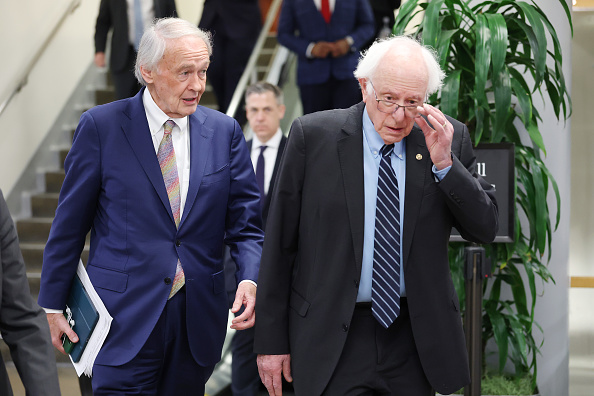
Photo credit: Anna Moneymaker / Staff / Getty Images News via Getty Images |
Last week, the Senate Committee on Health, Education, Labor, and Pensions held a hearing on gender transition for minors. Republicans invited psychiatrist Kurt Miceli and detransitioner Chloe Cole to discuss the harms of cross-sex hormones and surgeries. Democrats invited Shannon Minter, a lawyer with the National Center for LGBTQ Rights, to defend the benefits of “gender-affirming care.”
What was striking, however, was that neither Minter nor Democratic senators Bernie Sanders and Ed Markey mentioned the World Professional Association for Transgender Health (WPATH), widely regarded as the leading U.S. authority in transgender medicine.
“It’s possible that the failure to mention WPATH at last week’s hearing was just an oversight,” Leor Sapir writes, “but it’s more likely that the organization has become a liability for transgender advocacy groups (like Minter’s National Center for LGBTQ Rights) and their allies in the Democratic Party.”
Indeed, WPATH has been embroiled in a series of recent controversies. “The most disturbing revelation,” notes Sapir, “is that WPATH commissioned and then suppressed evidence reviews after learning that they would not support its preferred approach to treating adolescents.” The organization has also been criticized for failing to manage conflicts of interest, imposing ideological litmus tests, and issuing “medical necessity” statements that support insurance coverage for transgender procedures.
Read more about the group’s recent missteps. |
|
|
Next term, the Supreme Court will hear arguments in Suncor v. Boulder County, a case that could determine whether local jurisdictions can impose their energy preferences on the rest of the country. Boulder County argues that fossil-fuel emissions are harming residents and that energy companies should therefore pay damages.
“The suit’s practical effect is to force energy companies to change their production practices nationwide,” Ilya Shapiro explains. “Boulder is free to enact the Green New Deal within its borders if it wants. But it may not force Wyoming or Texas to do so through market coercion.”
Read more about the case, and why Shapiro says the Court’s decision should be an easy one. |
|
|
In The Greatest Sentence Ever Written, Walter Isaacson delivers “a brisk dive into the nation’s origins,” Michael Gibson writes, “viewed through Thomas Jefferson’s scintillating string of words in the preamble to the Declaration of Independence.”
What makes that sentence the greatest ever written? Gibson points to the extraordinary results of the principles it expresses: American leadership in science, technology, medicine, and countless other fields, as well as the creation of the richest and freest society in human history.
Read his assessment of Isaacson’s new book, which Gibson calls both “a reminder of what binds us as a people” and a guide to helping “correct the nation’s perilous course.” |
|
|
Since 1998, there have been at least 350 attempts to cancel campus commencement speakers. Earlier this year, South Carolina State University succeeded in doing so after students objected to a speaker’s support for President Trump and criticism of DEI.
Encouragingly, however, some colleges appear to be holding firm, Paul du Quenoy observes. New York University, for example, has faced criticism for selecting social psychologist Jonathan Haidt as this year’s commencement speaker. Opponents objected to his criticism of DEI and support for viewpoint diversity, but NYU has stood by its choice, describing Haidt as “one of the most consequential thinkers of the 21st century.”
Read about the other colleges that are pushing back against speaker cancellation efforts. |
|
|
“The mayor wants to make things cheaper by giving out ‘free stuff.’ Conservatives want him to make things cheaper by cutting red tape.”
|
|
|
| A quarterly magazine of urban affairs, published by the Manhattan Institute, edited by Brian C. Anderson. |
|
|
|
Copyright © 2026 Manhattan Institute, All rights reserved. |
|
| |
|