|
Forwarded this email? Sign up for free to have it sent directly to your inbox. |
|
|
|
Good morning,
Today, we’re looking at New York’s data-center bill, the end of the state’s Regents exam, Britain’s reverse George Floyd moment, a looming court battle over prediction markets, and America’s 1976 bicentennial celebration.
Write to us at editors@city-journal.org with questions or comments. |
|
|
|
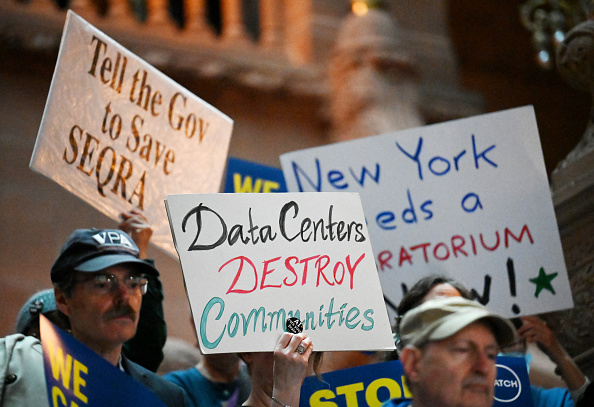
Photo credit: Albany Times Union/Hearst Newspapers / Contributor / Hearst Newspapers via Getty Images |
Cities’ competitiveness has long depended on their regulatory environment, tax burden, transportation infrastructure, and labor market flexibility. Compute capacity is now also a vital metric, given the rapid rise of artificial intelligence.
New York has spent years making itself less competitive in all these areas—and it appears eager to continue that pattern with compute capacity. Earlier this month, state lawmakers approved a bill that would impose a 12-month pause on data-center construction and add new costs like wage mandates and renewable-energy rules.
“More fundamentally, the bill rests on a faulty premise,” Sean Speer writes. “As my colleague Ken Girardin has argued, rising electricity costs are primarily the product of Albany’s own energy policies, including restrictions on new gas generation. Data centers have become convenient scapegoats for a problem the state largely created.”
Read more about the bill. |
|
|
Starting with the class entering high school in September 2027, New York students will no longer have to pass the Regents exams to graduate. The state will instead award diplomas based on “demonstrated readiness.”
But what can a high school diploma alone really tell a college admissions officer or employer about a student’s knowledge and abilities? “A graduation standard by itself does nothing,” Jennifer Weber and Ray Domanico maintain. “It only means something when teachers have reference papers against which to score submissions, compare their scores with peers, and have their scoring checked by someone outside the school building.” The Regents exam was far from perfect, but none of the reforms the state has announced in its place thus far provide the structure for a real, performance-based measurement system. Read more. |
|
|
In Britain last December, 18-year-old Henry Nowak was stabbed five times. The police arrived more than 15 minutes later, appearing more concerned that the murderer might’ve been the victim of a racist assault than with Nowak’s well-being. Nowak was arrested, even as he told officers nine times, “I can’t breathe.” An hour later, he was pronounced dead.
“In a mirror image of events six years ago, the case led to accusations of anti-white institutional racism, angry protests on the streets of Southampton, and politicians publicly declaring sympathy for Nowak’s family,” Joanna Williams writes. Beyond that, though, further comparisons to the American response to George Floyd’s death don’t line up. In 2020, British celebrities joined Americans in blacking out their social media; people across the U.K. took to the streets to protest, ignoring pandemic restrictions; policemen and politicians took the knee; violence broke out.
“In contrast, the response to Henry Nowak’s murder has been notably muted: no celebrities have expressed sympathy, and no politicians have knelt in solidarity,” Williams writes. Read more. |
|
|
Founded in 2018, Kalshi is currently the biggest prediction market platform in the U.S. With prediction markets, users buy contracts that pay out if an event happens. Like traditional sports books, Kalshi is regulated by the Commodity Futures Trading Commission (CFTC) as a financial exchange, not by state gambling regulators.
“No state, tribe, or gambling operator mounted significant legal challenges until Kalshi began offering sports markets, which states and tribes argue constitute illegal gambling and violate state and tribal laws,” Steven Ruddock explains. “Kalshi and the CFTC maintain that they are swaps subject to exclusive federal oversight.”
This fight is almost certainly heading to the Supreme Court. What is less than certain is how the Court would rule, Ruddock writes. Read his take. |
|
|
Fifty years ago, America’s 200th birthday was such a big deal that four U.S. presidents or future presidents were involved in the celebrations: Richard Nixon, Gerald Ford, Ronald Reagan, and Jimmy Carter all played a role.
“Fifty years after the bicentennial spectacle, America’s semiquincentennial year has been much quieter—and there won’t be a presidential election to anchor it,” Tevi Troy writes. “The next time we’ll see the confluence of a presidential election and a big national anniversary will be America’s tricentennial—the 300th anniversary celebration, in 2076.”
Read more about the celebrations of 1976, which Troy argues will be hard to match. |
|
|
“The following is a comprehensive list of everything that has gotten cheaper due to government interjection into the free market: ”
|
|
|
|
A quarterly magazine of urban affairs, published by the Manhattan Institute, edited by Brian C. Anderson. |
|
|
|
Copyright © 2026 Manhattan Institute, All rights reserved. |
|
| |
|