|
Forwarded this email? Sign up for free to have it sent directly to your inbox. |
|
|
|
Good morning,
Today, we’re looking at Alan Greenspan’s legacy, DEI at the University of California, “culturally responsive education,” and a historian’s misrepresentation of two economists.
Write to us at editors@city-journal.org with questions or comments. |
|
|
|
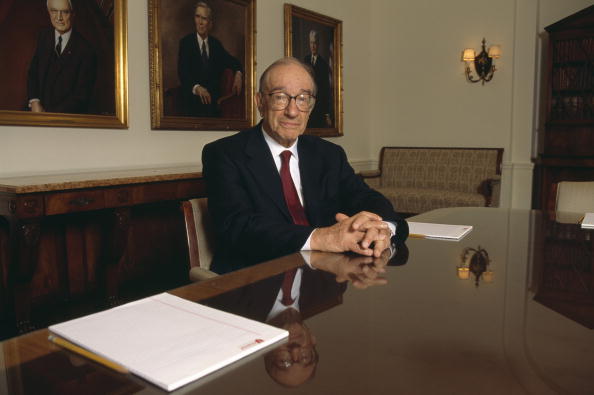
Photo credit: Diana Walker / Contributor / The Chronicle Collection via Getty Images |
Alan Greenspan, the longtime Federal Reserve chairman, died on Monday at 100. A former musician, he led the central bank from 1987 to 2006 and was a firm believer in limited regulation and free markets. During his tenure, the Fed succeeded in achieving low inflation and unemployment.
But he “was neither the deft ‘maestro’ who supposedly orchestrated markets into a generation of prosperity—the reputation he enjoyed as chairman—nor the blinkered ideologue whose failure to recognize mounting risks helped precipitate the worst economic crisis since the Great Depression, the legacy he carried after 2008,” Nicole Gelinas writes. “Rather, he was a conscientious, curious, and politically astute technocrat whose aura of mystique obscured a simpler reality: he was never truly in control of financial markets, let alone the economy, because nobody is.”
Read more about the Greenspan legacy. |
|
|
MI has partnered with the Sun Valley Policy Forum’s Summer Institute, bringing some of your favorite City Journal contributors to Idaho’s iconic mountain town this summer: Heather Mac Donald, Reihan Salam, Ilya Shapiro, Shawn Regan, Jesse Arm, Judge Glock, Brandon Fuller, Mark Mills, and more. Friends of City Journal receive discounted registration. We hope to see you there.
|
|
|
|
Last year, the University of California said that it would end a diversity-hiring initiative tied to its President’s Postdoctoral Fellowship Program (PPFP). Under pressure from “scholar-activists,” the UC system reversed course just two weeks later. Through PPFP, UC hires postdoctoral fellows who are then prioritized for tenure-track faculty jobs. Most of these fellows consider themselves activists, focused on DEI and political mobilization. “The episode offers a sobering lesson for reformers: when a university sustains an agenda long enough,” John D. Sailer and Forest Romm write, “that agenda becomes self-sustaining.” Read more. |
|
|
In 2015, the Every Student Succeeds Act gave states more control over teacher quality and school accountability. So states embedded “culturally responsive education,” or CRE, into teaching standards, program approval, and licensing requirements.
CRE may sound benign, with many parents assuming that it merely means that teachers should make accommodations for students’ different backgrounds, or ensure they give an honest account of U.S. history. But in many states, Dana Stagel-Plowe writes, “CRE rules and standards direct teachers to view society through the lens of an oppressor/oppressed dichotomy, to treat institutions (including their own schools) as inherently racist or sexist, and to encourage students to engage in activism.”
Read more about CRE—and how state lawmakers can dismantle it. |
|
|
In Hayek’s Bastards: Race, Gold, IQ, and the Capitalism of the Far Right, Quinn Slobodian argues that Ludwig von Mises and Friedrich Hayek left an opening to racial pseudoscience in their work, which bigots later exploited. Some of these descendants include “Alt-Right” figures whose worldview, according to Slobodian, is an outgrowth of neoliberalism.
“There’s a problem with Slobodian’s argument, though,” Phillip W. Magness writes. “He constructs his case for the ‘parenthetical opening’ through chronic misrepresentations of the Austrian economists that he places at the top of his neoliberal family tree.”
You can read his detailed takedown of Slobodian’s claims here. |
|
|
“The authors ask a key question: ‘When Americans are taught to see oppression everywhere, does that framework actually reduce prejudice, or does it instead train people to join moral mobs and devour one another over imagined sins?’
Relevant case studies exist, for example: Can we honestly say that race relations improved and racism declined in the U.S. as critical race theory, Black Lives Matter, DEI, and similar movements ascended?” |
|
|
| A quarterly magazine of urban affairs, published by the Manhattan Institute, edited by Brian C. Anderson. |
|
|
|
Copyright © 2026 Manhattan Institute, All rights reserved. |
|
| |
|