|
Forwarded this email? Sign up for free to have it sent directly to your inbox. |
|
|
|
Good morning,
Today, we’re looking at a problematic survey about “anti-LGBTQ+” policies, middle-class entitlement spending, a major setback for Philadelphia District Attorney Larry Krasner, and the triumph of Elon Musk.
Write to us at editors@city-journal.org with questions or comments. |
|
|
|
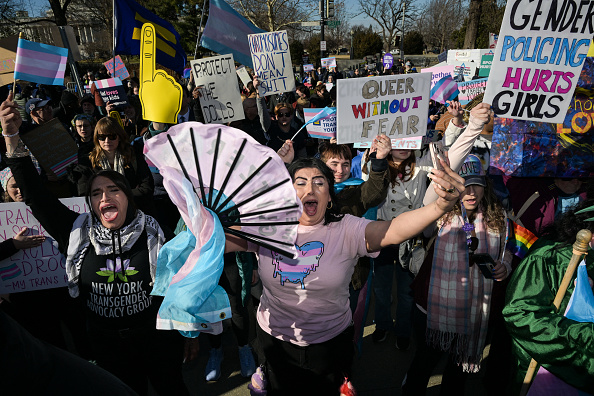
Photo credit: OLIVER CONTRERAS / Contributor / AFP via Getty Images |
Last year, the Trevor Project surveyed more than 16,000 LGBTQ+ youth ages 13 to 24 about suicide risk and the impact of “anti-LGBTQ+” policies. More than a third reported seriously considering suicide. The report concluded that “anti-LGBTQ+ victimization, policies and rhetoric contributed meaningfully to the rates of poor mental health and suicide risk observed among the LGBTQ+ young people who took this survey.”
But that may not be the case, Joseph Figliolia argues. “Many trans-identified young people have mental-health issues that predate a transgender identity,” he writes. “Those conditions can lead them to interpret ambiguous events more negatively, resulting in higher self-reported levels of stigma and rejection.”
Read more about the survey and the evidence it ignores. |
| |
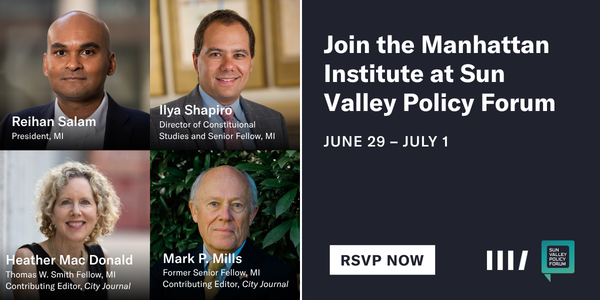
MI has partnered with the Sun Valley Policy Forum’s Summer Institute, bringing some of your favorite City Journal contributors to Idaho’s iconic mountain town this summer: Heather Mac Donald, Reihan Salam, Ilya Shapiro, Shawn Regan, Jesse Arm, Judge Glock, Brandon Fuller, Mark Mills, and more. Friends of City Journal receive discounted registration. We hope to see you there.
|
|
|
|
The bulk of the $4 trillion the U.S. federal government spends on anti-poverty entitlements goes to the middle class. In Europe, meantime, entitlement programs are even more heavily tilted toward the well-off. Many Democrats and left-leaning thinkers argue that this arrangement is the best way to help the poor because it encourages an otherwise stingy public to support social-welfare programs.
Chris Pope contends that this view is mistaken on two counts. First, aid targeted to the poor is not inherently unpopular. “Last year, only 13 percent of Americans told pollsters the government spends too much on assistance for the poor, while 62 percent said it spends too little,” he writes. Second, “extending benefits to the middle class often makes those benefits less generous.”
Read more here. |
|
|
Last week, the Pennsylvania Supreme Court reversed a lower court decision to grant a new trial to a convicted murderer. It was a striking decision, given that Philadelphia District Attorney Larry Krasner recently argued that the murderer should be granted a new trial.
In fact, the high court went so far as to say that Krasner’s office “violated its duty of candor,” “withheld material evidence from the court,” and “misstated facts in its pleadings,” among other missteps.
“Readers may be wondering why a prosecutor would go this far out of his way to help a convicted murderer. The most plausible answer: ideology,” Rafael A. Mangual writes. “Larry Krasner subscribes (sincerely, one suspects) to a ‘social justice’ view that elevates the concerns of perpetrators over those of victims.”
Read more. |
|
|
Elon Musk is officially a trillionaire, and not everyone is pleased. Critics argue that he is too rich and too powerful, treating his fortune as a measure of what he has taken from society. Not so, John O. McGinnis writes. “However large his net worth,” he observes, “Tesla, SpaceX, Starlink, and related ventures have produced far more value for consumers, employees, shareholders, and the public than Musk himself possesses.” Indeed, after SpaceX’s IPO, more than 4,400 employees reportedly became millionaires. The company has dramatically lowered the cost of reaching low-Earth orbit. Starlink provides high-speed internet to underserved regions around the world. Tesla produces electric vehicles that help reduce transportation emissions. Neuralink is developing technology that could enable people with paralysis to control robotic limbs with their thoughts. “Musk’s wealth is not the negation of liberal democracy,” McGinnis writes. “At its best, it is one of liberal democracy’s most astonishing vindications: private freedom transformed into public possibility, the commercial republic renewing not just prosperity but the human imagination itself.”
Read on. |
|
|
“What an absolute mess. They are at best waiting out Trump with these obfuscations. Renaming a course and leaving the content the same is dishonest and par for the course.”
|
|
|
|
A quarterly magazine of urban affairs, published by the Manhattan Institute, edited by Brian C. Anderson. |
|
|
|
Copyright © 2026 Manhattan Institute, All rights reserved. |
|
| |
|