|
Forwarded this email? Sign up for free to have it sent directly to your inbox. |
|
|
|
Good morning,
Today, we’re looking at New York City Mayor Zohran Mamdani’s first six months in office, recent Supreme Court rulings, New York teachers’ unions latest lawsuit, and the indispensable George Washington.
Write to us at editors@city-journal.org with questions or comments. |
|
|
|
Photo credit: Spencer Platt / Staff / Getty Images News via Getty Images |
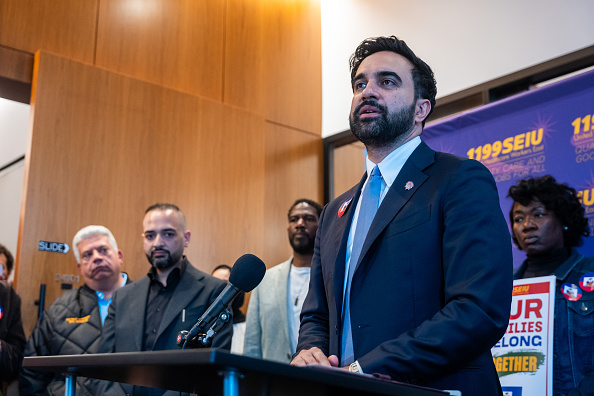
Last week, New York City Mayor Zohran Mamdani claimed that “if these past months have shown us anything, it is that socialists not only understand economics as well as the capitalists who came before but that we can solve their years of mismanagement through an embrace of our principles.” Not quite, Josh Appel argues.
“On the contrary,” he writes, “Mamdani’s first six months in office indicate the success of capitalism and the regular machinations of municipal government, not democratic socialism.”
For one thing, Mamdani failed to raise property taxes after widespread backlash. His rent freeze will likely face legal challenges (and won’t bring down housing prices). He was forced to drop his free busing idea. There will only be two city-run grocery stores—and the first won’t be operating until late 2027. And nothing has come of his envisioned $30 minimum wage or Department of Community Safety.
“On the most visible statistic of all,” Appel writes, “Mamdani deserves no credit: city crime numbers stand at historic lows, not because of socialism but because of NYPD Commissioner Jessica Tisch’s tough-on-crime policing, which got started under Eric Adams’s administration.” |
| |
In the term just ended, the Supreme Court issued several rulings favorable to President Trump. It allowed him to remove the heads of previously independent agencies and deport hundreds of thousands of refugees. It ruled against Colorado’s ban on conversion therapy and Hawaii’s gun regulations. And it struck down a campaign-finance law to the benefit of the Republican Party.
But the rulings don’t suggest that the Court has become “Trumpy.” It also ruled against Trump on many issues: tariffs, birthright citizenship, the National Guard in cities, removing a Fed governor, and counting late mail-in ballots.
“You simply can’t view the Court through a political lens, but instead must realize that the justices are looking at legal issues,” Ilya Shapiro explains. “All nine are doing their best to interpret the Constitution and federal laws faithfully and apply them to the facts of particular cases. . . . this isn’t a situation where there are two wings of the Court and then one or two swing votes.”
Read more about some of the cases. |
|
|
Last month, the New York State United Teachers (NYSUT) and the United Federation of Teachers (UFT) sued the State University of New York, a charter authorizer. The lawsuit aims to stop the transfer of a charter from Success Academy to Strive Charter School. NYSUT has done this before. Earlier this year, it sued SUNY to block new charters on Long Island. But why?
“NYSUT is responding to declining student enrollment in New York State, which is expected to reduce teaching positions—and, consequently, dues-paying members,” Danyela Souza Egorov explains. But “the state should encourage educational innovation,” she writes, “not try to smother high-performing charter-school operators. Without charters, New York’s most disadvantaged students will lose access to quality schools, and the primary beneficiaries will be the teachers’ unions’ bank accounts.”
|
|
|
When we think of the American Revolution, Thomas Jefferson’s resounding words often come to mind, and deservedly so. They “laid down certain truths—that all men are created equal, and enter into the world possessing rights that no government can deprive them of—that would guide and inspire this people in the years ahead,” Wilfred M. McClay writes.
But we must also remember the actions that led America to victory, especially those of George Washington—“the indispensable man,” as one of his biographers referred to him.
That title was no exaggeration. A committed patriot, Washington refused pay as commander-in-chief of the Continental Army, and the challenges he faced were enormous. “He was constantly dealing with problems of exhaustion, desertion, plunging morale, disease, and devastating winter weather,” McClay points out, “coping with an army on the edge of dissolution.”
But Washington was persistent—and ultimately triumphant. Read McClay’s tribute here. |
|
|
“It was awesome. I was 12 and also born and raised in New York (Manhattan). We were a different country then. Some of the problems and concerns are the same but things got better then and will again today, provided we remain faithful to the country’s principles.”
|
|
|
|
A quarterly magazine of urban affairs, published by the Manhattan Institute, edited by Brian C. Anderson. |
|
|
|
Copyright © 2026 Manhattan Institute, All rights reserved. |
|
| |
|