|
Forwarded this email? Sign up for free to have it sent directly to your inbox. |
|
|
|
Good morning,
Today, we’re looking at the need for gratitude, America’s July 4 celebrations, and Elvis Presley.
Write to us at editors@city-journal.org with questions or comments. |
|
|
|
Photo credit: VCG / Contributor / Visual China Group via Getty Images |
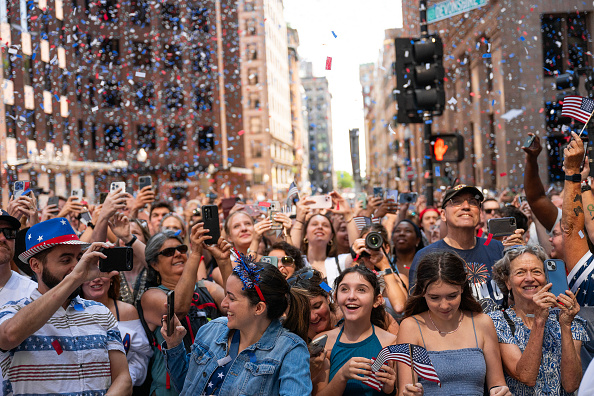
America’s bicentennial in 1976 seemed much more consequential than this year’s 250th. Perhaps today’s extreme political division and distrust has contributed to the coarseness of the current climate.
“But cynicism is too easy, and it obscures all that we have to be thankful for,” Ryan Cole argues. “With the imperfections of our history duly noted—and we note them often—a strong case can be made that no people has ever had it as good as we Americans do.”
Indeed, from economic mobility to earning power to consumer choice to military strength, America is rich with freedom and opportunity. “Maybe, given two and a half centuries of success in this experiment in liberty, Americans have lost some of our capacity for gratitude,” Cole writes. “We should seek to revive it.” |
|
|
On July 4, 1976, Joshua T. Katz was six years old, living in Manhattan on Riverside Drive. It was a dark time for New York City. Public spaces were covered in graffiti and litter, crime was rampant, and a municipal bankruptcy was looming.
“Still, there was the bicentennial,” he writes, “and for that one day, at least, New Yorkers celebrated, as did the rest of America.” The highlight for many was Operation Sail, or “the Tall Ships,” when more than 200 boats floated up the Hudson River. The U.S. Coast Guard’s 295-foot Eagle, still in use today, led the way. The Eagle is expected to play a role in this year’s semiquincentennial version of Operation Sail, Katz observes. But that might be about the only thing the two celebrations have in common, given today’s political polarization and its effect on patriotic spirit. “But maybe, just maybe,” Katz writes, “the Tall Ships of 2026 will bring people together again—as they did, so memorably, half a century ago.” |
|
|
Elvis Presley is a quintessentially American figure. He was born in the South, catapulted to stardom seemingly overnight, and soon became an icon of our national culture. His jump-suited impersonators haunt Las Vegas to this day.
Presley gave his most American performance in 1973, when he sang a three-part ballad, “An American Trilogy,” before an international audience at his satellite-broadcasted Aloha From Hawaii concert. The song was one part Southern pride, one part protest anthem, and one part callback to the Union army, and through it Presley delivered a chilling, career-defining performance. Read John Hirschauer’s reflection on the song and Elvis’s career here.
|
|
|
“If a majority of the Supreme Court is saying that men pretending to be women are not really women, I think maybe we ought to accept this as the final word of authority on the matter. (Not the physicians who profit from this fraud.)”
|
|
|
|
A quarterly magazine of urban affairs, published by the Manhattan Institute, edited by Brian C. Anderson. |
|
|
|
Copyright © 2026 Manhattan Institute, All rights reserved. |
|
| |
|