|
Forwarded this email? Sign up for free to have it sent directly to your inbox. |
|
|
Good morning,
Today, we’re looking at the sacrifice of NYPD officer Didarul Islam, why the Assisted Outpatient Treatment program could be at risk, crumbling public transit in cities, and the “indigenous identitarianism” movement.
Write to us at editors@city-journal.org with questions or comments. |
|
|
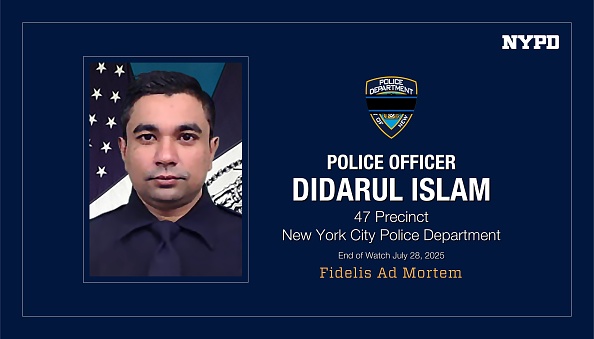
NYPD officer Didarul Islam was one of four innocent victims killed in the Manhattan shooting on Monday. A Bangladeshi immigrant, he was a husband, a father—and a hero.
Now more than ever, Rafael A. Mangual writes, we must “reacquaint ourselves with the sacrifices that officers make for us every day.” Indeed, it’s easy to take police for granted in a city like New York, where their presence is so visible. “Add to that the complacency of a mainstream media that focuses more on what cops get wrong than on what they get right,” Mangual points out, “and you can see why it’s getting increasingly difficult to find men and women willing to make such sacrifices.” Officer Islam’s sacrifice should be an inspiration to all of us.
|
|
|
More than ten years ago, Congress authorized grants for Assisted Outpatient Treatment (AOT), a program for those with untreated mental illness. “When such individuals fail to seek or follow voluntary treatment and cannot survive in the community without supervision,” Carolyn Gorman explains, “judges may use AOT to mandate community-based services, such as mental-health treatment (psychotherapy or medication) and case management, aimed at preventing violence, self-harm, incarceration, and hospitalization.”
But earlier this month, the Government Accountability Office published a report on three evaluations that the Department of Health and Human Services conducted, finding them “inconclusive.” This makes it easier to argue that the program doesn’t work, Gorman points out. But independent evaluations have found impressive outcomes. Read more about them, and the program, here.
|
|
|
High-cost American cities are facing a housing crisis. Solving it will take more than just building more homes. It will take better, faster transit that reaches city edges.
Indeed, as Evan J. Zimmerman writes, crumbling transit infrastructure “forces people to vie for a limited pool of dwellings near the urban core instead of moving to potentially commutable areas on the outskirts of the city.” Read his take on the role that public transportation can play in easing the housing shortage. |
|
|
There’s a popular movement on the left that labels non-indigenous North Americans “settlers.” The thinking: such people should be considered second-class citizens, and they should express gratitude for the “opportunity” to live on land “owned” by indigenous people.
Adam Zivo writes that in Canada, his home country, the movement “has already begun to erode democratic decision-making in favor of race-based hierarchies.” He warns Americans against embracing this dangerous thinking. |
|
|
“I guarantee that if they are allowed to stay, even if only as legalized residents, that within ten years there will be a movement to make them full citizens. The argument will be that they have proved themselves worthy of becoming full citizens. This is still amnesty—delayed, but still amnesty.”
|
|
|
Photo credit: Anadolu / Contributor / Anadolu via Getty Images |
|
|
A quarterly magazine of urban affairs, published by the Manhattan Institute, edited by Brian C. Anderson. |
|
|
Copyright © 2025 Manhattan Institute, All rights reserved. |
|
|
|