|
Forwarded this email? Sign up for free to have it sent directly to your inbox. |
|
|
|
Good morning,
Today, we’re looking at a new lawsuit against New York City’s rent freeze and the growing problem of hate crimes in the city.
Write to us at editors@city-journal.org with questions or comments. |
|
|
|
Photo credit: ANGELA WEISS / Contributor / AFP via Getty Images |
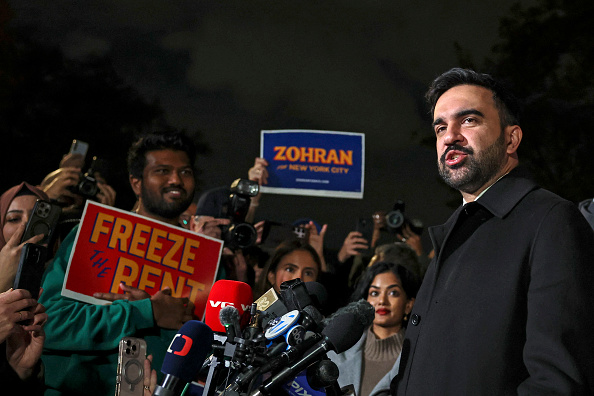
By law, New York City’s Rent Guidelines Board (RGB) is required to consider economic factors like operating costs, taxes, and vacancy rates when weighing whether to raise stabilized rents. Last month, it voted to impose 0 percent rent increases on rent-stabilized units for both one- and two-year leases.
Now, a group of affected property owners is asking a state court to nullify the rent freeze. Represented by former First Deputy Mayor Randy Mastro and his law firm, the group argues that the RGB’s own research doesn’t support a 0 percent increase.
Indeed, in the most recent year, landlords’ expenses increased by 5.3 percent. That means that to hold net operating income constant, owners need increases of 3.4 percent on one-year leases and 4.8 percent on two-year leases. Further, the RGB alleged that landlords have seen a 6.2 percent jump in net operating income. “But that number is drawn from a dataset that includes buildings with both stabilized and market-rate units,” John Ketcham explains. “In these mixed buildings, the income landlords derive from the market-rate units offsets losses from the stabilized units, making it appear that the stabilized market is far healthier than is truly the case.”
Read more about the RGB’s decision and the property owners’ lawsuit. |
|
|
Last week, an Asian man and a Jewish man were stabbed near a synagogue in New York City. The assailant yelled “Allahu Akbar,” and the NYPD is evaluating the attacks as a potential hate crime. It’s part of a troubling pattern, Josh Appel observes. Hate crimes jumped 69 percent in 2023, and they continue to climb. In New York City, more than half of hate crimes target Jews, despite the small share of the population they represent. “While hate crimes resemble ordinary crimes in many ways, they are unique because they go beyond the victim,” Appel writes. “A bias-motivated attack on one person threatens an entire community and risks driving a whole group out of civic life, regardless of criminal intent.”
Read more about how the city can get hate crimes under control. |
|
|
|
In this episode of the City Journal Podcast, Ralph Clark, CEO of SoundThinking (formerly ShotSpotter), discusses the technology of acoustic gunshot detection, its impact on public safety, and the arguments surrounding its use. Host Rafael Mangual and Clark explore how the technology saves lives, enhances policing, and addresses community concerns. They also consider the future of surveillance technology in law enforcement.
|
|
|
|
“Like George Floyd, Michael Brown brings to mind a quote from Macbeth: ‘Nothing in his life became him like the leaving it; he died as one that had been studied in his death.’ Brown was raised under a system that brought out the worst in him and had given him up for dead, long before his fatal encounter with Ofc. Wilson. In life, Michael Brown was nothing to these political grifters; in death, he is a cash cow.”
|
|
|
|
A quarterly magazine of urban affairs, published by the Manhattan Institute, edited by Brian C. Anderson. |
|
|
|
Copyright © 2026 Manhattan Institute, All rights reserved. |
|
|
|
|