|
Forwarded this email? Sign up for free to have it sent directly to your inbox. |
|
|
|
Good morning,
Today, we’re looking at California’s race-based policies, New York’s war on Amazon, a noteworthy recent DSA meeting, and a religious charter school in Tennessee.
Write to us at editors@city-journal.org with questions or comments. |
|
|
|
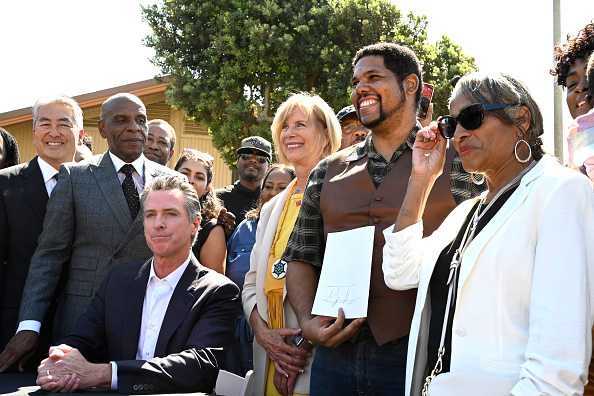
Photo credit: MediaNews Group/Long Beach Press-Telegram via Getty Images / Contributor / MediaNews Group via Getty Images |
The notion that racial disparities are evidence of discrimination runs deep within California’s government.
In 2021, the California Arts Council published a training to help members examine “the relationship between government, white supremacy culture, and racial equity practices.” That same year, the California State Board of Education approved an Ethnic Studies Model Curriculum “as a guide” for high schools, while the state legislature enacted a model curriculum that was based, in part, on the “pedagogy of the oppressed.” The California Water Boards promotes an approach where “individuals and groups receive different resources, opportunities, support, or treatment based on their specific needs.”
In 2022, California Governor Gavin Newsom ordered state agencies to “more effectively advance equity.” His directive called for bureaucrats to administer state programs through a racial equity lens and help “disadvantaged business enterprises” access federal dollars.
“In other words, the executive order effectively enshrined the principle that California’s government would prioritize citizens based on the color of their skin,” Christopher Rufo and Ryan Thorpe write. “Institution after institution, agency after agency, the effective message is the same: the United States of America is rotten with racism, white people are oppressors, the government must equalize outcomes, and wealth redistribution is justified to achieve that end.”
Read more from their investigation. |
|
|
Companies like Amazon use third-party contractors for “last-mile” deliveries from warehouses to customers. But the New York City Council has proposed legislation that would ban them from doing so.
The city council frames the bill as a pro-labor move, concerned about safety at Amazon’s facilities. So Adam Lehodey recently visited the company’s “DAB5” last-mile facility in Brooklyn, the fourth one to open there, to see what it was like.
“The work is physically taxing—workers move packages and boxes all day,” he writes. “Yet the conditions I witnessed, as we stopped along the routes and spoke to workers on e-bikes and in trucks, were a far cry from the nightmare environments alleged about some Amazon facilities.”
The electric trucks have 57 censors and cameras, while the doors lock automatically. Any driver-related safety incident is reported back to the site leader. Staff wages average $24 an hour, and workers get health insurance and 401(k) accounts. One employee told Lehodey that he makes “a whole lot more” than he did at his old job.
“If anything, Amazon’s profitability, plus a competitive labor market, has pushed up wages and encouraged investment in new e-bikes and vehicles with enhanced safety features used throughout the facility,” Lehodey writes. The city council bill would likely discourage future investment and could axe more than 10,000 jobs.
Read more. |
|
|
Over the weekend, the Democratic Socialists of America’s board of directors, the National Political Committee (NPC), met to determine how the DSA would endorse a 2028 presidential candidate. Many members view Congresswoman Alexandria Ocasio-Cortez as the group’s likeliest endorsement, while others see her as milquetoast and beyond the DSA’s control.
“The debate revealed a split over how electorally respectable the DSA needs to be—and how much influence its most extreme members should hold,” Stu Smith writes. “It also exposed a contradiction at the heart of the organization: despite its claim to being champions of democracy, the organization’s core cadre deliberately structured discussion of the endorsement process to sideline the broader membership.”
Read more about the meeting. |
|
|
Religious charter schools are currently prohibited nationwide. So Tennessee’s approval earlier this year of a charter for Union Academy, a faith-based college preparatory, will almost certainly end up before the Supreme Court. No legal challenge has been filed, but it’s likely only a matter of time, Ray Domanico argues. “This is a line-in-the-sand issue for many charter school advocates and those opposed to the use of public money to support religious instruction.”
Union Academy will open with 320 students next August and will expand to 780 students by 2034. “Some will oppose Union Academy and similar schools because they believe, erroneously, that nonreligious public education is fundamental to the American experiment,” Domanico writes. “Our Founders would be surprised to hear that, since there were no public schools in the early American republic, and religious institutions provided much of the social services, a role overtaken by the public sector in the twentieth century.”
Read more. |
|
|
“As the author states, legitimate questions and debates about data centers need to be distinguished from the Left’s opportunism to link every controversial situation to anarchy and political power.”
|
|
|
|
A quarterly magazine of urban affairs, published by the Manhattan Institute, edited by Brian C. Anderson. |
|
|
|
Copyright © 2026 Manhattan Institute, All rights reserved. |
|
| |
|