|
Forwarded this email? Sign up for free to have it sent directly to your inbox. |
|
|
Good morning, Today, we’re looking at New York mayor Zohran Mamdani’s recent comment about his security deposit and why college students are censoring their views. Write to us at editors@city-journal.org with questions or comments. |
|
|
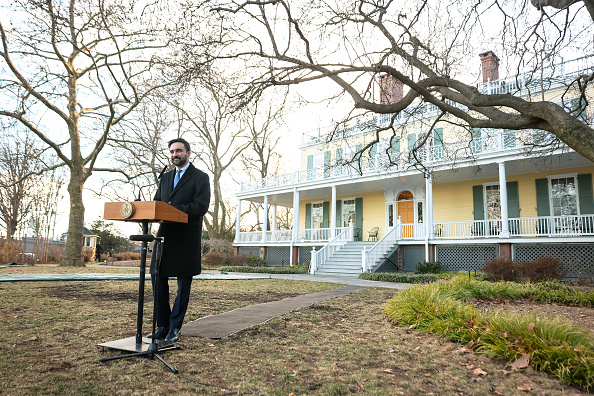
Last week, New York mayor Zohran Mamdani and his wife, Rama Duwaji, moved into Gracie Mansion, the mayor’s official residence in Manhattan. He invited the press to witness the move and was asked whether he had received his security deposit back. “The security deposit is being put toward the final month,” he said.
As any renter in the city knows, the security deposit isn’t to be used toward rent. It goes to the owner, who can withhold it at the end of the lease to pay for damages, or return it to the tenant.
“Given the state-imposed constraints on rent-regulated leases, it’s highly unlikely that the mayor and the owner of his Astoria apartment worked out a specially tailored deal in advance and included this agreement in the lease,” Nicole Gelinas writes. “It also seems improbable that Mamdani’s landlord is a neglectful property owner whose egregious management justifies the withholding of rent: just after the election, Mamdani complained only about a leaky sink—one that his building superintendent was attending to—a common enough inconvenience for homeowners as well as renters.”
Neither the mayor’s office nor a person believed to be an owner of the mayor’s apartment responded to Gelinas’s request for comment. Her theory: either Mamdani ran out on his final month’s rent, or he and his landlord worked out an informal agreement after his election. “Either conclusion makes for an unsalutary start for New York City’s top official,” she writes. |
|
|
University faculty in America today are increasingly more likely to describe themselves as “very liberal.” In 1995, the ratio of liberal professors to conservatives was two-to-one. In 2019, it was six-to-one. What, then, does a politically homogeneous faculty mean for students?
Data show that it silences them. A poll published in August found that 88 percent of students at Northwestern and the University of Michigan were pretending to be more progressive so that they could succeed. “Liberal education requires a campus where students can argue with faculty and peers and dissent from prevailing orthodoxies,” Kevin Wallsten writes. “If students feel uncomfortable expressing themselves, or routinely self-censor, that can’t happen.”
Read more about what the data show. |
|
|
The Manhattan Institute is proud to serve as the Principal Institutional Partner for the Sun Valley Policy Forum’s 2026 Winter Summit in the iconic resort town of Sun Valley, Idaho on February 11, 2026.
We are thrilled to join Joe Lonsdale and MI senior fellow Christopher F. Rufo for an evening on principled leadership and the future of American institutions in an AI-driven era. Please click here to learn more about the Sun Valley Policy Forum and our partnership and to purchase tickets at a discounted rate for friends of the Manhattan Institute.
|
|
|
|
Jason L. Riley, senior fellow at the Manhattan Institute and one of the most incisive voices in today’s debates over race and public policy, joins Rafael Mangual to discuss how the Left frames racial disparities to advance a victimhood mentality, rather than solutions rooted in responsibility, opportunity, and community empowerment. |
|
|
“I went to graduate school around 1974, and I took a Business Law course. When the professor covered the SBA, he told the all-white class that they need not apply, as the program was designed exclusively for minorities. Fifty + years of discrimination.”
|
|
|
Photo credit: Michael M. Santiago / Staff / Getty Images News via Getty Images |
|
|
A quarterly magazine of urban affairs, published by the Manhattan Institute, edited by Brian C. Anderson. |
|
|
Copyright © 2025 Manhattan Institute, All rights reserved. |
|
|
|