|
Forwarded this email? Sign up for free to have it sent directly to your inbox. |
|
|
Good morning, Today, we’re looking at Zohran Mamdani’s Committee on Community Safety, the divisions within the Republican Party, a problematic new formula for kidney disease, and NGOs in New York. Write to us at editors@city-journal.org with questions or comments. |
|
|
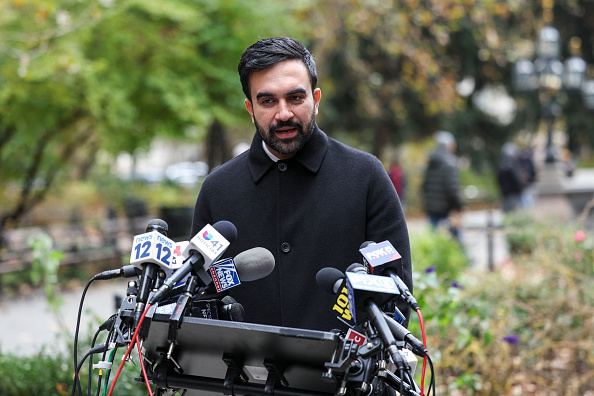
Last month, Mayor-elect Zohran Mamdani released the names of those on his Committee on Community Safety, a 26-member group that will advise him on criminal justice. On the list: several activists who are openly hostile to law enforcement and reject the idea of carceral punishment.
“These choices raise questions about Mamdani’s real intentions,” Stu Smith writes. “He has publicly distanced himself from his earlier support for ‘defunding the police’ and other 2020-vintage radicalisms. But his selected advisors suggest he may not have traveled as far from those positions as he now implies.”
Indeed, one of the members has argued that policing is a form of social control, while others have called for reducing the jail population or capping prison sentences. Read more about what Smith believes “may become the largest anti-policing experiment in the world.” |
|
|
The deep divisions within the Republican Party have been hardening for years. On one end there’s the tech Right, which backs innovation and growth; on the other, the populist Right, which backs cultural values and tradition. Corbin K. Barthold argues in our Autumn issue that it’s imperative for each side to work together—or they will both fall behind.
“Tech must accept that the populists are the Republican base. They bring the votes, and their attitudes must be taken seriously,” he points out. And the same goes for the MAGA wing. “The tech industry generates wealth (which does, in fact, trickle down) and, in the years ahead, promises cheaper energy, better health, and abundant housing,” Barthold writes. “Populists who move to tear down tech risk harming the very families they seek to protect.”
Read more about how each side can coexist—and even complement the other—here. |
|
|
NYC Health + Hospitals operates more than 70 patient-care facilities across the city. It recently introduced a new formula that helps doctors treat chronic kidney disease and determine patients’ eligibility for transplants.
The problem? It’s replacing a formula that accounted for racial differences in muscle mass. “The old formula was based on empirical data. By accurately estimating kidney function, it was explicitly designed to give black patients an equal path to treatment,” writes nephrologist Stanley Goldfarb. “Removing the race adjustment will lead to black patients receiving sooner-than-necessary referrals for kidney care and transplants, while slowing white patients’ access to the same procedures.” Read his take. |
|
|
Instead of providing social services directly through its municipal workforce, New York delivers many of them through NGOs. This arrangement offers a bigger bang for the city’s buck, given that the workforce is typically nonunion and paid less. “When the government wants to scale up a service, such as community-based mental health programs, homeless shelters, or alternatives to incarceration,” Stephen Eide writes, “NGOs allow it to do so widely and rapidly.”
The NGOs have shaped city politics, too, Eide observes, “but progressives and conservatives have both been slow to grasp the full implications of NGOs’ heft in 2020s New York.” Read his take. |
|
|
Photo credit: ANGELA WEISS / Contributor / AFP via Getty Images |
|
|
A quarterly magazine of urban affairs, published by the Manhattan Institute, edited by Brian C. Anderson. |
|
|
Copyright © 2025 Manhattan Institute, All rights reserved. |
|
|
|