|
Forwarded this email? Sign up for free to have it sent directly to your inbox. |
|
|
|
Good morning,
Today, we’re looking at L.A.’s homeless encampments and struggles with basic governance, automatic license plate readers’ role in fighting crime, DHS’s proposed fee on international students, and how New York lost its check on the far Left.
Write to us at editors@city-journal.org with questions or comments. |
| |
|
Photo credit: AFP Contributor / Contributor / AFP via Getty Images |
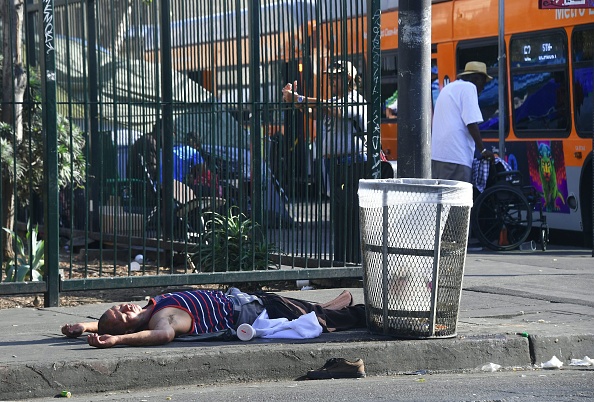
Hugo Soto-Martínez, a Los Angeles city councilman and DSA member, has coined a new euphemism to describe the drug-addicted vagrants who have colonized the city’s streets. They are “our neighbors,” he says.
“‘Neighbor’ traditionally conjures the image of someone with an equal stake in one’s community as oneself, who shares one’s interest in stability, and who can be counted on, in times of need, for help,” writes Heather Mac Donald. “Would Soto-Martinez and his fellow DSA members ask an encampment occupant to watch their children while they run an errand?”
Of course not, but Soto-Martinez is using the term to justify lifting bans on homeless “encampments” (another euphemism, Mac Donald notes) in his district. But if the councilman and his allies continue to gain strength in L.A. politics, “expect this green light for street squalor to extend more widely, as the Left pushes Los Angeles further toward uncontrolled anarchy,” she writes.
Read more here. |
|
|
Los Angeles is the second-largest city in the U.S. It’s the center of a trillion-dollar regional economy. And it’s the hub of America’s entertainment industry.
Yet it struggles to perform basic urban government functions. Thieves have stripped copper wire from streetlights, while the city neglects repair and maintenance, leaving entire blocks dark for months on end. Sidewalks are falling apart. Infrastructure is aging. Public parks repeatedly turn into open-air drug markets. Streets become homeless encampments. Businesses are fleeing. Hollywood is struggling. School enrollment is declining.
How can this be, when resources are so vast? L.A.’s economy is larger than that of many countries. It has a nearly $14 billion annual budget, larger than almost every U.S. city. It has some of the most valuable real estate in the world.
“Living in Los Angeles has long involved a certain implicit bargain. Residents tolerated high taxes, extensive regulation, and steep housing costs because, in return, the city offered economic opportunity, natural beauty, and cultural prestige,” Shawn Regan writes. “But as public disorder spreads and basic services worsen, that bargain looks like a bad deal for families, businesses, and entire industries.”
Read more about the city’s governance failures. |
|
|
As the debate over automatic license plate readers continues—are they essential for public safety, or an invasion of privacy?—Ian Adams and Scott Mourtgos published a working paper analyzing whether ALPRs are effective in fighting crime.
They found that ALPRs reduce motor vehicle thefts by 11 percent one year after deployment. “The decline held through the end of the year—a sign that it’s the cameras, not the publicity around them, driving the change,” Adams and Mourtgos write. Further, they note, “while the cameras did not detectably accelerate the return of stolen vehicles overall, among vehicles that were recovered, the typical recovery arrived about six hours sooner, a small but significant change.”
Read more about their findings, and what they could mean for cities weighing the technology’s costs and benefits. |
|
|
The U.S.’s Optional Practical Training (OPT) program allows international students to work in the country after graduation. “It’s our main pipeline for top talent immigrating here,” Jeremy Neufeld and Adam Ozimek write. The founder of Moderna first got a job through OPT, as did engineers at OpenAI, Tesla, NVIDIA, and Intel.
The Department of Homeland Security is now considering implementing a $100,000 fee on these students. The move “would effectively shut down the country’s most important program for new high-skilled immigrants, who will instead go to competitor or adversarial countries to study,” Neufeld and Ozimek argue. “This will play directly into the hands of China, which rolled out a visa last year aiming to attract foreign-educated STEM talent.”
Read more about the potential ramifications, and what the Trump administration could be doing instead to improve the U.S. immigration system. |
|
|
Five years ago, New York Governor Andrew Cuomo resigned after several women alleged he sexually harassed them. Since then, the far Left has emerged as a dominant force in state politics. That’s because Cuomo actively tried to stymie the progressive wing (he backed the Independent Democratic Conference, a group of centrist state senate Democrats).
“Andrew Cuomo was never a conservative and should not be confused for one,” Joseph Burns writes. “He delivered wins for progressives on key issues, but he also managed to keep major progressive figures and institutions in check, preventing them from gaining undue influence over the direction of state politics.”
Read more. |
|
|
“More of a reason to get your children out of public schools.” |
|
|
|
A quarterly magazine of urban affairs, published by the Manhattan Institute, edited by Brian C. Anderson. |
|
|
|
Copyright © 2026 Manhattan Institute, All rights reserved. |
|
|
|
|