|
Forwarded this email? Sign up for free to have it sent directly to your inbox. |
|
|
|
Good morning,
Today, we’re looking at New York City’s pied-à-terre tax rollout, state disparate-impact policies, Mayor Zohran Mamdani’s fight with the UFT, and a new book about the Supreme Court.
Write to us at editors@city-journal.org with questions or comments. |
| |
|
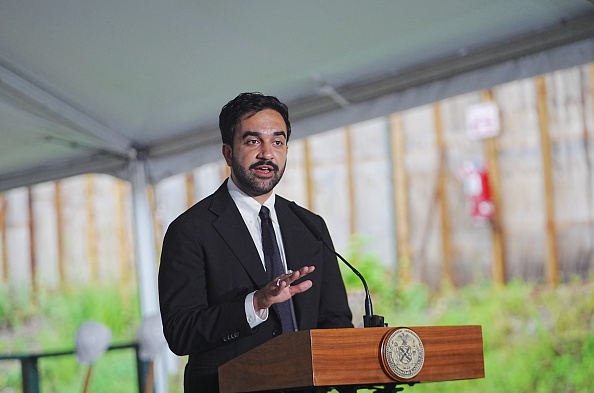
Photo credit: Anadolu / Contributor / Anadolu via Getty Images |
Last week, New York City political leaders gathered to air concerns about the messy implementation of Mayor Zohran Mamdani’s new pied-à-terre tax. And what a mess it has been, indeed. The tax took effect on July 1, and eight days later, the city held a public hearing to finalize the rules. These were approved the next day. Then, on July 25, the city published a searchable list of 960,000 properties—based on outdated records—that could be subject to the tax. If homeowners qualified for an exemption, the burden was on them to prove it. It wasn’t long before a group of homeowners sued the city over the tax. As of August 18, the city had completed 5,001 exemption applications out of 9,884 (2,318 have been approved).
“Ryan Foley, a senior real-estate litigator at Starr Associates, told me that the surcharge’s inclusion in the state budget allowed it to bypass a legislative process that should have included committee hearings and floor debates,” Daniel Edward Rosen writes. “Its practicality was never fully debated, making problems with implementation and enforcement far more likely.”
Read more. |
|
|
Last month, the Department of Education announced that it was axing regulations surrounding disparate impact, the idea that demographic disparities are evidence of discrimination, regardless of intent. Now, to determine whether a civil rights violation has been committed, a party will have to show evidence of discriminatory intent—not just demographic data.
“The implications of the ruling are significant, but more work remains—especially at the state level, where many have baked disparate-impact doctrine into their laws,” Neetu Arnold explains.
Maryland offers a clear example. A 2014 law requires school districts to submit action plans whenever a school is flagged for demographically disproportionate discipline. “Maryland state policy simply assumes that any ‘uneven application of discipline to minority and disabled students’ is sufficient to demonstrate ‘inherent unfairness,’ without any further investigation,” Arnold writes. The Maryland State Department of Education said that it does not expect the federal policy change to affect the law.
Read more. |
|
|
Normally, the New York City Council would make provision for one-time cash payments to school paraprofessionals—staff who support teachers and students but are not licensed teachers themselves—as part of regular United Federation of Teachers union contract negotiations. Now, however, the city council has passed legislation to make these payments.
Mayor Zohran Mamdani is suing the council over its attempt to make the payments. “The stakes are far bigger than the council legislation’s quarter-billion-dollar price tag: if courts don’t rule for the mayor, public-employee unions will be emboldened to make more demands that they haven’t been able to win at the bargaining table,” Ken Girardin writes.
Read more about the lawsuit and its potential consequences. |
|
|
In Last Branch Standing, Sarah Isgur, editor of SCOTUSblog, offers a fun and easy way to understand the American judiciary. She shows that the Supreme Court is “a complex, interesting, fundamentally human organization that deserves to be respected,” Andy Smarick writes. “Overall, the book’s major contribution isn’t to make an extended central argument so much as to offer chunks of knowledge, much of it memorable.” Read his review. |
|
|
“Washington is one of the most beautiful places in the universe. Especially in the summer. Unfortunately it’s populated primarily by virtue-signaling liberals who have little to no concern as to how the policies they advocate affect real people.”
|
|
|
|
A quarterly magazine of urban affairs, published by the Manhattan Institute, edited by Brian C. Anderson. |
|
|
|
Copyright © 2026 Manhattan Institute, All rights reserved. |
|
|
|
|