|
Forwarded this email? Sign up for free to have it sent directly to your inbox. |
|
|
Good morning,
Today, we’re looking at New York City’s ability to deal with a recession, why high graduation rates deserve skepticism, a lawsuit against New Mexico’s child-welfare agency, and a book about criminal-justice reform.
Write to us at editors@city-journal.org with questions or comments. |
|
|
Photo credit: Michael Brochstein/ZUMA Press Wire/Alamy Stock Photo |
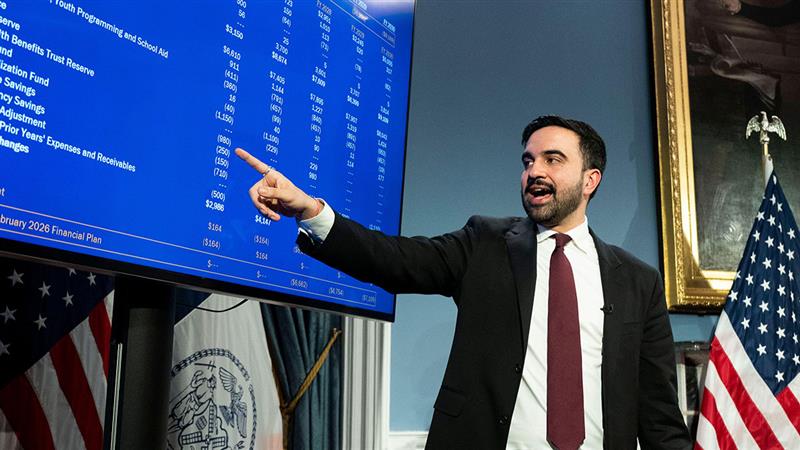
Aside from Eric Adams, no New York City mayor in modern history has avoided an economic downturn. And no mayor in modern history is more unprepared to deal with one than Zohran Mamdani. “The city faces deeper problems than the 34-year-old mayor’s inexperience and his ideological resistance to what he calls ‘austerity’—that is, serious budget cuts,” Nicole Gelinas writes. “Mamdani’s proposed state tax hikes on the city’s wealthy earners and businesses would deepen the city’s reliance on its most volatile revenue sources.”
Read more about why New York City could soon enter a recession and what it can do to prepare. |
|
|
Over recent months, several city and state leaders have touted their schools’ rising graduation rates as evidence of student achievement. There’s just one problem: those students’ test scores have declined.
For instance, Minnesota Governor Tim Walz recently touted the state’s 84.9 percent graduation rate. But between 2021 and 2025, proficiency in eleventh-grade math fell from 41.4 percent to 35 percent. In 2021, nearly 60 percent of tenth-grade students were proficient in reading; that number is now about 50 percent. And nearly two-thirds of students don’t meet grade-level standards in science.
“Politicians and school administrators may find it convenient to sidestep or ignore declining academic outcomes on standardized tests,” Neetu Arnold writes. “But by dismissing clear evidence, they preserve the status quo instead of reckoning honestly with the results of the time and money they have invested.” Read more.
|
|
|
Earlier this month, New Mexico Attorney General Raùl Torrez sued the state’s Children, Youth, and Families Department (CYFD) for repeatedly failing to protect kids in foster care. That failure has led to horrific outcomes. A number of children have been abused and neglected in unsafe homes, with one child dying from malnutrition and another committing suicide.
“Torrez and his department have identified more than just incompetence or a lack of communication among different agencies or even the moral failures,” Naomi Schaefer Riley observes. “He explains that ‘rather than prioritizing child safety . . . CYFD has a cultural orientation that prioritizes reunification—reunification at the expense of safety.’ It is this culture of reunification, he says, that drives ‘most of the tragic outcomes’ in the system.”
Read more about the lawsuit and CYFD’s systemic failure to protect children. |
|
|
In The Science of Second Chances, economist Jennifer Doleac argues that criminal-justice policies in the U.S. need to do better at giving crime-committers opportunities to start over and putting them “on a better path going forward.”
It may sound like an odd argument, given that the typical state prisoner has about ten prior arrests and five prior convictions—and therefore has already had several “second” chances. Even so, Doleac’s take is worth considering, Rafael A. Mangual argues. “While she’s not always right, the conversation would be more productive if reformers sounded more like her,” he writes.
Read Mangual’s review. |
|
|
“To paraphrase the great Milton Friedman, if you put social justice before individual freedom, you will get neither; if you put individual freedom before social justice, you will get a high degree of both.”
|
|
|
A quarterly magazine of urban affairs, published by the Manhattan Institute, edited by Brian C. Anderson. |
|
|
Copyright © 2026 Manhattan Institute, All rights reserved. |
|
|
|