
A clever device invented to end a war. Destruction of the sacred and violence against the innocent. Mayhem. Pillage. Atrocity. Embers and sparks rising into the night air. The inventor himself stands sorrowful in victory, guilty amid the celebration.
Don’t be fooled into thinking I’m describing Robert Oppenheimer and America’s victory over Japan. It’s Christopher Nolan’s Odysseus, moving through the alleys and open squares of Troy as his fellow Bronze Age Greeks storm and sack the Trojan citadel.
Finally, a reason to check your email.
Sign up for our free newsletter today.
Nolan released Oppenheimer, his billion-dollar blockbuster about man’s discovery of atomic fire, in the summer of 2023. Three years later, he has returned to the Promethean theme, only now through a story nearly 3,000 years old. In Homer—and throughout Greek tradition—the Trojan Horse is a legendary feat of tactical brilliance. For Nolan, however, it is a devastating war crime.
Ready to sail home from the shores of Ilium, the Greeks believe they have won the war thanks to Odysseus’s genius. But for his ruse to succeed, it must exploit the goodness of their enemies. It requires violating a principle that ought never to be broken, whatever the consequences: the law of Zeus, the sacred code of hospitality and gift-giving, a moral order of reciprocity and respect toward the stranger.
In Nolan’s telling, civilization rests on a foundation of moral virtues—integrity, trust, self-restraint, and stewardship—that prevent it from collapsing into barbarism and corruption. The moral lines are clear. In Homer’s poem, not so much. One must read the fine print to discover why the gods are angry with some of the Greeks but not others, why certain men are denied a swift and intact homecoming while others sink to the bottom of the sea. If attacking Troy was not exactly a righteous cause for Homer, neither was it an unjust war. Nolan’s epic, however, puts atrocities front and center, and everyone is guilty. (To underline the point, the Trojans wear white; the Greeks, black.) The film frames Odysseus’s subsequent ten-year struggle to return home as divine punishment for shattering Zeus’s sacred social contract into unusable shards. The moral core is gone; the upshot is that no one is going home. The Greeks had it wrong. They may have won the battle, but they lost the war.
Nolan’s impending Dark Age plot device has some basis in historical fact. For reasons that remain a mystery, the major civilizations of the Mycenaean age collapsed sometime between 1200 B.C. and 1100 B.C., not long after the Trojan War. (That war, by the way, was probably real; a preponderance of the evidence points to its having occurred around 1180 B.C.) The Greek kingdoms disappeared, and their great palaces rapidly fell into ruin. The Egyptian, Hittite, and Babylonian empires also collapsed. A Dark Age lasting some 400 years followed.
A coalition known as the Sea Peoples—a group of seafaring raiders—is often blamed for the destruction. We do not know who they were; they may have been Greek in part. But the archaeological evidence for foreign invasion is weak. Rather than invaders, it is also plausible that the Sea Peoples were displaced refugees fleeing the ravages of social disintegration, desperate for sanctuary in a way that only hastened the ruin of already crumbling empires.
At any rate, Odysseus’s key epiphany in Nolan’s film is that his own and his fellow Greeks’ moral failings provide the spark to the Sea Peoples’ powder keg.
It’s hard to adapt a novel into a movie, and even harder to condense an epic poem of 12,000 lines into a three-hour megahit that audiences around the world will love. Nolan prunes the story to the elements he can shape, and at times stretch, to serve his theme of civilization’s breakdown. We have the Cyclops, the Laestrygonians, the underworld of Hades, the choice between Scylla and Charybdis, the suitors as freeloading parasites, and Circe, who turns Odysseus’s men into pigs. The Sirens sing. Homer weaves these episodes together with a different moral thread. Nolan changes some and preserves others but reduces them all to a single insistence: forcing Odysseus to confront an escalating series of ever more grotesque and perverted violations of the sacred law he first broke at Troy. The stranger is nowhere welcome.
It’s conservatives, not liberals, who have traditionally argued that the moral principles sustaining civilization originate in family, community, and religious institutions. From Adam Smith and Edmund Burke to Russell Kirk and Roger Scruton, the argument has been much the same: politics, trade, commerce, and daily life all presuppose civic virtues—trustworthiness, mutual respect, delayed gratification, fidelity to promises. When those virtues erode, all hell breaks loose.
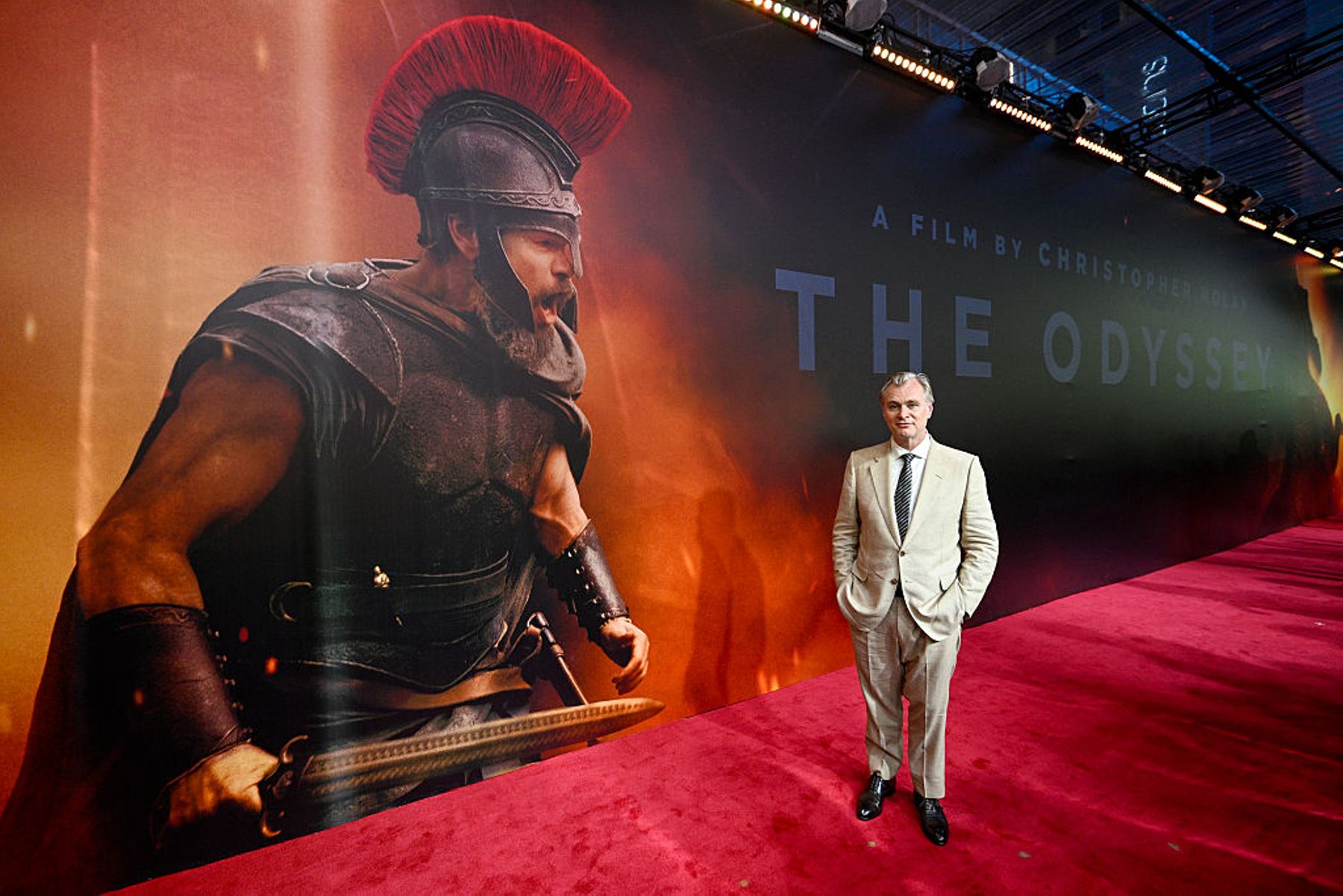
Now Christopher Nolan depicts Odysseus as a sacrilegious criminal whose cleverness sets an entire civilization sliding into the Dark Ages. If you thought Burke’s Reflections on the Revolution in France was a high-octane blast of conservative lamentation over the profanation of sacred values, wait until you see Nolan’s tale of Bronze Age civilizational free fall. Odysseus causes the world to fall apart. The Dark Age is his fault. His genius broke the moral bonds that hold civilization together.
It is a bit ironic, of course, that in the month leading up to the film’s release, conservatives were up in arms about what they feared Nolan’s movie might be: a three-hour DEI struggle session desecrating a masterpiece of Western literature. And to be fair, the prerelease press tour and marketing campaign were a disaster. Race swaps. Gender flips. Actresses blaming Homer for not giving women a larger role. Actors peddling crackpot left-wing revisionist history in promotional interviews. An epic reinterpreted through a feminist lens. Boxes ticked in casting to qualify for awards. The warning signs were all there.
But contrary to those expectations, Nolan has produced a genuinely fun, absorbing, and at times touching adventure. For anyone who wants it to be more than it is—more than a summer blockbuster that needs to earn $1 billion—I can only say this: Homer’s poem is still with us. The Odyssey has endured for nearly 3,000 years. It has survived the decline and fall of not one but two civilizations because it is one of the greatest stories ever told. It will survive Hollywood. It will survive even us.
Some critics have seized upon the casting choices and won’t let go. They howled when two-minute previews featured Eliot Page, formerly Ellen, now surgically and hormonally reengineered into a diminutive man, playing a Greek warrior. The volume rose further when it was revealed that Lupita Nyong’o, a black actress of Kenyan descent, had been cast as Helen. Yet the rush of Nolan’s epic carries one along so swiftly that it scarcely matters to see an Asian man in armor swimming to his death, enchanted by the Sirens. Had this been a historical reconstruction (like Nolan’s Dunkirk) or a film committed to Homeric realism, casting would have been more consequential. But this is a tentpole blockbuster with swords and sandals. You should care no more about the Korean swimming to his doom than about Matt Damon’s Boston Irish accent. Just go with it—and the same goes for the boats and costumes.
The Odyssey is the second great work in the history of Western literature. It is also the first to be told out of chronological order, which naturally plays to Nolan’s strengths as a storyteller. He is a gifted filmmaker who has already earned his place in Hollywood’s pantheon. His previous films have played with narrative complexity, mixed genres, and layered timelines; they have wrestled with moral ambiguity and ended in homecomings. Both Inception and Interstellar are about fathers trying to return to their children. All of that is here as well, rendered with vividness and emotional force.
Nevertheless, some small complaints are worth lodging. The movie is too loud, with booming noises often muffling important lines of dialogue. (Nolan’s Tenet was worse in this respect. Despite seeing it twice, I still have no idea exactly what happens in it.)
The larger difficulties with the film concern the moral theme itself: the sequence of clever invention, atrocity, and remorse. First, there is Odysseus’s transformational arc. If he is indeed a villain, how can he plausibly become a hero again by the film’s end? The greater the crime, the greater the demands of redemption. But Nolan misdirects here. Instead of showing how Odysseus might atone, the film turns inward to his feelings of guilt. He becomes the chief obstacle to his own homecoming. His arc hinges on overcoming that guilt so he can return to his wife, son, and kingdom. But being guilty and feeling guilty are different things. The narrative momentum of Homer’s plot carries us forward anyway: a father must save his son from murder. If he does not return home, his son will die. In the end, however, Nolan’s story addresses only one side of that moral balance. Precipitating a Dark Age would seem to be a grave wrongdoing. Reuniting with his wife, saving his son, and sailing into exile cannot close that moral gap.
The second problem concerns Nolan’s choices about what to keep and what to discard from Homer. My old teacher of Greek, Seth Benardete, a legendary scholar of the classics, used to say that The Odyssey is a poem about suffering. It is about a man who learns to shape and channel suffering into the achievement of the extraordinary.
On that note, most strikingly, Nolan leaves out the moment that Odysseus encounters Achilles in Hades. It’s a scene that acts as a fulcrum between The Odyssey and The Iliad, shifting the perspective on what’s worth striving for. That change is so dramatic that some ancient commentators concluded the two poems must have been written by two different people—or one poem was written when Homer was young, the other when he was old. In any case, both Achilles and Odysseus face the same choice: immortality and a shortened life on earth, on the one hand, or mortality and home on the other. Having seized immortal glory at Troy, here in Hades, Achilles now regrets his choice. Odysseus, in contrast, has chosen a human life over the everlasting life of a god. The mystery The Odyssey seeks to uncover is why. It is a fascinating riddle, and I believe the answer is a paradox: it is wondrous what we can achieve both despite and because of the limits of being human. A life of striving on earth—with all its suffering and the realities of aging and death—is richer than the empty perfection of the gods.
The ocean itself is the ultimate symbol of that choice. For seafaring people, it’s not merely a highway for conveyance. The vast dark expanse. The unstoppable waves, great and small, yet always unending. A mingling of chaos and possibility whose depths we cannot fathom. A power we depend on but cannot fully understand. Its sheer rolling weight. The source of life. It is the arena in which we shape and test our mastery.
Homer’s poem ends with Tiresias telling Odysseus that he must make peace with Poseidon. With an oar over his shoulder, he must travel to lands so distant that he will encounter a people who have never known the sea. Tiresias tells him they will mistake the oar he carries for a tool used to separate wheat from chaff—not an oar but a winnowing fan. But are they mistaken about its function? Odysseus is to drive the oar into the ground there, then offer sacrifices and prayers to Poseidon. And only then will they know us by our mastery of the deep.
Hear me out: Odysseus wasn’t a villain. History says the Trojans and Hittites also succumbed to the Dark Ages. Greek moral violations can’t explain it. Odysseus was a hero, and I believe there are lessons beyond guilt in the Trojan Horse.