
Lee Mendelson wanted to spare Charlie Brown a bit of trouble. The CBS executive, overseeing director Bill Melendez’s efforts to animate Charles Schulz’s new Halloween special, bristled at Melendez’s suggestion that three voiceless neighbors hand the trick-or-treating character a rock.
“When Charles Schulz said Charlie Brown should get a rock at the first house in his treat bag, Bill suggested it be done three times at three houses,” Mendelson told the Washington Post. “I mildly objected that it was too cruel, but I was vetoed, fortunately.”
Finally, a reason to check your email.
Sign up for our free newsletter today.
The special that Mendelson shepherded, It’s the Great Pumpkin, Charlie Brown, first aired 60 years ago this week. It is a masterpiece: richly animated, perfectly scored, and seemingly devised in a lab to make you long for the autumns of childhood. For decades, it was shown annually on network television and became a Halloween staple. Today, it is buried on a streaming platform and will become increasingly irrelevant the longer it stays there.
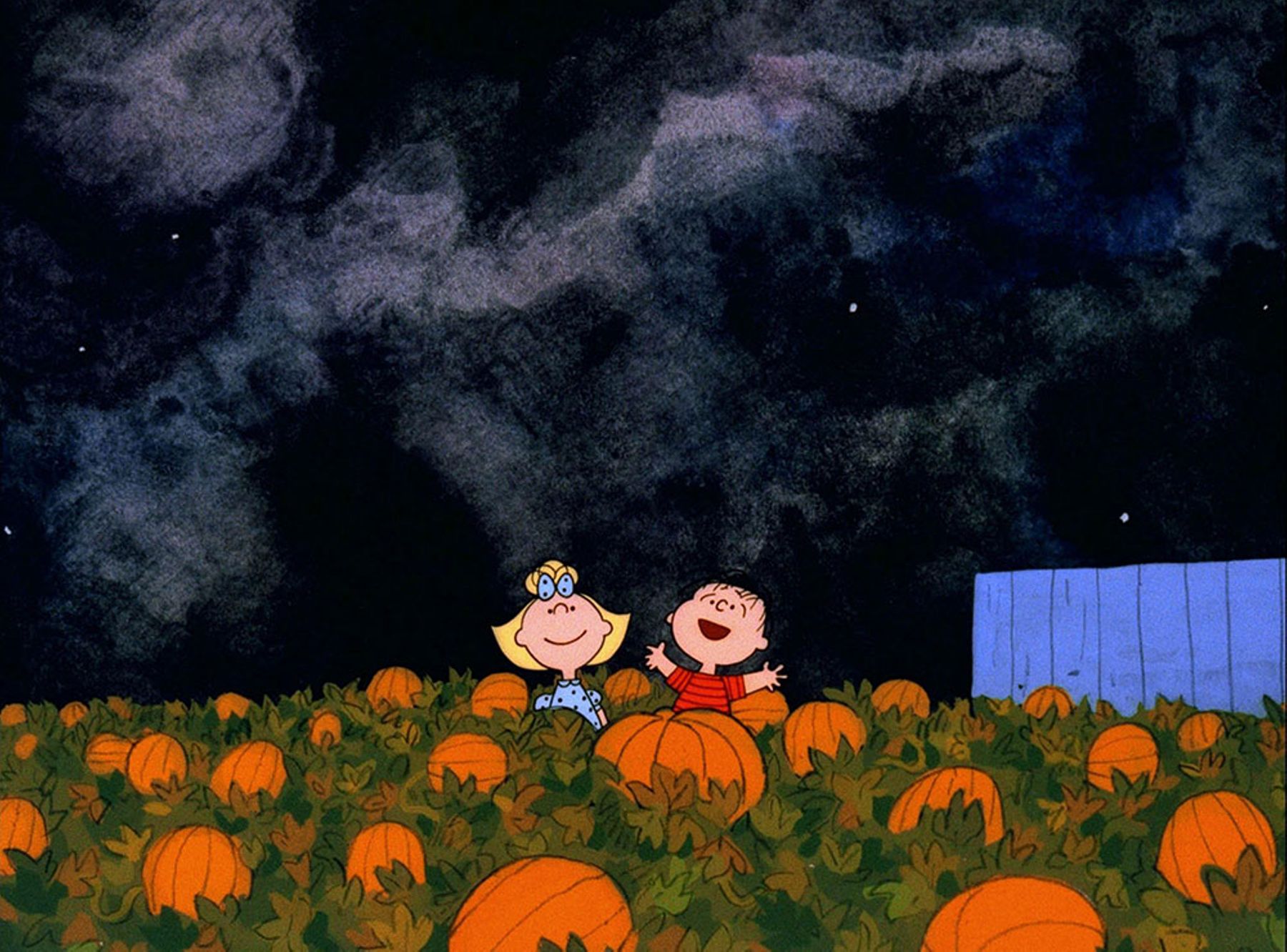
Like every Peanuts product, the Great Pumpkin reflects creator Charles Schulz’s boyish wonder and brooding melancholy. Linus expresses fervent belief in the “Great Pumpkin,” a being who visits “the most sincere” pumpkin patch every year. Linus, to a chorus of mockery, spends his Halloween at a local patch in hopes of seeing the figure with his own eyes.
The special opens with a portrait of autumn in an American suburb. Linus and sister Lucy step onto their back stairs to the anacrusis of Vince Guaraldi’s Peanuts theme. An orange sun sits low in the distance before a rose-colored sky, with an assortment of deep yellow-to-red leaves littering the ground. If you have ever been to New England or the Midwest in October, you have seen something like this, and when it comes on screen, you can almost smell it.
Linus and Lucy stroll through a maze of houses, none of which seems to have a driveway, to a nearby pumpkin patch. The sun, mostly hidden behind the homes, is shown again about to set, blood-red against a now-redder sky. Linus hoists pumpkins for Lucy’s review, but she rejects each one, finally approving the biggest one on the lot. He rolls it home himself, where Lucy sets down paper, plunges a kitchen knife, and removes the pumpkin’s insides.
“You didn’t tell me you were gonna kill it,” Linus cries.
Memorable scenes follow. Charlie Brown is interrupted while raking, first by Linus, who jumps into the growing pile of leaves, and then by Lucy, who purports to be holding a signed document attesting that she will, at long last, hold a football in place for Charlie to kick. Though he had speculated, in delightfully colorful language that would never be used today, that she wanted him to “land flat on my back and kill myself,” Charlie agrees to try the kick. Lucy, of course, yanks the ball away, and later tells Charlie Brown that the document was “never notarized.” (Schulz, on death’s door and holding back tears as he reflected on his final Peanuts strip, recalled lamenting that Charlie “never even got to hit the football. What a dirty trick.”)
We then jump indoors. One of the great Peanuts tunes, Guaraldi’s bittersweet “Great Pumpkin Waltz,” plays as Linus narrates a letter to the special’s eponymous pumpkin. Linus is visited by a rotating band of critics, who variously mock and interrogate his faith. He finds one admirer, Sally, whom he convinces to join him in a pumpkin patch on Halloween night in hopes of seeing the Great Pumpkin up close.
From there, the special builds speed. The other Peanuts characters go trick-or-treating in mostly matching ghost costumes. All get candy, money, or other treats, save Charlie Brown, who gets the three rocks. Charlie’s thrice-repeated lament, “I got a rock,” would enter the American cultural lexicon.
Snoopy, meantime, is dressed up as a fighter pilot. In an extended sequence, he recreates a World War I flying ace’s pursuit of the Red Baron, flying in goggles on top of a bullet-torn doghouse. He lands at a brilliantly painted recreation of the French countryside, ducking into a stream and then a hideaway. Lee Mendelson called the flight sequence, which could never have been made for children today, “one of the most memorable animated scenes ever.”
The special reaches its climax as Snoopy slides into the gang’s Halloween party, first bobbing for apples before listening to Schroeder’s piano mélange of World War I–era songs. After he leaves the party, Snoopy rustles through the pumpkin patch. Linus and Sally, waiting in the dead of night, are startled. Linus faints at the film’s climatic image, as a black silhouette emerges from the ground—Snoopy. Sally, dejected, storms away, and Linus sleeps much of the night in the cold.
As was so often true with Schulz, who insisted on having Linus read from the Gospel of Luke in A Charlie Brown Christmas, religious themes lurk just beneath the surface. As Rich Cohen observed, Linus repeatedly insists that the Great Pumpkin will visit his pumpkin patch because it is “sincere.” When Sally leaves in anger, Linus tells her he will put in a good word for her “if” the Great Pumpkin comes; he shudders at the words, fearing that his use of the conditional tense proves him a less-than-true believer.
The “sincerity” motif has prompted multiple interpretations. A Christian pastor, cited in an essay by Cohen, argued that Linus’s doomed hopes reveal that “sincerity is worthless if the object of faith is false.” Cohen responded that the special’s brand of sincerity can help order “an otherwise formless succession of days.” Schulz, for his part, agreed that the Great Pumpkin was “sacrilegious.”
From its first airing in 1966 across more than five decades, the Great Pumpkin was shown once or perhaps twice a year on broadcast television. Homes around the country gathered at the same time to watch the same special on the same network. Schulz’s story became interwoven with Halloween in America.
That effectively ended in 2020, when Apple TV bought the rights to the entire collection of Peanuts specials. After allowing PBS to run the shows for two years, the company took them off air, stashed them away, and—failing to understand the conditions that made the specials iconic—decided to make them free for a couple of days during their respective holiday seasons.
At the special’s inception, television was a source of common culture. In 1966, when the Great Pumpkin first aired, roughly 93 percent of American households had a television. By 2010, that number approached 99 percent. Until the rise of streaming services, almost every household with a television at least had basic cable. Many of today’s streaming packages still carry the major networks.
These networks, which air programs at specific times, created the conditions for specials like the Great Pumpkin to enter the American cultural bloodstream. A special shown once or twice a year in primetime on a major network commanded an audience. The specials’ cultural status was created, in part, by mass viewership; the viewer knew that other Americans were watching alongside him, which is one reason things like the CBS “Special Presentation” montage provoke nostalgia.
Apple’s free-streaming window seems superficially like the old cable arrangement, but it’s nothing of the sort and will only ensure the specials’ cultural irrelevance. When a headline broadcaster like CBS devotes a primetime slot to special programming, people watch, even in the fractured age of streaming. When Apple TV, which most Americans don’t have and don’t want, offers people the ability to “stream” a treasured classic, no one watches, because it is not a shared, 30-minute experience. It is no longer special.
Programs like the Great Pumpkin help transmit the meaning and cultural content of each holiday across time. They preserve the values of previous generations, and are presented identically, every year, even if some consider them outmoded or worse. They bring people to the screen to connect with artists who, in most cases, have long since died, but who created defining stories accessible to viewers young and old.
Ultimately, it seems, Linus himself had the appropriate level of pessimism.
“There are three things I’ve learned never to discuss with people,” he said. “Religion, politics, and the Great Pumpkin.”