
I spent nearly two decades in California’s labor movement, organizing nurses with the California Nurses Association; actors with the Screen Actors Guild; teachers with SEIU Local 99; city workers with SEIU Local 1021; and more. But by 2014, something had changed, and I left the movement.
Today, many California unions embrace “social justice unionism,” a form of labor politics focused on left-wing cultural priorities rather than workers’ interests. The ideology has captured much of the state’s labor movement, with unions aligning themselves with hard-left politicians who share their convictions.
Finally, a reason to check your email.
Sign up for our free newsletter today.
This dynamic is on full display in Oakland, where one of my former unions, SEIU Local 1021, is headquartered. The local boasts more than 60,000 members and purports to represent workers across Northern California. But instead of fighting exclusively for better working conditions, the union increasingly focuses on things like “reproductive rights, climate justice, immigrants, Black Lives and gender equality.”
SEIU Local 1021 has not been subtle about this shift. In 2021, union delegates voted overwhelmingly to pass a “racial justice plank,” which committed the local to fighting the “over-policing of Black and brown communities” and working to abolish “private, for-profit prisons and immigration detention centers” statewide. This framework became a core organizing priority, demonstrating the union’s commitment to identity politics.
As SEIU 1021 turned its attention to social justice, it also became intertwined with Oakland’s failed leaders. Starting in 2022, for example, the union boosted the campaign and administration of Sheng Thao, the since-recalled Oakland mayor now facing federal corruption charges.
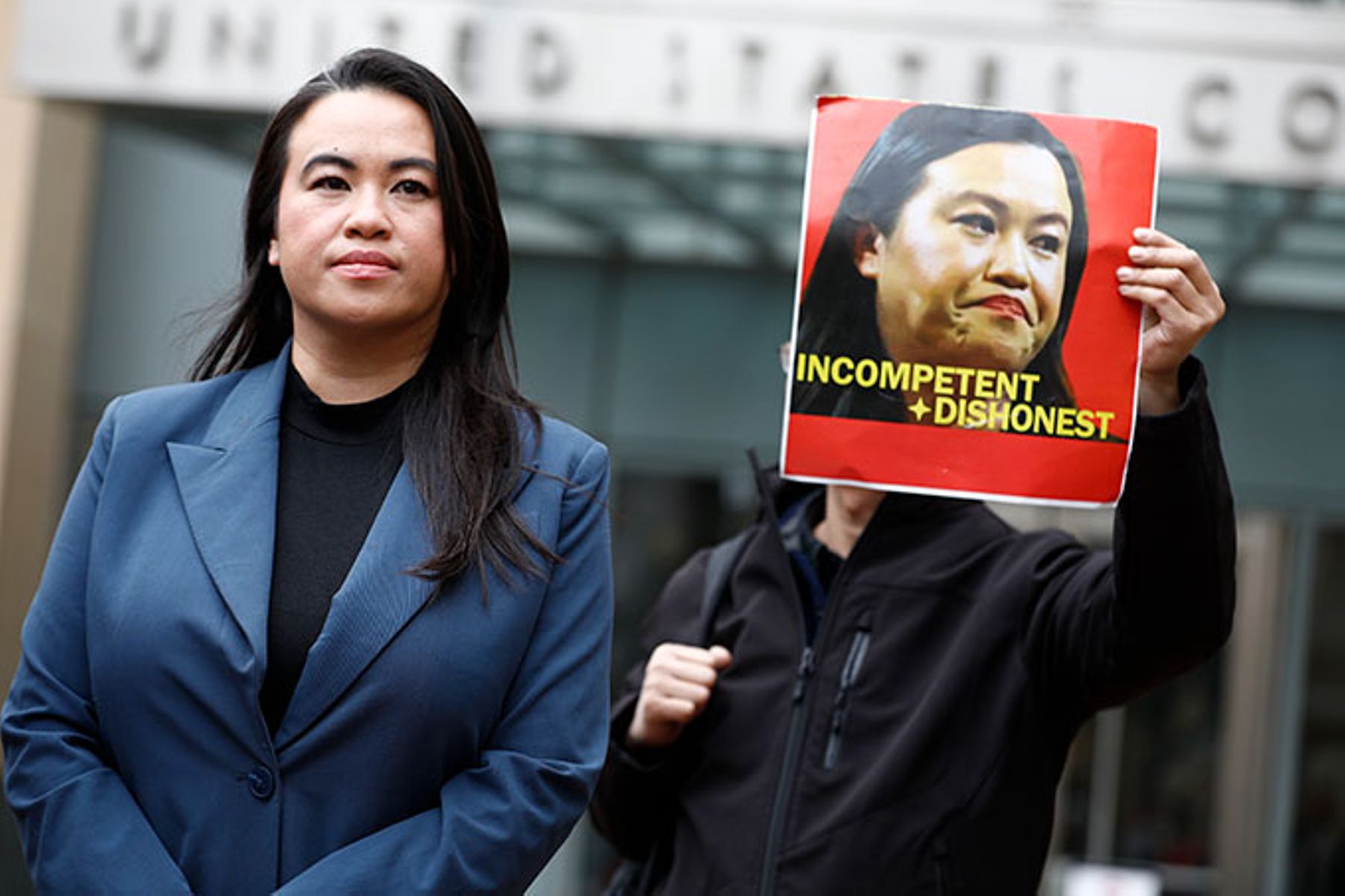
Thao was elected as Oakland’s mayor in 2022, after serving as a city councilmember. (I was one of her opponents.) Unions played a major role in her victory. SEIU Local 1021, for example, contributed $100,000 to “Working Families for a Better Oakland,” a union-dominated group that received over $550,000 for Thao’s campaign.
According to a lawsuit, Thao should never have been able to run. Plaintiffs claimed that Thao missed the filing deadline, and that the acting city clerk, Krystal Sams, tampered with Thao’s paperwork. Sams has served as a unit vice president for IFPTE Local 21, a union that donated to Working Families for a Better Oakland. The suit resulted in a settlement in which the city did not admit wrongdoing.
Under Thao’s leadership, Oakland experienced two of its worst years in recent memory. In 2023, burglaries, robberies, and motor-vehicle thefts rose 23 percent, 38 percent, and 44 percent, respectively, per an Oakland Police Department report. In 2024, In-N-Out closed its Oakland location, citing crime concerns—the first store closure in the company’s history. Later in 2024, 15 people were shot near Lake Merritt after a Juneteenth celebration, punctuating Thao’s chaotic tenure.
As a result of these failures, a group called Oakland United to Recall Sheng Thao launched a recall campaign in 2024. In June of that year, the campaign, which I led, had garnered enough signatures to get on that fall’s ballot. (Days after the campaign crossed the signature threshold, Thao’s home was raided by the FBI. She was later charged with bribery.)
Undeterred, SEIU 1021 gave the former mayor $50,000 to fight the recall—despite the FBI’s having already raided her home. Rank-and-file members were likely stunned by the union’s support for a mayor widely rejected by the very communities whom they claim to represent. In November, Thao was recalled, with some 60 percent of voters supporting her ouster.
Thao is just one of the hard-left politicians that SEIU 1021 has supported. The union also backed Oakland councilmember Carroll Fife, who ran for city council in 2020 with hopes of “eliminat[ing] racial disparities” and defunding the police. Per my earlier reporting, SEIU 1021 contributed $235,000 to her city council campaign.
Fife rose to national prominence through the “Moms 4 Housing” movement. In 2020, Fife and a group of activist mothers occupied a vacant home, reportedly “to protest house flipping.” Major outlets amplified their movement, including magazines like Vogue. The property the activists occupied was later transferred to a community land trust, which has partnered with an organization that supported Fife’s campaign.

Fife’s campaign illustrates the deep connections between the labor movement and California politicians. Her election bid was supported by ACCE Action, a “multi-racial, democratic, non-profit community organization” for which she previously served as director. ACCE, in turn, regularly partners with unions like SEIU and local labor councils—creating a parallel, activist-driven political infrastructure.
Social justice unionism is pushing Oakland to the brink of fiscal collapse. In 2015, activists founded the “No Coal in Oakland” movement, hoping to keep coal out of the city. The movement, backed by at least 17 labor unions, has secured support from many elected officials.
The campaign had just one problem: the city had already entered into a binding development agreement with Oakland Bulk and Oversized Terminal (OBOT), allowing coal to be shipped through the port. When the city reversed course and used its regulatory authority to block the project, it triggered years of litigation. Oakland eventually lost the lawsuit—a defeat that may prove especially costly.
An OBOT sublessee, Insight Terminal Solutions, filed claims seeking damages that could reach into the hundreds of millions—at a time when Oakland is already facing a structural budget deficit. Now, as the case moves toward resolution, the consequences of those union-backed loyalty pledges are materializing. The city could face at least $230 million in potential liability, with total exposure possibly exceeding $600 million—massive figures for a city already on the brink of bankruptcy.
Oakland workers are increasingly fed up with their leaders’ hard-left turn. According to my analysis, 503 of SEIU 1021’s 2,031 listed members are no longer paying dues. And as I reported earlier this year, former members are seeking to decertify SEIU 1021.
What’s happening in Oakland is happening across California. Internal documents cited by the California Policy Center show that in 2024, 26 percent of workers represented by SEIU Local 99 in the Los Angeles Unified School District have stopped paying union dues. Nearly 48 percent of the roughly 100,000 employees covered by SEIU Local 1000 have left or refused membership.
By prioritizing left-wing ideology over workers’ interests, California unions have left many rank-and-file members feeling alienated, disempowered, and frustrated with leadership that appears more focused on ideological campaigns than on workplace representation.
If California’s labor movement hopes to regain the trust of the working class, it must return to its original mission: representing workers. Until then, the state will continue to illustrate what happens when a movement built to balance power instead cozies up to it.