
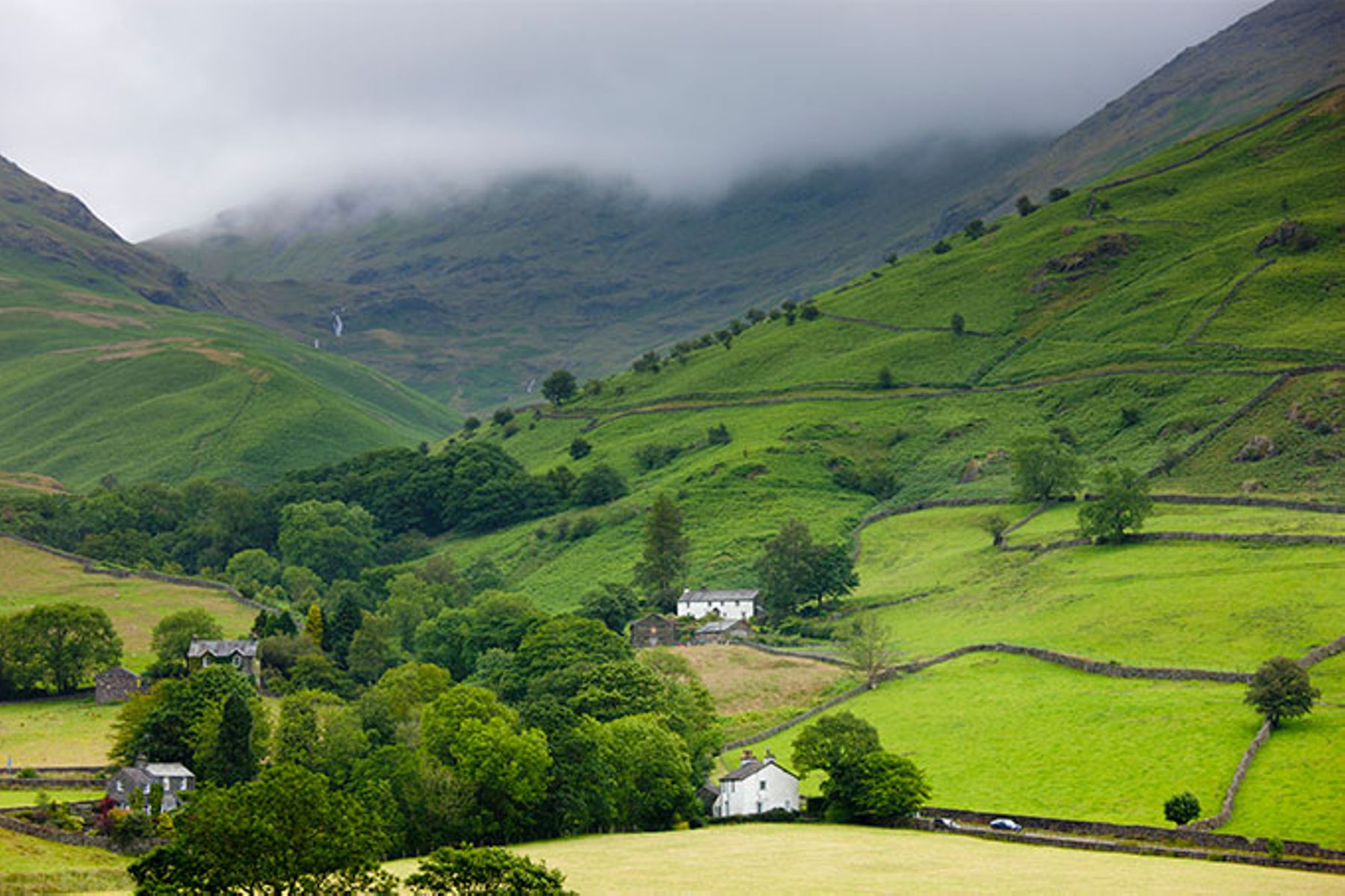
Picture the scene: gently rolling green hills, a babbling brook, sheep grazing in fields bounded by drystone walls. Perhaps a village sits in the distance, with honey-gold houses, church bells ringing, and, of course, a welcoming pub. The English countryside is celebrated worldwide—except, it seems, in England itself.
Where most people see a rural idyll, Britain’s bureaucrats spy a scandal. The countryside is a “white environment,” they complain. “White,” by their warped logic, means definitionally hostile to nonwhite people, which means racism, which is bad. So things must change. Last month, Britain’s Department for Environment, Food and Rural Affairs (DEFRA) set out proposals to make the countryside more attractive to minorities, reportedly complete with “diversity targets.”
Finally, a reason to check your email.
Sign up for our free newsletter today.
Bureaucrats and academics agree that rural areas must become effectively less English. DEFRA’s plans include outreach schemes to attract more Muslims to the countryside, recruiting more “diverse” staff, and producing marketing materials featuring ethnic minorities and written in “community languages.” British academics released a study on “rural racism,” suggesting that the countryside should offer more halal food and spaces for prayer (though presumably not in village churches).
The countryside is not the only target of this project. I’m lucky enough to live in Canterbury, a historic city built around a grand cathedral. For more than eight centuries, the cathedral has been a place of pilgrimage and worship. But recently, things have changed. The Cathedral has hosted “silent discos,” allowing revelers to “rave in the nave.” The aim is not just to generate revenue, but, according to the dean of Canterbury, “to engage with our wider communities, many of whom will never have set foot in a place of worship before, and to demonstrate that regardless of background or belief, they will find a warm welcome and a special experience here.”
Our cultural custodians have so little faith in England’s heritage that they assume the only way to interest people and attract visitors is fundamentally to alter it.
As if to prove this point, Canterbury Cathedral hosted an exhibition of graffiti art late last year, apparently to cultivate engagement with “marginalised communities.” Local groups were guided to ask questions of God that were, in turn, rendered into vibrant graffiti-style lettering and “expertly and sensitively affixed to the Cathedral’s stone pillars, walls and floors.” Pedants were quick to push back on critics, pointing out that the graffiti was just stickers. But why was graffiti of any kind, permanent or temporary, thought necessary in such a place? Do the leaders of the Church of England have so little confidence in the message of God, in the church’s magnificent architecture, or in the story of the murder of Thomas Becket to inspire visitors? Do they consider Britons so degraded that they can be won over only by the “relevance” or “edginess” of graffiti?
Just as with the desire to make the countryside more “diverse,” we see in such efforts complete disregard for the communities that use these spaces. So much for those who cherish a cathedral for worship, reflection, or, like me, to marvel at man’s creative potential. And, as with the report into the supposedly racist countryside, we see a desire to trash what is not just beautiful but quintessentially English.
In every aspect of our cultural life, the same nihilistic urge rules: anything that may produce a swell of pride for England or what the English have created must be exposed as outdated, irrelevant, and intolerant. It must be cheapened, defamed, and defiled until any remaining shred of pride is replaced by disgust.
This impulse doesn’t spare Shakespeare, either. Remarkably, a small, middle-England town of Stratford-upon-Avon produced a playwright of historic genius whose work has resonated with people around the world for more than four centuries. Attacks on Shakespeare are nothing new in academia, of course, but now the charity responsible for preserving the Bard’s legacy in his birthplace is “decolonis[ing]” its vast museum collection. Instead of encouraging people to marvel at timber-framed cottages, antique furniture, and ancient manuscripts, curators will point out “language or depictions that are racist, sexist, homophobic or otherwise harmful”—in other words, artifacts from an earlier era that doesn’t comply with today’s exacting (though always changing) standards for diversity, equity, and inclusion. Rather than revere Shakespeare’s legacy and inspire a new generation to fall in love with his plays, today’s cultural custodians flash danger signs warning people to keep their distance.
Shakespeare’s work is integral to English identity. His language shapes English-speakers’ conception of the world. Anyone who has been on a “wild goose chase” or got “in a pickle” or abandoned something complex because “it’s all Greek to me” is deploying his words, whether he knows it or not. But such is Shakespeare’s gift that though he, more than any other man, shaped what it means to be English, his work has universal value. He portrays emotions such as joy, grief, and anger, and experiences such as being young, falling in love, and growing old, that are not fixed to a time or place, or even to a nation or race, but to being human.
While the English don’t own Shakespeare, only late-sixteenth-century England provided the conditions for such a man to exist. English people can take pride in having given the world such a son. But according to the study with which his birthplace trust reportedly collaborated, seeing the Bard as a “unique” genius “benefits the ideology of white European supremacy.”
So Shakespeare’s life must be trashed and his work altered. The Royal Shakespeare Company now routinely adapts his plays by cutting scenes, transforming plays for political purposes, adding trigger warnings, and even changing the sex of characters to address issues such as racism, homophobia, toxic masculinity, gender stereotypes, and lack of consent.
Whether it’s the countryside, cathedrals, or Shakespeare, England’s educated classes are convinced that the original sin of racism not only taints everything English but also simmers beneath any unsuppressed expression of national pride. Redemption, they seem to believe, can come only through spoiling everything the English built in the past and continue to enjoy today. British elites have unleashed industrial-scale cultural vandalism within our museums, theaters, schools, and places of worship.
Everyday Britons, however, have grown tired of this assault on national heritage and identity. Last summer, as part of a viral campaign called “Raise the Colours,” citizens across the country began flying the Union Jack and the St. George’s cross flags. Unlike in America, where the stars and stripes routinely adorn public buildings, Britain has no great tradition of rallying around the national flag, except with punk rock irony or to cheer sporting success. While businesses and local authorities have rushed to display the rainbow pride flag in recent years, English people who flew the flag of St. George were branded “far right” and “divisive”; some local councils even removed the flags.
The Raise the Colours initiative shows that most Britons don’t detest their Englishness. Instead, it is the cultural elite—overeducated, self-loathing curators and gatekeepers—that is determined to destroy the nation’s heritage. The continuance of their program would spell nothing less than England’s cultural suicide.
Top Photo: Canterbury Cathedral (Photo by Krisztian Elek/SOPA Images/LightRocket via Getty Images)