
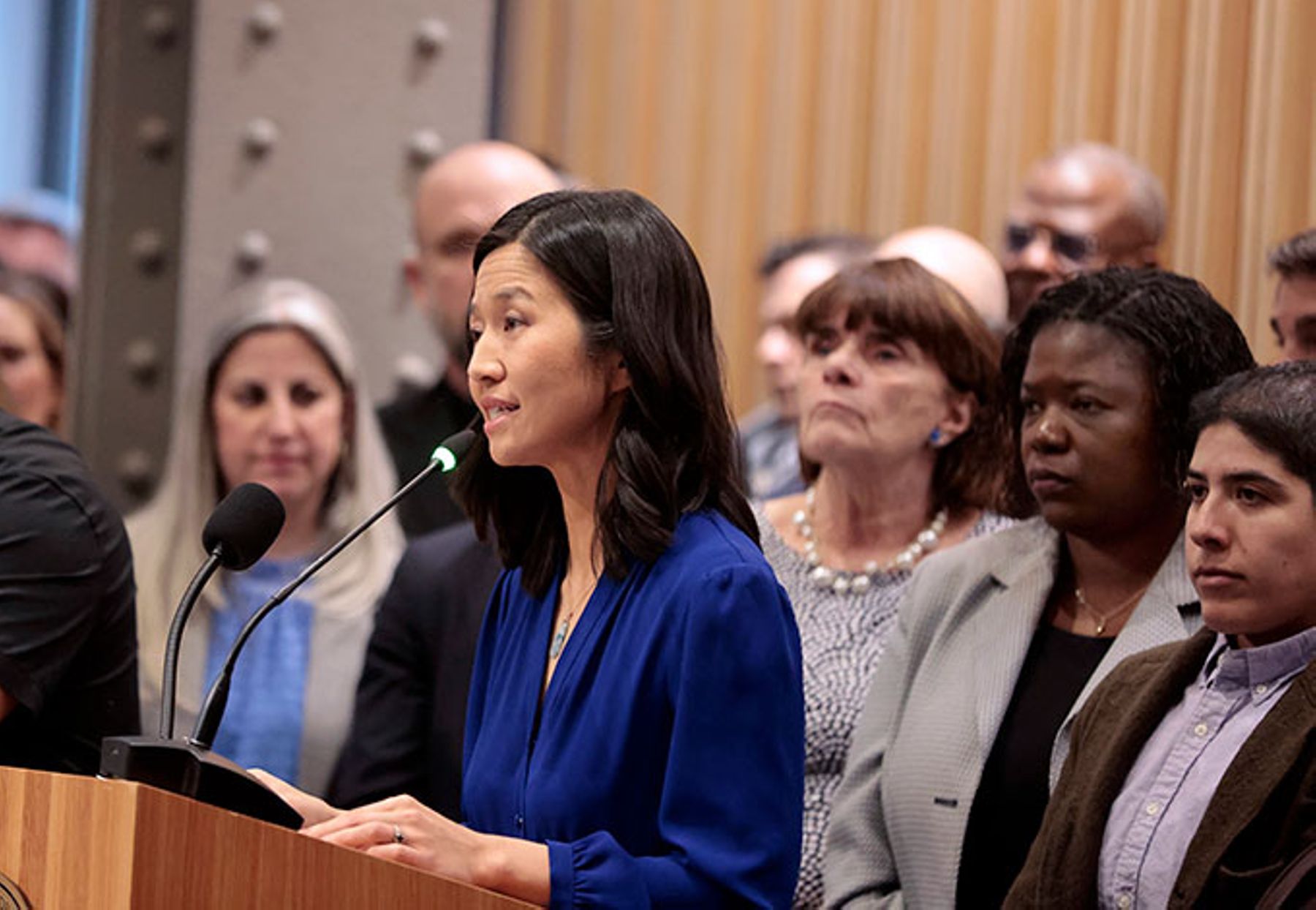
Earlier this week, Boston Mayor Michelle Wu endorsed a restrictive version of rent control that supporters are pushing for a November statewide ballot referendum in Massachusetts. “There is so much urgency and pressure from housing costs on our residents,” she said. “Something’s got to give.”
“Something” must indeed be done about the housing crisis in Boston and its metro area. But rent control is a bad solution, particularly as it’s being proposed. While apparently popular among voters, it is likely to worsen the housing shortage, not ameliorate it. Wu and allies should push to strengthen inadequate zoning-reform efforts instead.
Finally, a reason to check your email.
Sign up for our free newsletter today.
Massachusetts’s legislature prohibited rent control statewide in 1994. This year’s ballot proposal would undo that law, instead capping annual rent increases statewide at the lesser of 5 percent or the rate of price inflation. Owner-occupied small homes with up to four units would be exempt, as would new housing for the first decade of its existence.
Wu had earlier supported a less draconian proposal that failed in the legislature in 2023. That plan would have capped rent increases at inflation plus 6 percent, reaching a maximum of 10 percent. She has also advocated for a local option rather than statewide regulation. In an interview earlier this week, Wu expressed hope that the legislature would step in and pass a compromise measure, forestalling the statewide referendum.
The Boston area certainly has a housing affordability problem. The 2025 Greater Boston Housing Report Card from the Boston Foundation and others finds that the region is the fifth most-expensive rental market, trailing only New York, San Jose, San Francisco, and San Diego. The rental vacancy rate is extremely low, at just under 3 percent in 2024. Half of all renter households were “cost-burdened” in 2024, meaning that they paid more than 30 percent of income for housing; 26 percent were “severely cost-burdened,” paying more than 50 percent.
As the region’s population continues to grow, these conditions can be alleviated only by increasing the housing supply. Unfortunately, the “report card” finds that construction growth has slowed instead. New housing permits in the region averaged about 13,000 units annually in the 2010s, but they have fallen off in the current decade.
In Boston proper, Wu’s administration set a goal of 13,000 new housing units for the 2022–25 period. With a base of roughly 302,000 units in 2020, that represents an increase of a bit more than 1 percent a year—a reasonable goal for a moderately growing city, but the city’s own tracker indicates that it has undershot even this modest target, with only 11,804 units permitted over those four years.
It’s no wonder therefore that Massachusetts Governor Maura Healey has opposed the rent control measure, arguing that it will slow construction. That is indeed one likely effect of the measure, as real-estate developers would require a higher rate of return over a shorter time, to lock in their profits before rent controls kick in.
Another effect of the proposed rent controls would be to reduce rental vacancy rates even more. That was New York City’s experience when the state legislature sharply tightened rent stabilization in 2019.
In effect, Wu is promising to protect current tenants from shortage-driven rent increases, at the cost of driving away future residents, many of whom will be unable to find housing at rents they can afford. That’s bad for Boston and its metropolitan area. Both are dependent on colleges and universities with highly transient populations, as well as a growing tech sector that would be pushed to other metros with more plentiful housing.
Rather than turning to rent control—tried and proven to fail often enough that politicians should know better by now—Boston and its suburbs need to step up pro-housing production efforts. Wu’s own zoning-reform efforts have moved slowly. Neighboring Cambridge recently passed a reform that allows, in most of the city, new residential buildings up to four stories—six stories, if 20 percent of the units are income-restricted. The entire Boston region has also been implementing the 2021 MBTA Communities state law, which requires cities and towns with rail transit stations to allow moderate-density multifamily housing as-of-right in a “reasonably-sized” district. A January 2026 report finds 102 developments underway in MBTA communities, totaling just under 7,000 units. Many of these developments would not occur absent the state law, but in total they represent a tiny housing increment in a large metropolitan area.
New rent controls in the housing-constrained Boston region benefit existing renters while penalizing newcomers and the young and constraining future economic growth. Mayor Wu, Governor Healey, and the state legislature would be better off designing stronger pro-housing policies that overcome local resistance and allow more and denser housing to be built as-of-right, as occurred in Cambridge. If Boston instead goes the route that New York City has already taken, it can hardly expect a more favorable result.
Top Photo by David L. Ryan/The Boston Globe via Getty Images