
Being Thomas Jefferson: An Intimate History, by Andrew Burstein (Bloomsbury, 430 pp., $35)
When it comes to the idolizers and detractors of Thomas Jefferson, the historian Gordon Wood makes a trenchant point: “We Americans make a great mistake in idolizing . . . and making symbols of authentic historical figures, who cannot and should not be ripped out of their own time and place. By turning Jefferson into the kind of transcendent moral hero that no authentic historically situated human being could ever be, we leave ourselves demoralized by the time-bound weaknesses of this eighteenth-century slaveholder.” Wood’s fellow historian Joseph Ellis agreed: “In effect, the canonization of Jefferson as our preeminent political saint . . . virtually assured his eventual slide into the status of villain. . . . The core of the problem is not his inevitable flaws but our unrealistic expectations.”
Finally, a reason to check your email.
Sign up for our free newsletter today.
In Being Thomas Jefferson: An Intimate History, Andrew Burstein, former Professor of History at Louisiana State University, heeds the good advice of Wood and Ellis by avoiding hagiography and revisiting his vexed subject in his own historical context. His life of Jefferson, he says, “aims not to promote or dethrone, but to explain the talented Jefferson with the tools of the archive.” Burstein shows his mastery of the Jefferson archive on every page, but he also brings judicious psychological insight to the task. Archives, after all, do not interpret themselves, and it is the discriminating scholar and critic in Burstein that gives his book its unusual distinction.
Thomas Jefferson (1743–1826) was born at his father’s plantation in Albemarle County, Virginia. Peter Jefferson was a wealthy surveyor, and his wife, Jane, was of the aristocratic Randolph family. Thomas’s father died in 1757, when he was 14, and his mother died in 1776, when he was 33, just before the Declaration of Independence was published. Though Jefferson left no detailed account of these losses, it’s fair to surmise that his relationship with both parents was strong, inheriting as he did the grace and elegance of his mother and the numerological and literary interests of his father, who bequeathed him, as he said, “my books, my mathematical instruments, and my cherry-tree desk and bookcase.” Among them were several volumes of The Tatler and The Spectator, Addison and Steele being favorite authors of the colonists. If Jefferson grew up to take an interest in many different things—science, architecture, government, literature, music, and horticulture among them—he was always a confirmed bibliophile.
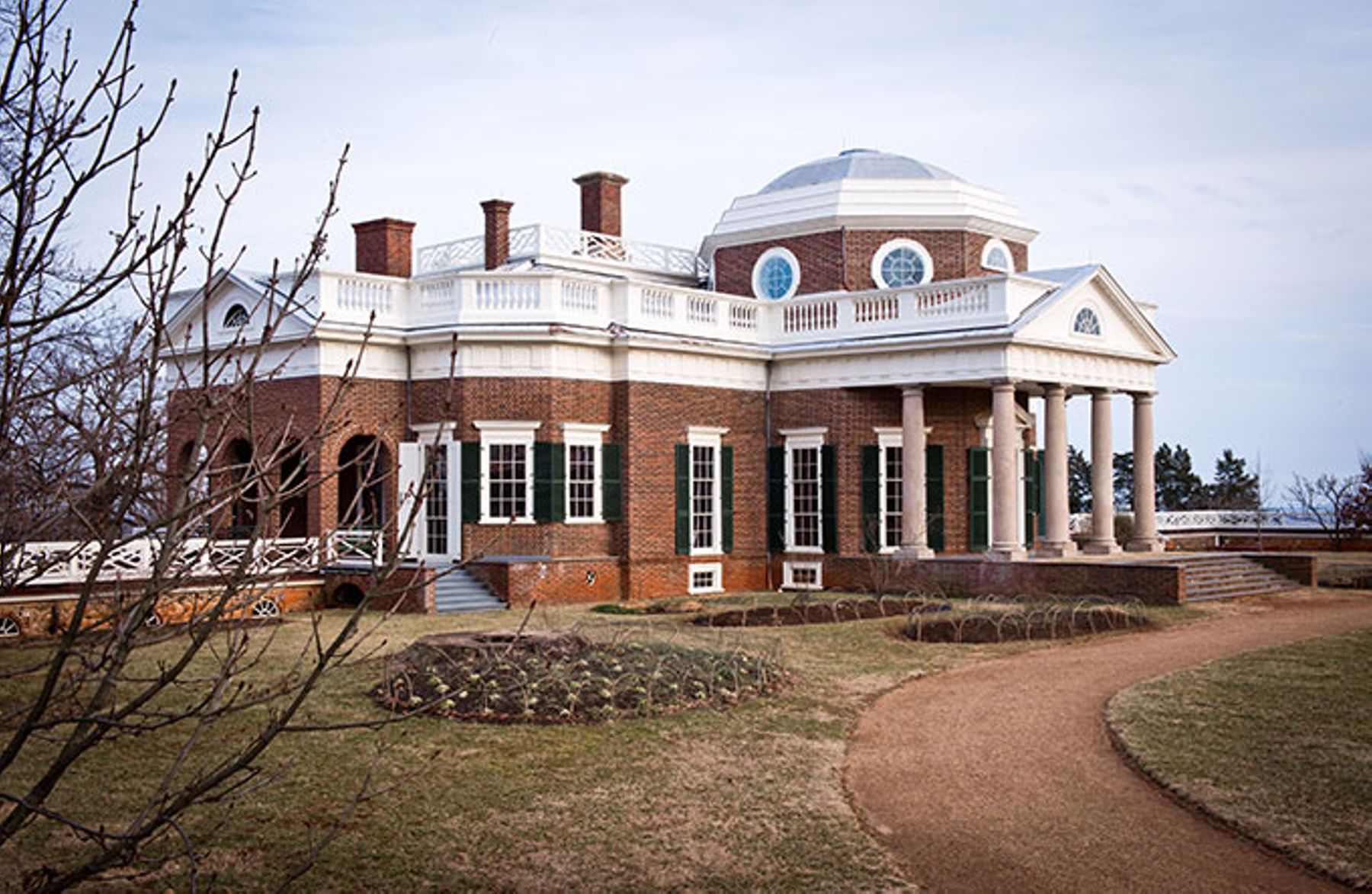
Jefferson’s accomplishments are many. In addition to writing the Declaration of Independence, he designed his own residence, Monticello, and founded, near the end of his life, the University of Virginia. He also had a distinguished diplomatic career, establishing protocols for U.S. foreign policy as Minister to France (1785–1789) and negotiating various treaties as our first Secretary of State (1790–1793). In addition, he authored the Virginia Statute for Religious Freedom and was twice elected governor during some of the hardest years of the War of American Independence (1775–1783). As the nation’s third president from 1801 to 1809, he presided over the Louisiana Purchase, the Lewis and Clark Expedition, and the Tripolitan War, which put a stop to Muslim pirates extorting tribute from American merchantmen along the Barbary Coast.
Jefferson was a leader of the Democratic-Republican Party, which championed an agrarian America of limited government with an emphasis on states’ rights, no central bank, and as little debt as possible—in opposition to the Federalists, who favored strong federal government, a central bank, a commercial and industrial economy, and high tariffs. The Federalists opposed the French Revolution; the Democratic-Republican Party supported it, with Jefferson declaring that “The liberty of the whole earth was depending on the issue of the contest, and rather that it should have failed, I would have seen half the earth desolated.” For William Short, Jefferson’s private secretary at the time, this sentiment could only be seen as an example of his friend’s “cold-bloodedness.” It was also proof of how avid he was to be seen as the savior of democratic republicanism, even if it required his excusing the murderous mayhem of France’s revolutionaries.
In addition to bequeathing his son his books, Peter Jefferson also left him, as he said, “my Mulatto fellow Tawny.” His father left him with 175 slaves, and Jefferson, over time, increased the number to approximately 607. One of the slaves was Sally Hemings. No historian has ever managed to ascertain the exact nature of the relationship between Jefferson and Hemings, and Burstein sensibly respects its mysteriousness, though he does remark on the poignancy of Hemings’s choosing to pass on Jefferson’s inkwell and spectacles to her son Madison. For Burstein, “The inkwell presumably symbolized the writing he did in the privacy of his bedchamber, and the spectacles sat upon the eyes that had looked upon her own face.” Still, there was something deeply providential about the Founder’s death. Thomas Jefferson, with all his sins on his head, and with all his contradictions unresolved, died, along with his old friend John Adams, on July 4, 1826, the 50th anniversary of the signing of the Declaration of Independence.
If we look at Jefferson’s Declaration of Independence and compare it with his musings on race in Notes on the State of Virigina, we can see a writer who has gone from the sublime to the ridiculous. It would be difficult to say whether there is more arrogance or stupidity in the pseudo-scientifical air with which he articulates his prejudices against the black race. “Their griefs are transient,” the callous would-be savant in Jefferson observes:
Those numberless afflictions, which render it doubtful whether heaven has given life to us in mercy or in wrath, are less felt, and sooner forgotten with them. In general, their existence appears to participate more of sensation than reflection. To this must be ascribed their disposition to sleep when abstracted from their diversions, and unemployed in labour. An animal whose body is at rest, and who does not reflect, must be disposed to sleep of course.
Apropos such crude views, Ellis says: “Lafayette believed in the most expansive understanding of the Jeffersonian promise. Jefferson himself did not,” precisely because he had convinced himself that “All Blacks, men and women, occupied a lower and inferior stratum of the human race.” Of course, with such prejudices, Jefferson could never have shared Lafayette’s bold proposals for abolition: he was too persuaded that emancipation could only be carried out through expatriation, which, as the historian Andrew O’Shaughnessy notes, “lent support to the institution’s continuance.” And yet, elsewhere in the Notes, we find Jefferson asking: “with what execration should the statesman be loaded, who permitted one half the citizens . . . to trample on the rights of the other?” Despite all his mad rationalizing, Jefferson knew slavery was wrong.
Burstein makes an astute point about Jefferson’s rhetoric when he says, apropos his First Inaugural Address, that Jefferson “would have his rhetorically uplifted Americans forget that their nation was marred by the enslavement of the dark-skinned and the forced removal of Indigenous tribes. He cast the youthful republic as a barely settled continent belonging, in effect, to the freethinking descendants of the Greek polis, the Roman republic, and the mighty Ossianic and Saxon sagas.” No wonder that some of his more down-to-earth fellow Founders questioned the practicality of his otherwise beguiling rhetoric. It could seem deliberately evasive. It could also seem deluded, which is rather different from being simply hypocritical. Jefferson might have recommended “party concord” to his countrymen, but he never seemed to realize how guilty he himself was of fomenting party discord. Nor did he seem to realize that recommending “benign religion” to his compatriots was at odds with the thoroughgoing contempt he showed for orthodox Christianity. Richard Price, the Unitarian divine whose celebration of the French Revolution inspired Edmund Burke’s excoriating Reflections on the French Revolution (1790), was one of the few ministers whom the anticlerical Jefferson could abide, precisely because Price shared the Founder’s Socinianism. In any case, there was never anything even remotely “benign” in Jefferson’s own religious views, for all his vaunted respect for religious freedom.
One can see the same inconsistency in Jefferson’s agrarianism that he displayed in his attitudes towards party and religion. Burstein asks whether it did not strike Jefferson that Southern planters sent their sons North for their education, and his answer is revelatory: “Of course, it did. He himself ordered leather-bound books from Philadelphia publishers, superior clocks and sets of Windsor chairs from Northern makers. He prized the productions of Northern cities without softening his critique of the urban economy.” Alexander Hamilton would surely have pounced on these inconsistencies. Yet an even more striking example of the man’s inconsistency can be seen in his falling in love after Martha’s death with a beautiful young married artist named Maria Cosway, who knew nothing of the household management in which his first wife excelled. What was more, she was Roman Catholic, which made any prolongation of their liaison impossible, though not before Jefferson wrote her his wonderful “head and heart” letter of October 1786, which showed that even this most fervent believer in the Enlightenment wearied of its heartless abstractions.
As for Jefferson’s attempts throughout his career to appear above the political fray—a Cincinnatus who left his beloved Monticello only reluctantly, whenever the needs of his countrymen beckoned—John Adams was memorably barbed. After Jefferson left his post as Secretary of State in 1793, when wrangling with Hamilton had become unbearable, Adams wrote his daughter. “Jefferson thinks he shall by this step get a reputation of a humble, modest, meek man, wholly without ambition or vanity. He may even have deceived himself into this belief. But if the prospect opens, the world will see . . . he is as ambitious as Oliver Cromwell though no soldier.” Abigail Adams was no less acerbic: “I am obliged to look upon him as a man whose mind is warped by prejudice . . . However wise and scientific as a philosopher, as a politician he is a child, and the dupe of party!”
The irony here is that Jefferson knew what he was about in breaking with Adams, since it was at this point that his presidential star rose. More and more, Jefferson was hailed as the “manly and energetic” author of the Declaration. As Burstein remarks: “The more Jefferson’s authorship was heralded, the more Federalists grumbled that it was a ‘weapon,’ a cheap election ploy. The partisan press went into overdrive, drawing the contrast between Jefferson as a ‘republican in manners,’ and Adams as a ‘monarchist.’” The “friend of the people” image that would help Jefferson win the presidency was taking shape. One of the revelations of Burstein’s book is what an effective partisan politician Jefferson was, though this was different from being a good judge of policy. The colossal folly of his 1807 Embargo Act, which devastated the young country’s shipping interests, is a case in point.
If there is one matter to which Burstein does not pay adequate attention, it is his subject’s prophetic insistence on the advisability of limited government. “I am for a government rigorously free and simple,” Jefferson wrote a correspondent in 1799, “applying all the possible savings of the public revenue to the discharge of the national debt; and not for the multiplication of officers & salaries merely to make partisans.” Certainly, he was shrewd about the tyrannical corruption to which such “multiplication of officers” could give rise, realizing, as he said, that “These rogues set out with stealing the people’s good opinion, and then steal from them the right of withdrawing it, by contriving laws and associations against the power of the people themselves.” If Jefferson could have seen the gargantuan extent to which our own administrative state has swelled, he would have marveled at the prescience of his strictures. John Adams, it is true, as late as 1821, wrote to his fellow Founder: “I think a free government is necessarily a complicated piece of machinery, the nice and exact adjustment of whose springs, wheels and weights are not yet well comprehended by the artists of the age and still less by the people.” But it was Jefferson who foresaw the grave trouble that would ensue if this “adjustment” were not made responsibly for the benefit, not of politicians, but of the people whose interests politicians are entrusted to serve.
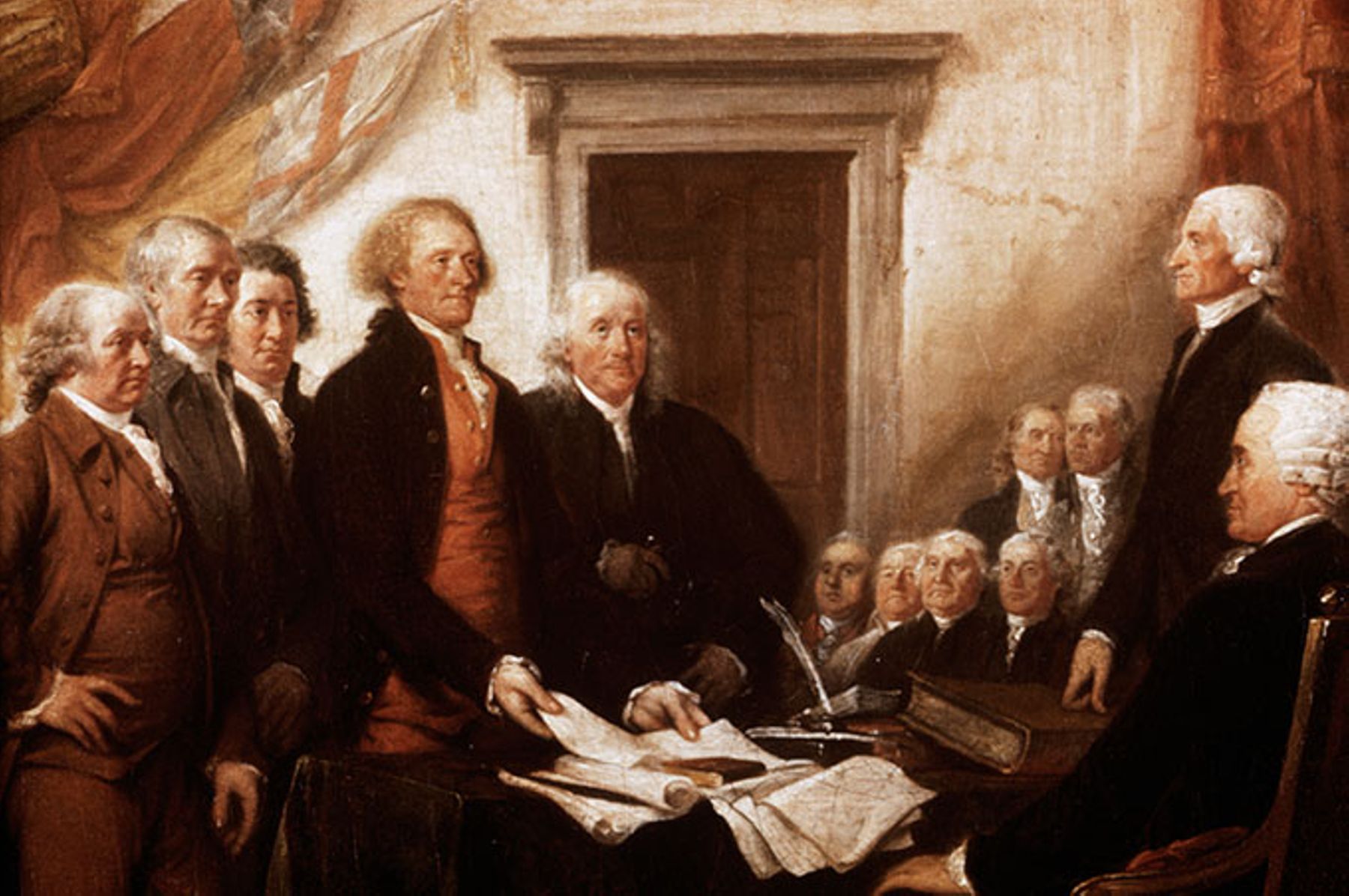
While Burstein does not solve the enigma of Jefferson, he does return us to foundational problems inherent in that enigma, which certainly did not escape Gordon Wood. “Jefferson has come in for some very brutal and often deserved bashing by historians over the past half century,” Wood wrote in The Idea of America: Reflections on the Birth of the United States (2011). “Although he has traditionally been seen as America’s premier spokesman for democracy, he was an aristocratic slaveholder, and the irony of that conjunction has been too much for many historians to bear, especially as historians have made slavery the central fact in the founding of the nation. Jefferson seems to be the ultimate hypocrite.” That historians have made slavery “the central fact” of the Founding may be true, but it was Jefferson himself who unavoidably placed slavery front and center when he wrote the splendid words: “We hold these truths to be sacred and undeniable that all men are created equal,” later revised by Benjamin Franklin to read “We hold these truths to be self-evident” to give the text a more rationalist, nonreligious ring. Regardless of the exact phrasing, the famed sentence ensured that the slave-owning Jefferson would never be spared the charge of hypocrisy.
Describing the bitter backbiting that went on between Jefferson and his political rivals Hamilton and Burr, Burstein writes: “The irregularities and intrigues that punctuate this era in American politics are stunning. Rumormongering, physical threats, sensational duels, newspaper wars, sedition trials, slavery debates, and sexual slurs marked an erratic public discourse. Financial insolvency and persistent health problems rocked private worlds and bled into the postures and positions taken by public men.” In light of such inescapably human factors, for Jefferson and Thomas Paine to place their “faith in the educability and rationality of ordinary people,” despite their own penchant for condemning their political enemies in the most vituperative terms imaginable, was, to say the least, “surprising.” As Burstein observes, a politics rooted in a belief “in the essential goodness of citizens” was “unsustainable in a hyper partisan environment.” It is unsustainable in any human environment.
On this score, Jefferson’s Federalist enemies, who saw good government as a means of forestalling the passions and corruption of men with a system of checks and balances, always had the more realistic view. Indeed, no one better exemplified humanity’s inalienable moral frailty than Jefferson himself, about which Burstein is clearsighted. Jefferson, he says, “wrote eloquently . . . [of] the dehumanizing effect of slavery, but he willed freedom to his enslaved flesh and blood while leaving many other individuals to suffer terribly. . . . Because he died over $100,000 in debt (several million in today’s dollars), the majority of those he kept in bondage were sold along with Monticello, a good many separated from the people and places they’d long known. It went beyond poor planning.”
For Lawrence Goldman, editor of The Federalist Papers, “in the world sketched out by Madison, Hamilton and Jay, men might be vicious, but if they respected constitutional arrangements and proprieties, the community would remain safe and still prosper.” The world sketched out by Thomas Jefferson might, in one sense, have led to the Civil War, but it also led to the winning of that war by the patriot in Abraham Lincoln who realized, as early as 1859, that, as he said, “it is now no child’s play to save the principles of Jefferson from total overthrow in this nation.” In preparing to celebrate America’s 250th birthday, we, too, should reconsecrate ourselves to Jefferson’s best principles—certainly with respect to equality and his advocacy of limited government, of which Ronald Reagan was so justly fond. For help in doing so, we can read Andrew Burstein’s lively and incisive book.
Top Photo: Bettmann / Contributor / Bettmann via Getty Images