
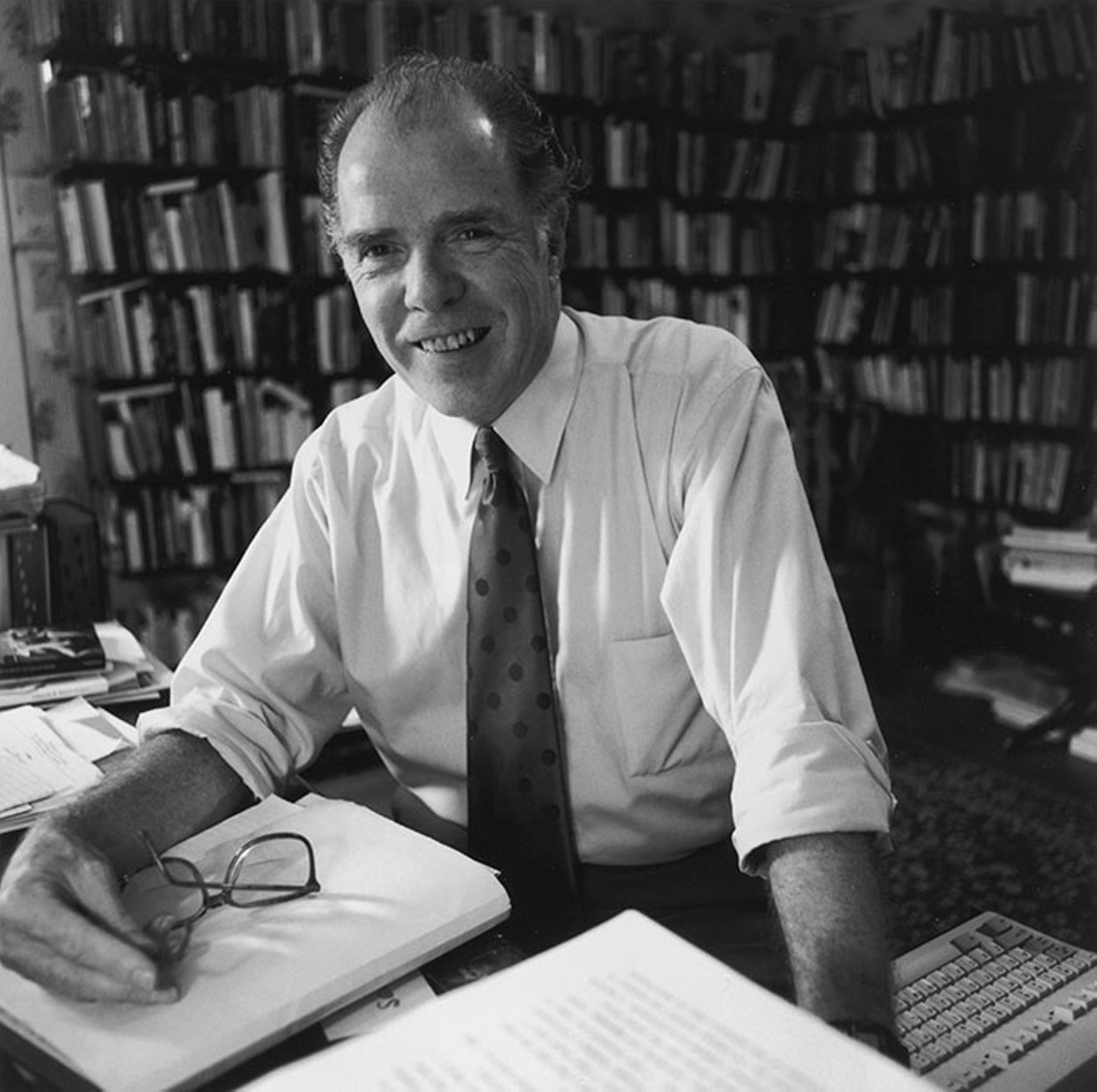
William Kennedy suffered first the indignity of nonpublication, then the commercial reproach of poor sales before, in his mid-fifties, becoming one of the most admired novelists in America with the publication of Ironweed, which won the 1984 Pulitzer Prize for Fiction. When success came, he was confident enough to enjoy it. He bought a Jaguar, made some celebrity friends, gave lots of interviews. But he never left Albany, New York, the setting of nine of his novels, for very long. Nor could fame keep him away from his writing desk. A journalist for many years at the San Juan Star and the Albany Times-Union before committing fully to fiction, he was fitted to a Smith-Corona like a jockey to his thoroughbred. All that was missing were the shirt garters and the fedora.
Born in 1928, Kennedy grew up in a working-class home in Irish-American North Albany. His father was a police officer who brought his son to gambling halls, giving him an early lesson in how to work both sides of the street. An omnivorous, self-directed reader even as a boy, Kennedy got his early exposure from newspapers, comic strips, and boys’ weeklies rather than great books, but he quickly graduated to the canonical, including those panoramic Victorians, Dickens and George Eliot. He later spoke of checking 35 books at a time out of the Albany Public Library as part of a course of passionate self-education. He belongs to a deep culture of print that is rapidly disappearing.
Finally, a reason to check your email.
Sign up for our free newsletter today.
After graduating from Siena College, he pursued journalism and was nominated for a Pulitzer for an investigative series on slum housing that he did for the Times-Union. But his fiction confounds our sense of how an ex-newspaperman should write. His novel copy would have been red-penciled to death by any city desk editor as prolix, excessive, and tending to mystification. Kennedy recognized the hazards of journalism for the would-be imaginative writer; he has said it took him years to overcome the fallacy that one need only absorb experience and then “get it all down.”
Kennedy’s fictional Albany is intensely social, a world of speakeasies and political clubs and poolrooms. His characters are chancers, aiming always to be legendary, to do things with style even in defeat. The moment of becoming is what interests him. In the opening scene of Billy Phelan’s Greatest Game (1978), a young hustler, a gifted amateur, is on the verge of bowling a perfect 300 game. Here is how Kennedy describes him as he reaches some kind of apotheosis in front of a few dozen jaded spectators in a bowling alley in a third-tier American city: “[S]ome men moved through the daily sludge of their lives and then, with a stroke, cut away the sludge and transformed themselves. Yet what they became was not the result of a sudden act, but the culmination of all they had ever done: a triumph for self-development, the end of something general, the beginning of something specific.”
Kennedy has admitted to a gregarious nature and some pleasure in showing off. A writer is often something of a chancer himself.
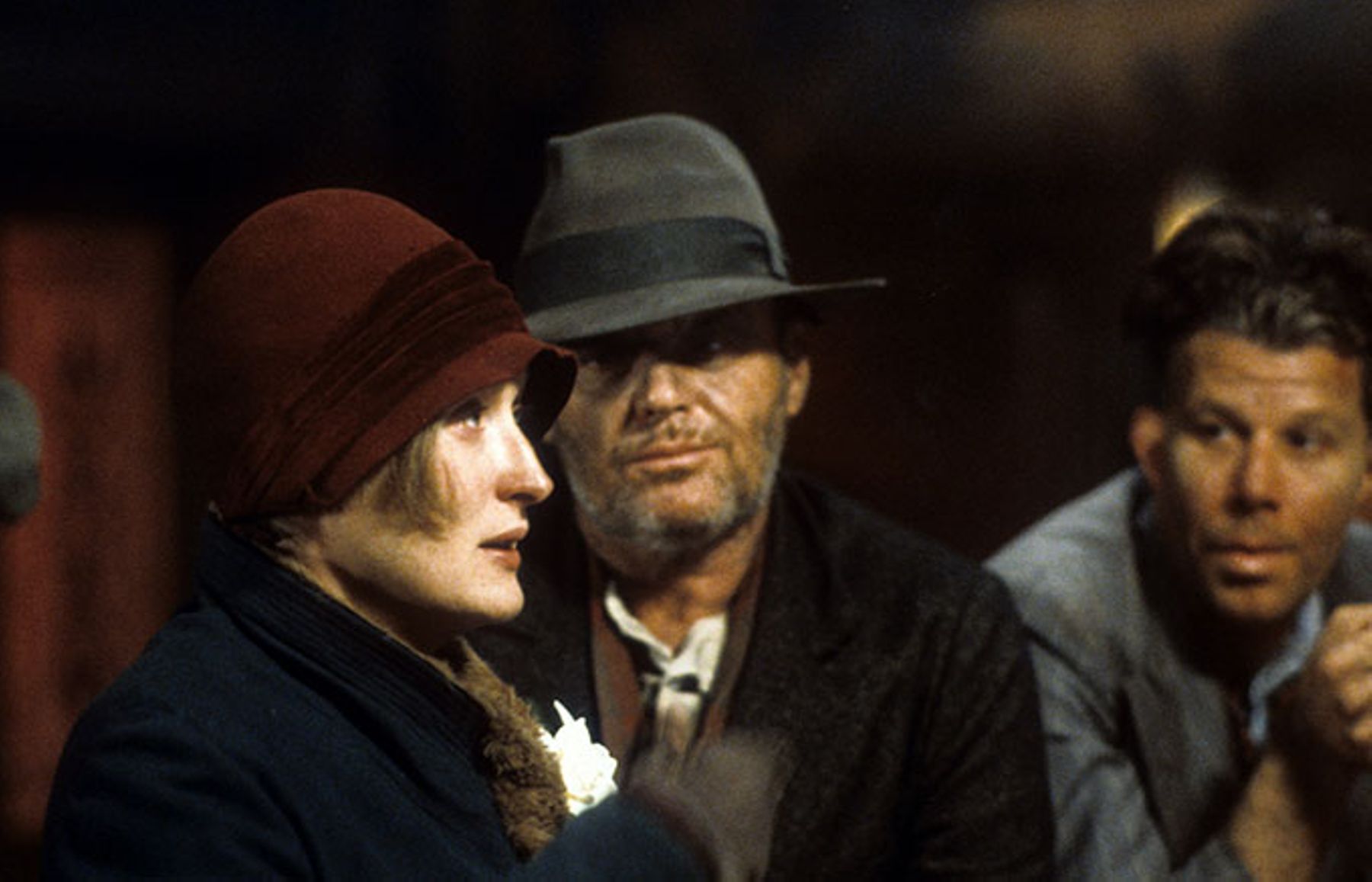
He was nearly 50 before he established himself as a novelist, but he had a plan: a cycle of novels set in Albany that would constitute a social history of a small and provincial city that, for him, contained the whole world. In 1976, he wrote in his “Statement of Plans” for the Albany Cycle, “I feel certain . . . that there will be a unity of meaning about the life of my own time in the diverse finished products, if I have the strength and the imaginative resources to indeed carry through to the finish what I now consider the raw material for a life’s work.” His first two Albany novels, Legs (1975) and Billy Phelan’s Greatest Game (1978), were politely reviewed but sold poorly. His third, Ironweed (1983), struggled to find a publisher until his friend Saul Bellow intervened and changed the course of Kennedy’s life. Bellow convinced Viking Press to publish the novel, whose quality was obvious. Ironweed won the Pulitzer, brought Kennedy a MacArthur “genius” award, and was made into a big-budget film starring Jack Nicholson and Meryl Streep. Oliver Twist himself was no more fortunate.
Most of Ironweed’s major characters are homeless alcoholics—“on the bum,” as Kennedy’s attenuated hero, Francis Phelan, puts it. Kennedy rejects the naturalistic treatment that such subjects have traditionally received in American fiction. “I was too interested in the dream element in life, the surreal,” he has said. In depicting all levels of Albany society, from politicians, bootleggers, and theatrical performers down to the working class and petty criminals, Kennedy assumes that human motives are the same everywhere even if the mathematics of advantage are different.
Kennedy calls his nine Albany novels a cycle because they don’t proceed chronologically and, while their characters and themes overlap, their relation is more oblique than might be implied by the more familiar concept of a “series.” Characters reappear, evoke their predecessors, drink in the same bars and political clubs. In favoring recurrence over linearity as an organizing principle, Kennedy was after more elusive metaphysical quarry. The closest American analogue to the Albany Cycle, in the scale of its ambition and rootedness in small-city life, might be August Wilson’s Pittsburgh Cycle of plays which, as Wilson projected—he did not live to complete it—would have included one play set in each decade of the twentieth century within the black neighborhoods of that city. Wilson’s and Kennedy’s demotic lyricism and their belief in their personal material unite them across barriers of race and genre. Wilson’s mostly male characters, like Kennedy’s, are always telling us exactly who they are, especially when they are trying to deceive. They are small men who believe themselves, against the weight of the evidence, to be big men.
Kennedy paints in dark tones, but he sees the humor in us, too. Even the bums of Ironweed are funny. Francis Phelan’s sidekick, Rudy, is a perfect engine of comic bafflement, malapropism, and indignation. Francis doubts Rudy’s claim to be Native American through his mother.
“You’re a liar. Your old lady was a Mex, that’s why you got them high cheekbones. Indian I don’t buy.”
“She come off the reservation in Skokie, Illinois, went down to Chicago, and got a job sellin’ peanuts at Wrigley Field.”
“They ain’t got any Indians in Illinois. I never seen one damned Indian all the time I was out there.”
“They keep to themselves,” Rudy said.
One hears echoes of John O’Hara and Elmore Leonard in Kennedy’s attunement to the differences in written and spoken language. Like Leonard, Kennedy got a lot of work as a screenwriter after he became famous, including on Francis Ford Coppola’s grandiose The Cotton Club (1984). He also wrote the script for Hector Babenco’s too-faithful adaptation of Ironweed (1987), which Kennedy admired more than the critics did. He made some money from Hollywood, which made his life easier. In the end, though, the committee work of film creation did not suit him. Like his most vivid characters, he would be his own man or nothing at all.
Since there is nothing new under the sun, writers who wish to astonish us with style must smash existing elements together at high speed. Kennedy’s style is an unlikely combination of the wised-up newspaper columnists of print media’s golden age (he cited Damon Runyon as an early model) with the antic and erudite high modernism of Joyce and Bellow. Joyce is the obvious antecedent, in his Irishness and his small-city obsession; as Kennedy puts it, both he and Joyce were “[people] whose imagination has become fused with a single place, and in that place [find] all the elements that a man ever needs for the life of the soul.” But Bellow is probably the decisive influence, the key that turned the lock. When Kennedy writes of the “gravy vested” men of the Albany saloons, one hears Bellow. Kennedy has Bellow’s love of urbanity and of wise guys, his deep interest in human character, and something of his joyous, swingy prose style. Both are connoisseurs of the irrepressible.
Kennedy resists being labeled an Irish-American novelist (“I’m an American writer who happens to be Irish”) for the same reason others have resisted being Jewish novelists or Southern novelists—because such labels are limiting. (He is properly vigilant in distinguishing between his being Irish-American, which he is to the tips of his brogues, and any connection with the Republic of Ireland, about which he claims to know very little.) He has always said that his proper subject is human nature—what finds us selfish and sinful, petty and mean, and occasionally redeemed by moments of grace. It is not hard to find the Baltimore Catechism hovering in the wings of his dramas, though Kennedy, who was raised Catholic, has not remained observant. It seems fair to say that he came to see the Church as a human institution like any other, which is to say at least partly a racket.
The greatest racket of them all was Daniel P. O’Connell’s Democratic political machine, which dominated Albany for 62 years, the longest-running such organization in the United States. Kennedy is its great historian in fiction. The O’Connell bargain will be familiar to anyone who has lived inside such a system: patronage jobs, communal belonging, and a free turkey on Thanksgiving in return for absolute loyalty. It was always a doubtful bargain, but for Kennedy the O’Connell machine evokes nostalgia and wry comedy, perhaps inevitably given that it was the matrix of his happy childhood. His quixotic history, O Albany (1983), braids his childhood memories with those of the bosses, flunkies, and scoundrels of the Democratic clubs. Despite its Catholic DNA, the machine tolerated the vices of Albany’s Nighttown, because it profited from them. These vices, too, became one of Kennedy’s great subjects.
As Kennedy scholar Benedict Giamo has written, the Albany novels are defined by the characters’ “struggle between freedom and determinism.” They are embedded in the communal life of the city, their fates largely determined by the forces of politics, economic hardship, and dumb luck. Kennedy’s men suffer the psychic constraints of living within a narrow social order. As he has said, “[My characters] all . . . fight against themselves . . . against tides that are very strong against them, against wars in their own minds and in their own societies.” And yet some saving dignity is always granted them, even the criminals, the half-wits, and the drunks.
From a belated beginning, Kennedy has produced a large body of novels, plays, screenplays, and history. His claim to an enduring reputation, however, almost certainly rests on the first three novels of the Albany Cycle (Legs, Billy Phelan’s Greatest Game, and Ironweed) which were published together in 1996 as the “Albany Trio.” These are the suns around which the rest of his works orbit; they contain the core of his worldview, the nexus of his concerns, the apogee of his style. The opening scene of Ironweed, in which Francis Phelan visits the grave of his son, Gerald, who died an infant when he slipped from Francis’s grasp, contains all the pathos that Kennedy could enjoin.
Twenty years gone, and Francis could now, in panoramic memory, see, feel, and hear every detail of the day [Gerald died], from the time he left the carbarns after work, to his talk about baseball with Bunt Dunn in King Brady’s saloon, and even to the walk home with Cap Lawlor, who said that Brady’s beer was getting a heavy taste to it and Brady ought to clean his pipes . . . now memory was vivid as eyesight.
Now 98, Kennedy has outlived the peak of his fame by several decades. Most novelists suffer posthumous decline, and the novel itself is an object of diminishing cultural interest. Even so, I’m betting that at least the best of Kennedy will remain in print. As a social historian of small-city American life, he is virtually unmatched; as a prose stylist, he rewards strong reading; and as a human soul in search of other souls, he exhorts us to do likewise. If, as a result of some epochal shift to the digital, we forget how to read a novelist as good as William Kennedy, the failure and the loss will be ours to bear.