
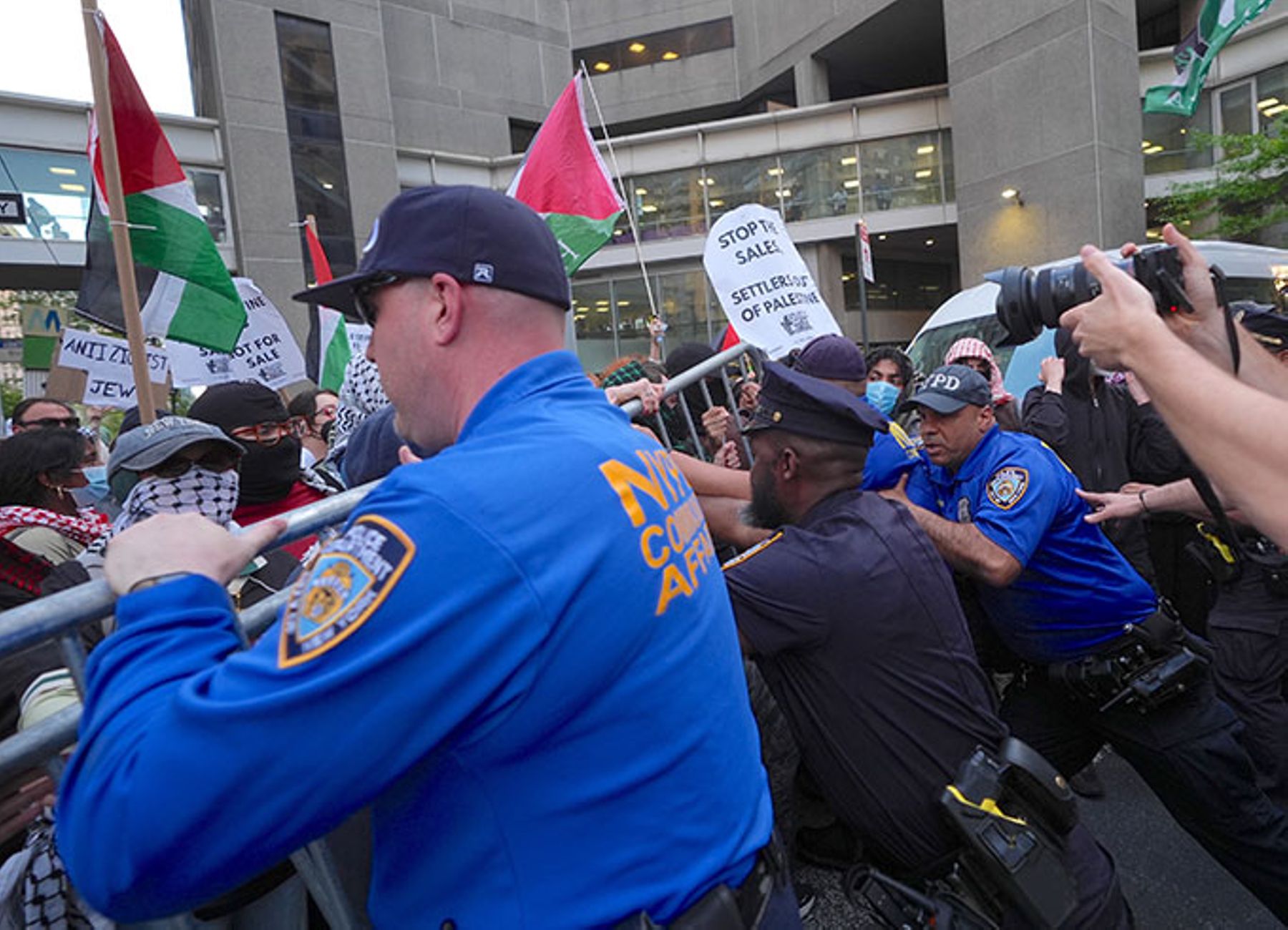
On May 11, masked hooligans surrounded a synagogue in Brooklyn, shoved congregants, and blocked them from entering. Just a few days before, keffiyeh-clad thugs rushed police barricades protecting a Manhattan synagogue. In April, a similar crowd harassed Jewish diners sitting at sidewalk tables. Ever since October 7, 2023, in fact, cities, towns, and campuses across America have been periodically overrun by such hoodlums.
Despite many of these acts being caught on video, few perpetrators have been forced to face the consequences of their actions—because their faces were covered.
Finally, a reason to check your email.
Sign up for our free newsletter today.
There is a solution: anti-masking laws. For over a century, states across the country barred face-covering during mass gatherings to combat the Ku Klux Klan’s harassment and intimidation campaigns. These laws worked, making public exposure the price of participation in Klan rallies. Similar laws could work today.
Indeed, many such laws were in force until relatively recently. During the Covid-19 pandemic, state anti-masking laws (including New York’s) were repealed—a short-sighted outgrowth of pandemic-era norms, the 2020 Black Lives Matter protests, and a naïve sense that anti-masking laws were an unnecessary relic of a bygone era.
How wrong we were. Pro-Hamas protesters have borrowed from the KKK’s playbook when it comes to intimidation. They hide behind masks to harass people they hate and interfere with the free exercise of fundamental constitutional rights.
These face-covering mobs are not made up of germaphobes. Their identity concealment is a tactic designed to intimidate and to avoid accountability—and is often encouraged by organizers. Masked protesters create an environment of fear, echoing and glorifying the atrocities committed by terrorists in keffiyehs on October 7, 2023, and across prior decades. Many of these people, when not freed from the bounds of decency by a face covering, are considered respectable members of society.
We still have an anti-KKK law on the federal books, signed into law in 1871 by President Ulysses S. Grant. The so-called Ku Klux Klan Act makes it a crime for “two or more persons” to “go in disguise on the highway, or on the premises of another” with the intention of preventing or hindering the free enjoyment of any federal right. Pro-Hamas demonstrators fit squarely within that definition and could thus be held criminally liable.
Under the KKK Act, victims can also bring a civil suit for damages. Liability extends to any person who, knowing wrongs “are about to be committed, and having power to prevent or aid in preventing the commission of the same, neglects or refuses to do so.” Thus, organizers of Jew-harassing rallies can be held liable as well.
These laws helped dismantle the KKK. Federal authorities should dust them off and enforce them against participants in these modern-day anti-Semitic intimidation campaigns, as well as against the groups that organize and bankroll them.
Local police are also generally empowered to make arrests for violations of federal law. And they should, breaking up masked rallies and demanding that participants identify themselves. If people know they’re likely to be exposed, participation in hate marches will plummet.
But that is not enough. The KKK Act has been ineffectively deployed against pro-Hamas mobs because, more than 150 years after its passage, it needs to be modernized.
A few suggestions: to cover the kinds of disguises used nowadays, Congress should clarify that “go in disguise” includes any face-covering or obstruction of identity. Congress should also clarify that “on the highway” includes any public streets or other public spaces. Congress should empower victims to sue even without physical injury or financial loss, as well as adding a civil penalty of $10,000 for each violation. Finally, law enforcement officers should be empowered to hand out citations to any person who hides his identity while participating in rights-impeding gathering. In this way, the KKK Act could serve as a targeted national anti-masking law covering mobs that seek to deprive others of their rights and freedoms.
With these updates, and a renewed focus on enforcement, Congress can transform the KKK Act from a forgotten law into a powerful tool fulfilling its original purpose: to protect the constitutional rights of all citizens from hooded mobs.