
When we celebrate the American Revolution, what do we think of? We likely recall the resounding words of Thomas Jefferson, explaining to the world our reasons for separating from our mother country, words that not only declared that we had come of age as a distinct “people” but also laid down certain truths—that all men are created equal, and enter into the world possessing rights that no government can deprive them of—that would guide and inspire this people in the years ahead.
But the Revolution was not just a matter of words but of deeds. It was deeply impressive for the Revolution’s leaders to sign their names to a document that pledged their “lives, fortunes, and sacred honor” to the cause. That pledge carried real weight, since they knew they would surely pay the ultimate price if their cause failed.
Finally, a reason to check your email.
Sign up for our free newsletter today.
It was quite another matter, though, to believe that the ragtag colonial forces could prevail against the greatest military power in the world—a result that even the most powerful words could not effect by themselves. The poet Robert Frost put it well: “Such as we were we gave ourselves outright,” he declared. We became ourselves by means of the uncoerced act of declaring ourselves. But then he added this important stipulation: “The deed of gift was many deeds of war.” Not just visionary words.
The Americans went into the struggle with huge disadvantages. Though the war had already begun in April 1775, with the clashes at Lexington and Concord, the country was not fully united behind the revolutionary cause, and there was no guarantee that a unity declared in the summer of 1776 would survive a hard and punishing conflict with a formidable foe. The Americans could field only the most rudimentary, ill-trained, and poorly supplied army. They had no navy to speak of. They had little money, and no obvious way of raising funds to build and support these essential military components. The deck seemed stacked against them.
On the very day that independence was voted on by the Continental Congress, the British were easily able to land, without any resistance, a large number of troops on Staten Island at the entrance to New York Harbor, the first installment in what would, by August, grow to a force of over 30,000. An American victory under such circumstances was beginning to look like a pipedream.
So how did the Americans pull through, and overcome the odds? They did so because they enjoyed certain vital advantages.
First, they were playing defense, and needed only to hold on long enough to wear down the British willingness to fight. In addition, other European powers would be happy to help deal a severe blow to then-dominant Britain, which meant that the Americans might find allies among Britain’s enemies, particularly its archenemy France.
The Americans had another crucial advantage. They were blessed with an inspiring leader in the person of George Washington, a committed patriot with extensive military experience and extraordinarily fine character, who commanded the admiration and loyalty of nearly all Americans. When he showed up at the Second Continental Congress in Philadelphia on May 9, 1775, wearing his imposing buff-and-blue military uniform, he was signaling, with something more emphatic than words, that he was ready to fight for the colonial cause. The Congress unanimously appointed him commander-in-chief of the Continental Army a few weeks later. He accepted the position on condition that he receive no pay for it.
There was good reason why one of his greatest biographers, James Thomas Flexner, would call him “the indispensable man.” It wasn’t an exaggeration.
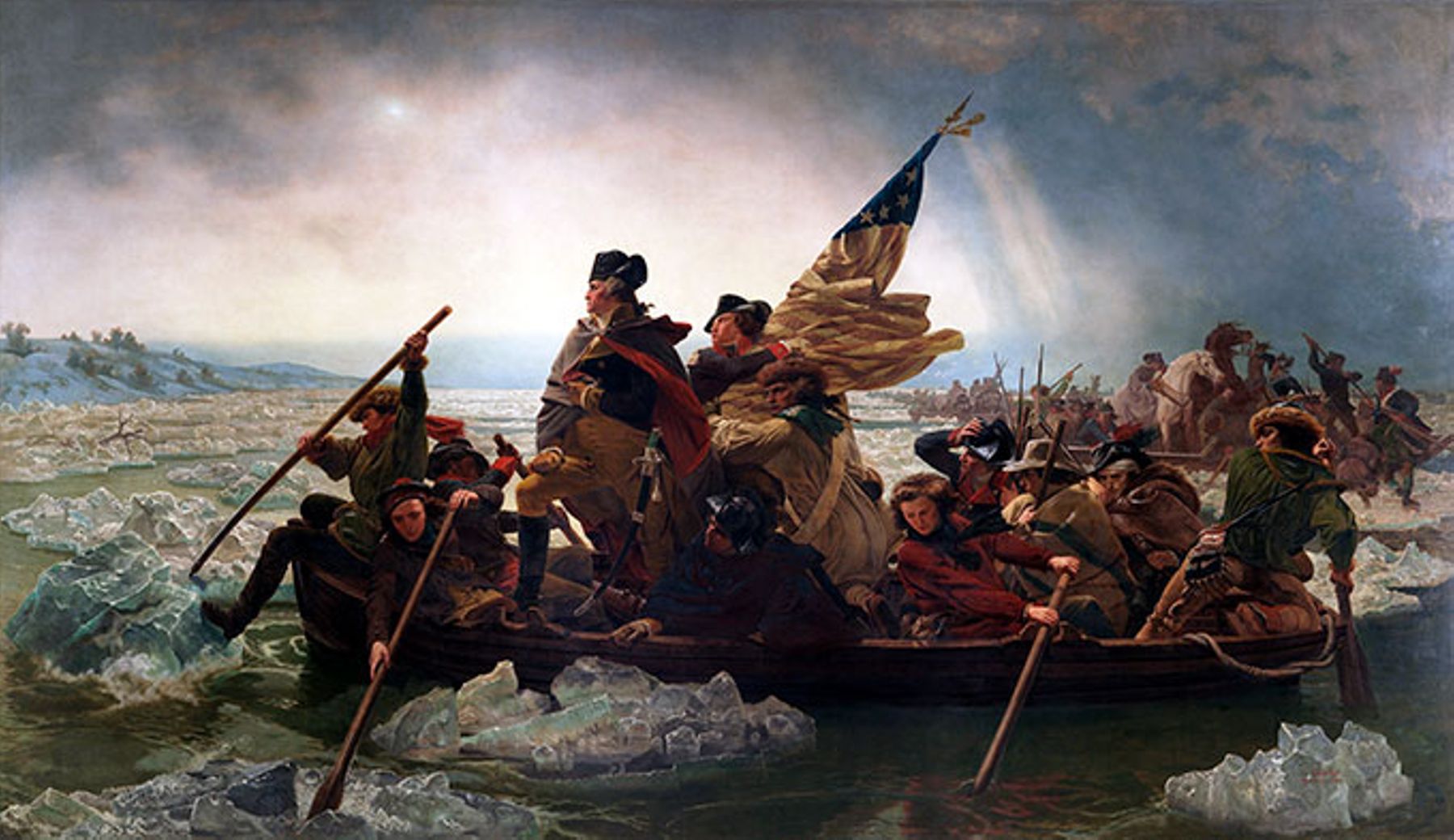
The challenges facing Washington were immense. First, he had to create and weld together an effective American army. This was no easy task. At the outset, in August 1776, he had 28,000 men under his command; by December, that number had shrunk to a mere 3,000. He was constantly dealing with problems of exhaustion, desertion, plunging morale, disease, and devastating winter weather, coping with an army on the edge of dissolution.
But Washington was persistent and intrepid. On Christmas night in 1776, he struck back with the utmost boldness. He led a force across the icy Delaware River and surprised at dawn a sleeping force of Hessian mercenaries at Trenton, New Jersey, routing them completely. Then, a week later, his forces enjoyed a similar triumph, repulsing a British force at Princeton. Two small victories, but a sign of good things to come.
Then in the fall of 1777, the Americans scored a decisive victory at Saratoga with the capture of 5,700 British troops. With this triumph, the French got the signal they had been waiting for: they now believed the Americans could fight effectively, and that it would be advantageous to help them. Eventually they entered the war, followed by the Spanish and the Dutch. This would not only mean additional trained troops but also the assistance of the French Navy, which could challenge British naval superiority. Things were looking up.
But the crippling hardship of the winter of 1777–78 represented a low point for Washington’s army. It was encamped at Valley Forge, 18 miles outside Philadelphia, and beset by exposure, hunger, and disease. Conditions were horrifyingly difficult, and the army’s very existence hung by a thread. The Marquis de Lafayette, a French aristocrat who had volunteered to fight with the Americans, observed that “the unfortunate soldiers . . . had neither coats, nor hats, nor shirts, nor shoes; their feet and legs froze till they grew black, and it was often necessary to amputate them.” More than 2,500 soldiers died by the end of February 1778; 1,000 deserted. Another 7,000 were too ill for duty.
But by May, Washington’s army had survived, and with the help of Prussian General von Steuben, another European believer in the American cause, had been drilled into a reasonably cohesive military force. Encouraged by its renewed discipline, by news of the French military alliance, and by a promise of extra pay from the Congress, the American troops were ready to move ahead.
Washington’s forces managed to stalemate the British in the mid-Atlantic region, and for them a stalemate was as good as a win in this war. They saw smashing victories in the West, where the British regulars were no match for fiercely independent American frontiersmen. But the most devastating blow came in the South, where an overconfident British General Charles Cornwallis had taken a force of 7,200 men northward into Virginia and ended up in Yorktown, a small port city strategically located near the mouth of Chesapeake Bay.
Cornwallis soon found himself trapped in the pincers of a combined operation, coming at him from both sea and land, with the decisive aid of the French Navy blockading the coast. He had no choice but to surrender.
On October 19 he did so. It is said that, as his forces marched out, the British band struck up a familiar English ballad, “The World Turned Upside Down.”
And so it must have seemed to Cornwallis and his men, and much of the rest of the world. The war was effectively over, and the impossible had happened: the American independence that had been so boldly declared in 1776, and courageously sought, despite long odds, in the seven long and often grim years afterward, had been achieved.
In remembering these magnificent results, we naturally think of Jefferson’s soaring words. But we should never forget the bloody struggle that followed, the profound sufferings of the men who fought and died for this seemingly unwinnable cause—and the indispensable man who led them. The deed of gift was many deeds of war.