An ambassador is an honest man sent to lie abroad for the good of his country, said the seventeenth-century English diplomat Sir Henry Wotton. By “to lie,” Wotton meant both to dwell somewhere (in a now-defunct usage) and to tell untruths. But ambassadors, as well as the untruths they are obliged to tell, change more rapidly than the embassy buildings in which those lies get told. Those buildings, for good or ill, are symbolic of their countries—their taste, power, ambition, prestige, and position in the world. Size, both absolute and relative to those of other legations, matters, no doubt, but it is not the sole criterion by which the natives of the receiving country will judge them. An ugly building suggests an ugly country, or at least one without taste.
Several recent American legation buildings demonstrate how inadvisable it is to entrust the construction of such important structures to bureaucrats and modernist architects. Possibly the worst is the American embassy in London, designed by the Philadelphia-based firm KieranTimberlake and opened in 2018, which manages to unite hideousness with banality. London, of course, is now full of such buildings, the City of London—the capital’s financial district—resembling an overcrowded and less opulent Dubai, with architecture so awful as to defy insult and sometimes even comical in its pursuit of originality. But the ubiquity of architectural crime is no excuse for committing it. What might have been exemplary is instead merely another participant in the architectural Walpurgisnacht of which so much of London now consists.
Finally, a reason to check your email.
Sign up for our free newsletter today.
Asked what it is, or what kind of professional activity goes on within it, an uninformed observer might guess that the embassy is the provincial headquarters of a multinational junk-food purveyor or a freight-forwarding company, though not one of any great or fundamental importance even to itself. The building has no grace or dignity and might as well have been cheap, though, in fact, it cost $1 billion. This, incidentally, suggests a virtual law of modernist, postmodernist, and brutalist architecture: expenditure does not conduce to beauty—if anything, the reverse—for it supplies architects with the means to indulge their often-diseased imaginations, striving after an originality that is mere bizarrerieand that usually succeeds only in creating anxiety or unease in the onlooker. La Rochefoucauld said that one can stare for long neither at the sun nor at death; had he been writing 360 years later, he might have added, nor at the United States Embassy in London.
The London embassy is not an aberration, however, or an unfortunate exception to a general rule of elegant building in which modern American diplomacy is carried on. Designed by Allied Works Architecture in association with Yost Grube Hall, and completed in 2021, the new American embassy in Maputo (Mozambique), for example, shares a feature with its London counterpart: a facade that looks as if a giant Parmesan cheese is expected to fall from the sky at any moment and will need grating as it lands.
The new American consulate in Milan, designed by SHoP Architects of New York in collaboration with Genius Loci Architettura, is a study in architectural incompetence and visual vandalism, masquerading (in the architect’s words) as sensitivity to context. Here was a golden opportunity to break modernism’s hold on American diplomatic architecture, for a site was chosen where classicism would have been appropriate and could have offered a rebuke to the ugliness that modernism has created, and continues to create, worldwide. Instead, the structure embraces a contemporary design that disdains both its surroundings and the city’s architectural heritage.
The construction of the consulate began well enough. The site was an old shooting range, whose neoclassical entrance, known as the Liberty Building and built in 1905, has been beautifully restored. It is precisely this success that makes the efforts of the modern architects all the more painful.
Entering through the neoclassical building and crossing a grassed courtyard, one confronts a stark modernist structure, at once startling and banal, rising awkwardly ahead and breaking the horizontal line of the older building. The consulate’s official website deploys the familiar language of contemporary architecture—high-flown bureaucratese, admixed with a kind of evangelical fervor:
A true 21st-century center for practicing American diplomacy, the new Consulate General campus is an expression of globally influenced design that celebrates and advances local tradition. It will serve as an enduring testament to cross-cultural collaboration—not only between two countries, but also to honor all of the places where exceptional individuals met throughout history, and will continue to meet into the future.
Is anyone expected to believe this? What does it mean to “celebrate and advance local tradition” while employing a “globally influenced design”? How does the new consulate honor, for example, the Field of the Cloth of Gold, held in northern France in 1520, where Henry VIII met Francis I, or Ujiji, on the shores of Lake Tanganyika, where Stanley met Livingstone in 1871? This is verbiage in which connotation entirely displaces denotation.
Those who write in this style either have nothing to say or something to hide. One could show an image of the new American modernist consulate building in Milan to 500 million people without one supposing that it had any connection to Italy, let alone that it “honored all the places where exceptional individuals met throughout history, and will continue to meet into the future.” Only bureaucrats haggling over wording in a meeting—or a politician attempting to bamboozle an audience—could have produced such a sentence.
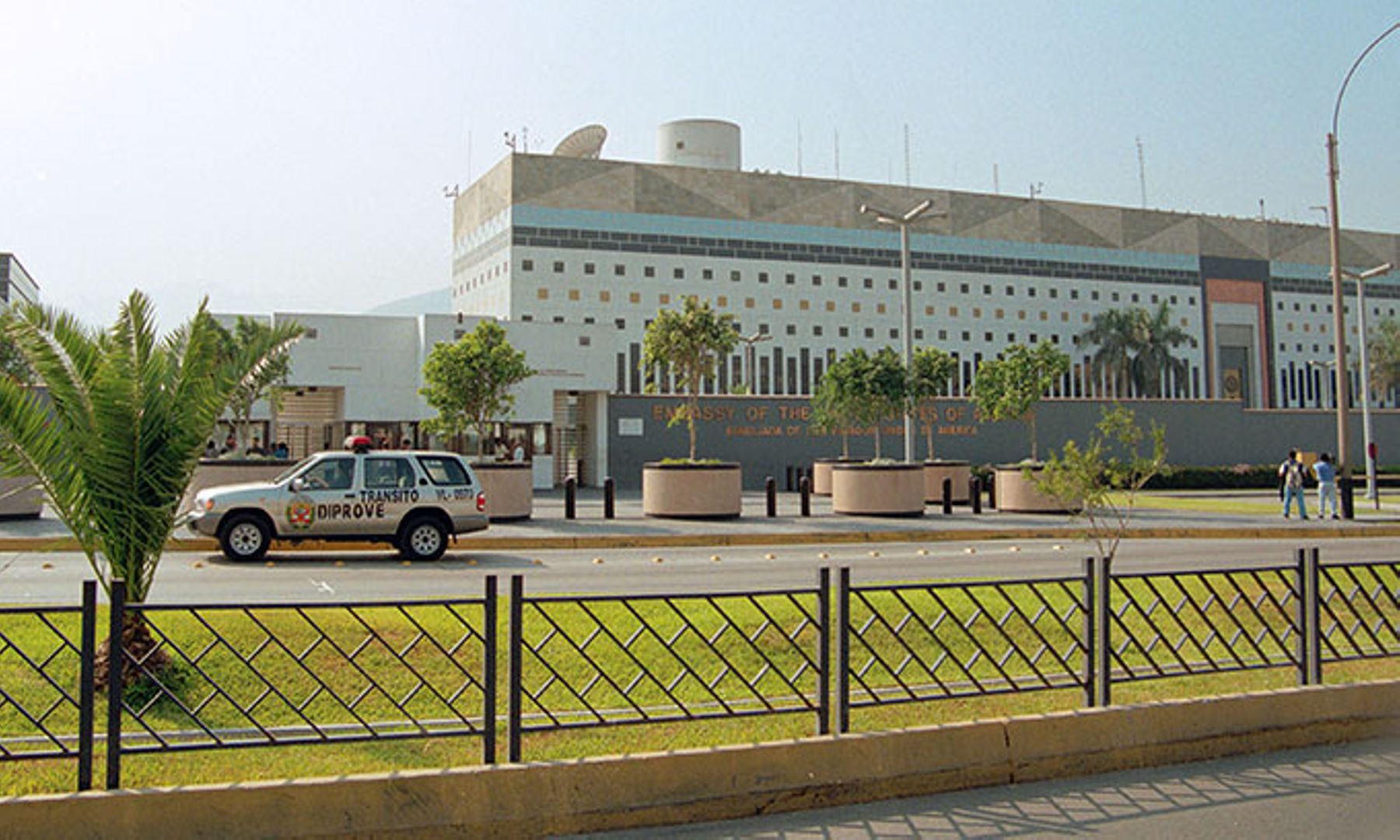
The language used to describe the new consulate is far from unique. The architects of the embassy in Lima, opened in 1995, claim the following:
The U.S. Embassy in Lima . . . challenged the firm [of architects] to achieve artistic expression within the constraints of strict security design guidelines. This project demonstrated cultural sensitivity and the successful blending together [of] images of the United States’s advanced technology with the traditional patterns and materials [of] the host country. The idea of the exterior facade is a monumental mural, which communicates through an abstract composition the spirit of the indigenous culture.
The embassy says of itself:
The frontage interchanges pastel colors with bright surfaces, creating an effect reminiscent of ancient Peruvian textiles. Framed by the beautiful hills of Monterrico, the Embassy as a whole may be considered an architectural masterpiece.
These passages offer no indication of who, exactly, is doing the reminiscing or the considering: reminiscences and judgments wander freely, untethered to any human subject, like the pain that Mrs. Gradgrind said existed somewhere in the room but could not positively say that she herself possessed. Once again, I think one could show a photograph of the building to many people, including in Lima, who would never suspect it of having any connection to indigenous culture. I suspect, too, that they would be hard-pressed to guess its function. Faced with this vast, elongated slab of a building, punctuated by three rows of mean, square windows clearly not meant to open, they might take it for a ministry of security erected by a military dictatorship, or the headquarters of some organization set up to oppress them. They would see nothing diplomatic about its domineering aspect—quite the contrary.
It is worth pausing over the architects’ use of the word “indigenous.” Here it is employed in an obviously technical sense, much as “native” once was in colonial regimes. The term is politically correct, in that a building’s supposed communication of “the spirit of indigenous culture” is assumed automatically to confer merit and to disarm criticism. It essentializes the dichotomy, based on race, between the indigenous and the alien. But the Spanish conquest of Peru occurred half a millennium ago—long enough, surely, for the culture of the conquerors, adapted over time to local conditions, to be considered indigenous rather than alien. Tacking a semi-demi “indigenous” decoration—allegedly indigenous, that is—onto a modernist building does nothing to make it more appropriate to its surroundings.
This was understood by the designers of the first purpose-built American embassy in Peru, constructed between 1942 and 1945, who adopted the Spanish colonial style, by then every bit as indigenous as pre-Columbian textiles, marvelous though the latter undoubtedly were. The building combined dignity—surely an essential quality in diplomatic architecture—with a genuine respect for an indigenous tradition. Building in the style of Sacsayhuamán was hardly practicable, for more than one reason. That respect was far more sincere than the indecipherable nod to ancient textiles or some other dragged-in aspect of a culture deemed indigenous in a special and implicitly racist sense.
Needless to say, the old embassy would now be derided as pastiche—which it undoubtedly was. But disdain for pastiche—the use of past forms in new buildings—is disdain for much of architectural history, and it rests on the false assumption that originality is a good in itself, irrespective of results. This assumption has opened architecture to the strange combination of bizarrerie and the lack of genuine individuality from which it now suffers.
The attempt to incorporate local traditions into modern embassy buildings has failed ever since anything that might be dismissed as pastiche has been rejected—or even avoided at all costs. In practice, this “referencing” of local tradition almost always collapses; either the reference bears too little resemblance to what it is meant to evoke and is therefore undecipherable to the onlooker, or it is tacked on incongruously, like the tail of a pantomime horse—or both. The American embassy built in the 1920s in Rio de Janeiro (when Rio was still Brazil’s capital) succeeded precisely because it was unashamedly a pastiche of Brazilian colonial and imperial architecture, one of the most pleasing vernaculars on earth, even if it emerged in the last territory in the Western world to abolish slavery. Aesthetic judgment, however, is not the same as moral judgment, and a man does not become a tyrant simply because he admires art produced under a tyranny.
The government body responsible for choosing the design of American embassies, the Bureau of Overseas Operations, looks and sees with the eyes of abstraction and ideology rather than those of mere sight. Consider, for example, the desiderata for the interiors of the new embassy now under construction in Beirut, at a projected cost of $1 billion. They are to be:
Functional
Flexible
Sustainable
Recycled
Healthy
Environmentally friendly
[Of high] quality Durable
Easy to maintain
Of restrained palette [to reduce] inventory
Timeless
Almost nothing in this list would distinguish these requirements from those of a new high school in a small provincial town. By “timeless,” what is evidently meant is not beauty sub specie aeternitatis but something so bland and neutral that it would not be out of place in an IKEA store.
How a restrained palette reduces “inventory” is a mystery. Does restrained simply mean limited, which would at least be intelligible? Or are we meant to believe that restrained colors of paint, upholstery, and carpeting (if any) are cheaper than brighter ones? This seems implausible, and, in any case, any such saving would amount to no more than a drop of tint in the very large bucket of the overall project.
One would never guess from this list that sight is an important human sense, or that aesthetics are of vital concern to civilized life. Of course, no one would want an embassy that was unhealthy (for example, so badly ventilated or overcrowded that tuberculosis might spread) or dysfunctional. Yet it is remarkable how often modern architects, having not merely aimed at functionality but elevated it to the summum bonum of architecture, have produced buildings that soon fail to perform their function and require costly readjustments, sometimes equaling or exceeding the original construction cost. Desiderata that go without saying do not need to be said. And while durability is plainly desirable, the record of contemporary architecture in this respect is far from impressive.
What, precisely, is meant by “environmentally friendly”? Most people would agree that water and energy should not be wasted and that efforts to limit such wastage are laudable and worth encouraging. But the environment includes—importantly—the visual environment, and apart from the restrained palette, desired for nonvisual reasons, no mention of it is made here, as if it could look after itself. Once water is saved and no carbon dioxide emitted, all is apparently well.
While these criteria for the new embassy in Beirut are pedestrian, utilitarian, and unambitious, the building itself, set on a 43-acre plot, is hardly modest. It will be the second-largest American embassy in the world (a curious fact in itself), after the one in Baghdad. Its principal achievement, it seems to me, will be to combine prepotency with banality. And if one purpose of an embassy is not merely to project power and importance but to embody civilizational virtues, among them the creation of beauty, this building fails.
The new American embassy in Hanoi, estimated to cost $1.2 billion and designed by EYP Architecture & Engineering, a U.S.-based firm, is an aesthetic mess, even on the architects’ own drawings: and architects’ drawings have a tendency, especially in modernist hands, to flatter the appearance of the future building, making it seem shinier, glossier, and more visually exciting than it turns out to be. Its principal elements are glass boxes of the kind that now dot skylines from Denver to Jakarta and that increasingly make cities seem like collections of huge airport terminals (and one cannot help wondering how eco-friendly all that glass is). Certainly, many of the projected interiors would do for the waiting areas of some of the world’s glossier airports—Dubai’s, for example. I suppose that for some people, an airport terminal is a home away from home; but for others, probably for most, an airport terminal is a place of anxiety: the gate is far away, you might miss the connection, thousands of strangers mill around you, and you’re just one of 74 million passing through this airport annually. At best, the new embassy will be a business-class lounge.
The disparate elements of the compound are arranged with no discernible overall order and sometimes set at awkward or jarring angles to one another. Though built from scratch, the design has a jerry-built quality, as if the planners added many of the subsidiary structures as afterthoughts once they realized that the central buildings were not large enough.
It is not, and never has been, easy to design a building that fulfills all the functions of an embassy, but it is now harder than ever. The sheer scale of the work has grown enormously, and with it the threats: not only the political hostility of states but also that of terrorist groups, even in officially friendly countries, as well as the mad fury of isolated individuals. We live in an era of car bombs—and now, drones.
Problems of embassy security are not new. I remember visiting the American embassy in San Salvador in the 1980s, during the civil war, when it was draped in netting to protect it from guerrilla projectiles, often within bazooka range. But such dangers are more than an order of magnitude greater than they were in the era of the Lima and Rio embassies I have mentioned. Security is rarely conducive to aesthetic excellence, and no modern Marquis de Vauban has emerged to reconcile fortification with beauty. Indeed, too overt an emphasis on security may even invite attack, insofar as it advertises fear and vulnerability rather than confidence.
Before the end of World War I, the United States maintained relatively few embassies, as if diplomacy were an activity of old, cynical, unscrupulous, decadent, and pre-Enlightenment polities, entanglement with which ran counter to American interests and principles. The war changed that. The need for diplomatic representation, and therefore for embassy buildings, grew accordingly.
Uncertainty soon arose about their proper style. Should they be grand, aristocratic, overbearing, and imperial, or modest and gentlemanly? Should they blend in or stand apart? The first model adopted, where new buildings were required, was the Southern mansion—graceful in its native setting but soon burdened with unhappy connotations for many Americans and, in any case, absurd in certain contexts. This was followed by the era of the transplanted White House: in effect, the large and elegant house of a country gentleman, plainly unsuited to many climates and political, social, or historical circumstances. Then came pastiche, in which elements of a graceful local tradition were adopted where such a tradition existed.
After World War II established the United States beyond dispute as the world’s greatest power, isolationism, whether absolute or relative, was no longer possible. The American government was obliged to concern itself with the affairs of almost every country on earth. With this new role came a perceived need to present America as a land—the land—in which the future mattered more than the past, which architecture had previously honored; and as a thrusting, innovative nation permanently in the vanguard of technique and technology.
The number of embassies grew greatly, and their buildings were expected to reconcile a series of contradictory imperatives. They had to be distinctly and unmistakably American, modern and future-facing, yet nod toward local customs, styles, and sensibilities; to exude confidence without becoming overbearing; to be dignified and ceremonial while housing an expanding bureaucracy; and to be both democratic and elitist, appealing to the general public as well as to its most sophisticated tranche. With so many competing demands, it’s hardly surprising that aesthetic considerations became secondary. The future-obsessed modernist rarely paused to consider that of all qualities, modernity is the most fleeting: the latest thing is never the latest for long. Modernity, of all criteria, is therefore the most foolish by which to judge the merit of a building.
Franklin Roosevelt, who transformed America profoundly even before the war compelled further change, understood this. He took a keen interest in public architecture, and in a 1939 speech observed: “We are seeking to follow the type of architecture which is good in the sense that it does not of necessity follow the whims of the moment but seeks an artistry which will be good for all time to come.”
Nothing could be further from the spirit of recently built American embassies. Perhaps the competing demands placed upon an embassy—certainly upon any large one—are not reconcilable, or at least not easily so. But an additional problem of American embassy architecture is merely a special case of a wider architectural malaise, one that has afflicted building worldwide since the irruption of modernism.
From the outset, modernism was totalitarian in feeling, doctrine, and substance; Gropius was initially a Communist and Le Corbusier a fascist, and it shows. Roosevelt’s insistence that architecture should be good did not prescribe a particular style. Alas, modernism from the beginning, and most of its descendants ever since, has been inherently inhuman: cold-blooded, deliberately charmless, puritanical, and rationalistic without being rational. Embassies, it seems, cannot escape its curse.