
In 1776, John Adams famously wrote to his wife, Abigail, that Independence Day would be “solemnized with Pomp and Parade, with Shows, Games, Sports, Guns, Bells, Bonfires and Illuminations from one End of this Continent to the other from this Time forward forever more.”
The Independence Day Adams had in mind was July 2, when the American colonies voted to separate from Great Britain, rather than July 4, when the Continental Congress approved the final text and adopted the Declaration of Independence, which was then printed with the later date. Adams was off by two days, but the rest of his prediction proved true.
Finally, a reason to check your email.
Sign up for our free newsletter today.
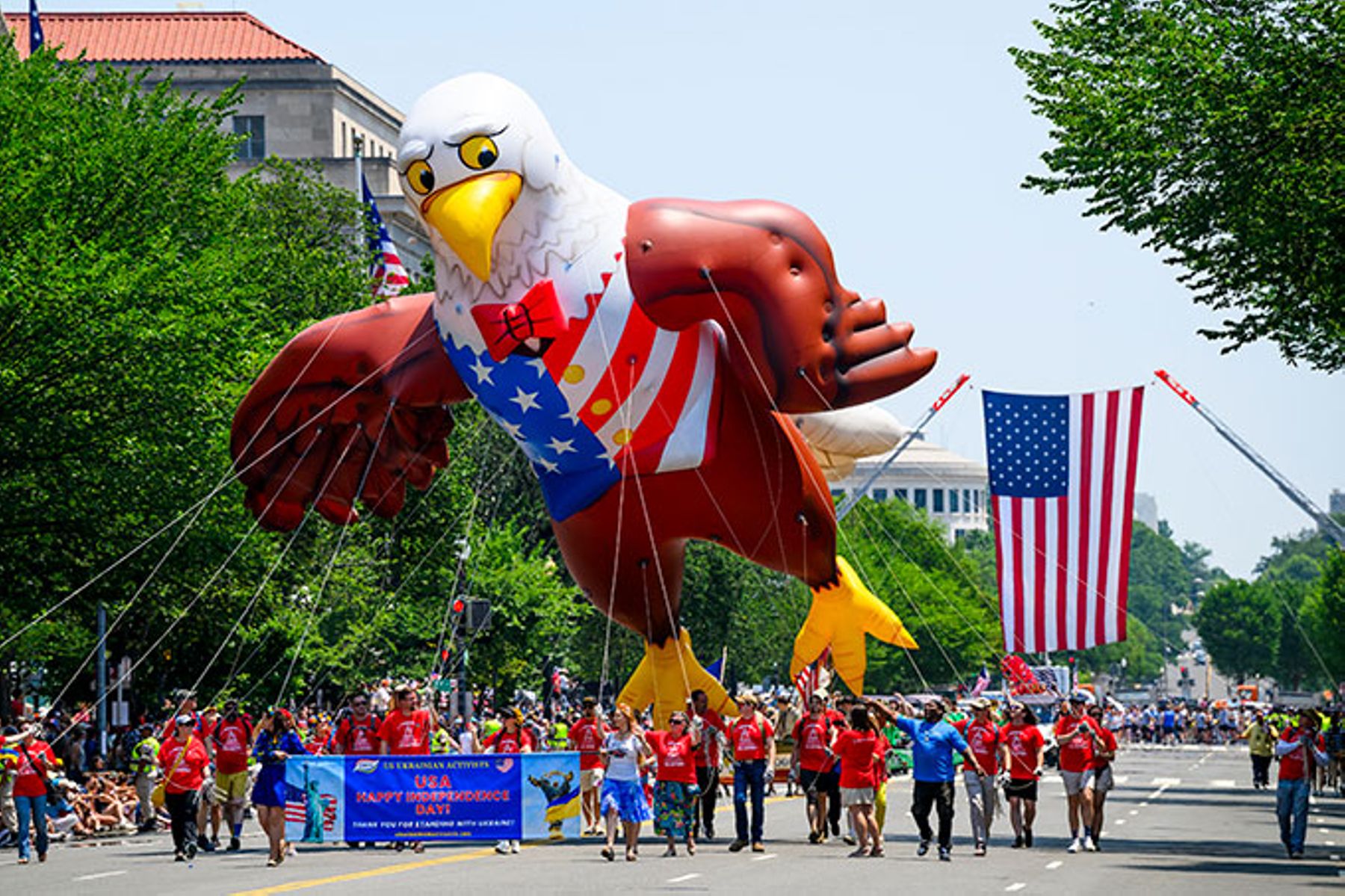
Since then, the second president’s list of festivities has grown to include state fairs and rodeos, drone shows, and an IndyCar Grand Prix, to name just a few of the celebrations planned for the national holiday. It’s also become, in American fashion, an extravaganza for marketing tie-ins—a Dunkin Donuts eagle-shaped cup and Dairy Queen’s Stars and Stripes Misty Float are two personal favorites this year—and lots of political and social commentary. No shortage of spectacle is planned to mark the American semiquincentennial. The 250th is both everywhere and easily ignored.
Perhaps the contrast is unfair, but our last great national party, 1976’s bicentennial, seems, in memory, a much more consequential event. Its success was far from guaranteed. The bicentennial was preceded by social upheaval, political assassinations, a war in Vietnam that killed 58,000 Americans, and Watergate, which brought down Richard Nixon’s presidency and with it Americans’ trust in their government, which fell to historic lows. Despite it all, citizens transcended these difficulties to stage a successful celebration, including concerts, marathons, festivals, and a flotilla of tall ships that drew over 6 million spectators to New York Harbor.
To be fair, 200 years is a more dramatic landmark than 250—bicentennial rolls off the tongue, unlike semiquincentennial. And it’s hard to see what the legacy of the current celebration will be beyond some pageantry. As we Americans are well aware, we are politically divided, distrustful of each other and of our institutions. Our politics have always been rough and tumble, but the coarseness of the current climate feels different than anything before.
The partisan divide has likely turned many citizens away from the 250th. The event’s commemoration was bound to echo the style and concerns of whoever sat in the White House in the summer of 2026. Accordingly, half the country would feel left out or just tune out, regardless of whether it was President Trump or President Harris overseeing the events. It doesn’t help that most Americans express pessimism about the nation’s future: 59 percent believe our best days are in the rearview mirror, according to Pew. How do you celebrate the past when you’re dreading the future?
But cynicism is too easy, and it obscures all that we have to be thankful for. With the imperfections of our history duly noted—and we note them often—a strong case can be made that no people has ever had it as good as we Americans do.
Whether it is earning power and consumer choice, economic mobility, quality of health care, the safety of our country from foreign attack—another nation’s army has not invaded or occupied American territory since the War of 1812—or the priceless individual liberties that we enjoy every day, often unconsciously, America has grown and succeeded beyond even our Founders’ brilliant imaginations. Perhaps this helps explain why, despite the political strife and their skepticism about the nation’s future, the majority of adult Americans say that they are happy: Gallup polls regularly show that nearly 80 percent of citizens are satisfied with their own lives. And when it comes to charity, Americans are among the world’s most generous people.
We should be grateful, then, for the many riches of the present, and grateful to those who, in the past, risked their lives to make it all possible. It would do us good to acknowledge this every July 4, and certainly on our 250th Independence Day.
An instructive event took place on the eve of our first great national celebration—the Golden Jubilee, the 50th anniversary of the Declaration of Independence, in 1826. Two years before, at the invitation of President James Monroe and Congress, the Marquis de Lafayette, now 66, returned to America after an absence of 40 years. Over 13 months, he traveled to all 24 states, taking stock of the progress made possible by the Revolution that he had helped Americans win.
He was stunned by the transformation of the country, which he described as “utopic.” The growth of the American population—now more than triple in size since the Revolution—and its spread from the Atlantic Ocean to the Mississippi River, with designs on the Pacific; the emergence of arts, industrial, educational, and philanthropic institutions; and feats of great engineering such as the Erie Canal and the Fairmount Waterworks in Philadelphia, amazed Lafayette. “The creations, improvements, dignity, prosperity, strength, and domestic happiness of this admirable republican confederation,” he wrote while steaming up the Mississippi, “surpasses everything that my imagination, which is said to be quite lively in such matters, could ever conceive.”
It was all made possible, Lafayette was happy to acknowledge, because of the representative government that the Revolution had made possible. His hosts famously choregraphed lengthy processions to bring him into their villages and cities, often through elegantly built arches, showering him with gifts and adoration. But this was not exactly an act of hero worship.

“Ingratitude has been experienced in all Ages,” George Washington wrote in the Revolution’s closing days. “Republics in particular have ever been famed for the exercise of that unnatural and sordid Vice.” At the time, Washington was addressing the treatment of American soldiers’ pecuniary needs at the war’s conclusion. But he was also citing a centuries-old adage: that republics, because of their egalitarian nature—and because citizens, not kings, are the source of their power—were reluctant to glorify their benefactors.
Early Americans, wrestling with this perception, viewed Lafayette’s visit not simply as an opportunity to see or shake hands with a celebrity. Rather, after nearly 50 years, it was a moment to offer him and the surviving veterans of the Revolution thanks for their services and for the rights they had won, now being enjoyed in growing prosperity. In contemporary accounts of Lafayette’s tour—personal correspondence, newspaper editorials, and countless speeches that politicians and other public officials gave in his honor—the word gratitude appears again and again.
In an era when many Americans lived much shorter lives than we do today, worked longer hours, endured disease and scarcity, and had their own bitter political divisions, they were still able to acknowledge and give thanks for how good they had it.
Maybe, given two and a half centuries of success in this experiment in liberty, Americans have lost some of our capacity for gratitude. We should seek to revive it. Despite political turmoil, technological disruption, wars, economic volatility, social upheaval, and institutional decline, America remains the best and freest place on earth. On this, the 250th anniversary of our freedom, let’s give thanks for that and resolve to press onward. As Americans have always done.
And yes, let’s have some pomp and parade, too.