
There is only one exact date from before my tenth birthday that I have never forgotten: July 4, 1976.
I was six and in Manhattan, the place I was born and raised. It was a famously grim time for New York. There was litter everywhere, and graffiti. My friends and I carried “mugger money.” The Son of Sam was about to embark on his killing spree. The Yankees would go on to be swept by the Reds in the World Series. And the City’s brush with bankruptcy—even at its worst, I cannot help but refer to it as “the City,” with a capital C—was on the minds even of children since our parents couldn’t stop talking about the infamous Daily News headline of October 30, 1975, that some argue cost Gerald Ford New York State, and with it the 1976 presidential election: “FORD TO CITY: DROP DEAD.”
Finally, a reason to check your email.
Sign up for our free newsletter today.
Still, there was the bicentennial, and for that one day, at least, New Yorkers celebrated, as did the rest of America. I had never been on an airplane and had barely left New York, but I was an avid reader and had in this way traveled the world. Among my favorite books were Johnny Tremain, Esther Forbes’s 1943 Newberry Medal–winning novel about a young boy in Boston in the years leading up to the Revolution, and a large-format work in the Golden Library of Knowledge series titled Famous American Ships: From the Discovery of the New World to the Battle of Manila Bay.
The apartment in which I grew up, and where my parents still live, is on Riverside Drive in Morningside Heights. The names give you a sense of the scene: high up over Riverside Park, with an unobstructed view of the Hudson River from the west-facing living room windows. The highlight of the bicentennial for many New Yorkers was Operation Sail, colloquially known as “the Tall Ships,” which featured more than 200 vessels, including the 16 tall ships from around the world that made up the Grand Parade of Sailing Ships. The flotilla went up the Hudson River that Fourth of July, and I had prime seating.
The lead boat was the U.S. Coast Guard’s Eagle, a 295-foot cutter nicknamed “America’s Tall Ship” that is still in use today and is expected to play a role this year, too, in the semiquincentennial iteration of Operation Sail. I was particularly excited to see the Eagle, for it appears in Famous American Ships. But I was excited as well to see the foreign ships, especially Amerigo Vespucci (Italy), since I knew that its namesake had given our country its name, and Nippon Maru (Japan), since I was a keen philatelist in those days and regularly saw the word Nippon in Roman letters on Japanese stamps.
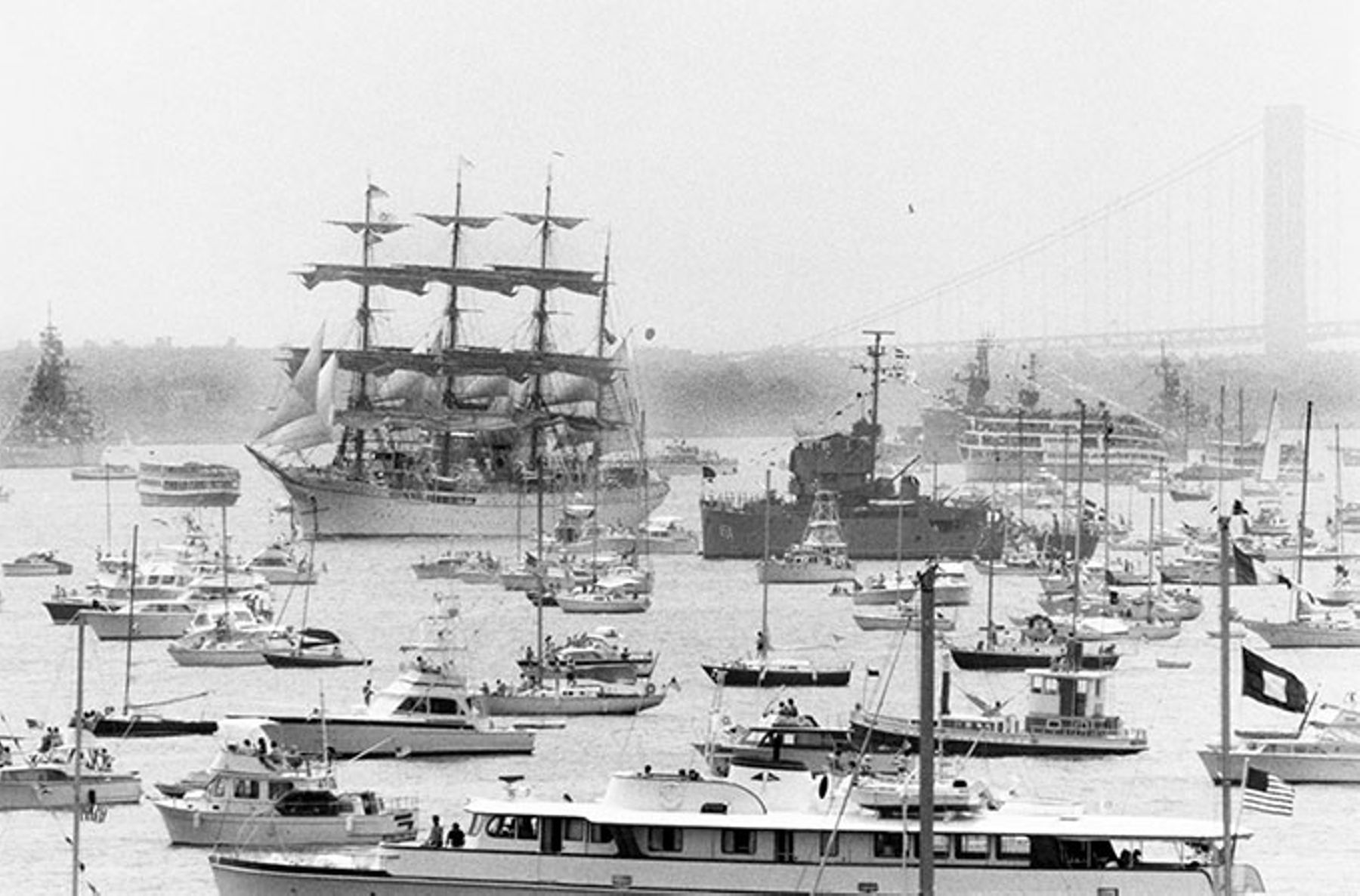
And then, there they were—not just on the page or in the imagination. What beautiful ships, with gorgeous sails and gorgeous masts, and crisply dressed crewmembers whose activities I tried to follow with binoculars!
In his 1989 book Upper West Side Story: A History and Guide, Peter Salwen writes of the occasion, “Hordes of guests descended on anyone with a river view.” We didn’t have hordes in apartment 82: merely a dozen or so friends and family members, one of whom brought a bottle of whisky in a fancy “1776” commemorative bottle that sat undrunk in my parents’ bar until I was a teenager. Eight guests I remember for certain, seven of them now gone.
This Fourth of July, I will be in Washington, D.C., rather than watching Operation Sail from my childhood apartment. Perhaps it’s just as well: the experience feels unrepeatable—and meanwhile, as people return to dust, the trees in Riverside Park rise into the sky. In these 50 years, green foliage has partly obstructed the view of the river from the eighth floor. In another 50, there will be no unobstructed view even from the building’s twelfth and top floor.
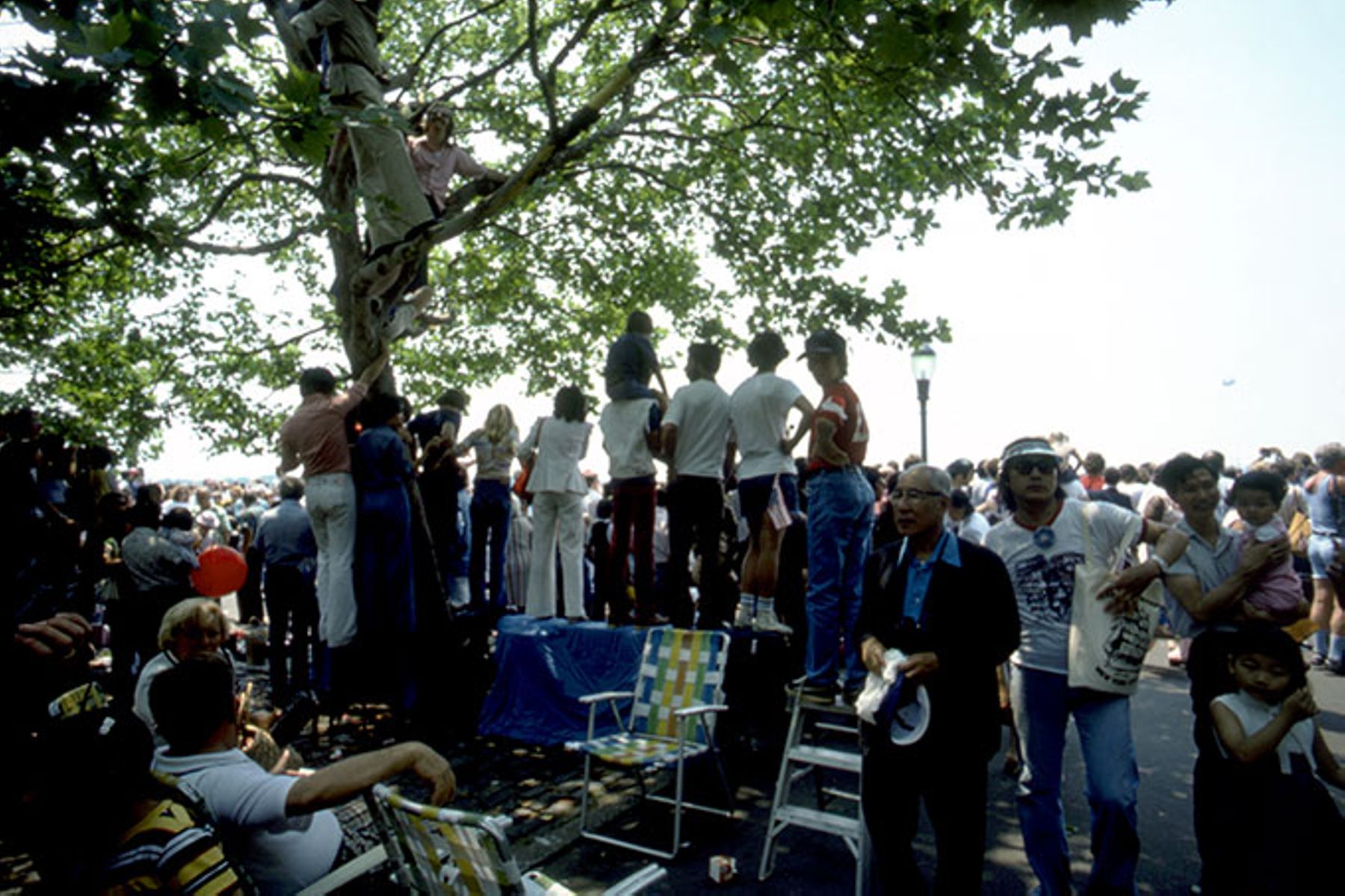
But if you weren’t there in 1976, I urge you to watch this time around, ideally in person, from whatever vantage point you can manage. Although there was a light drizzle on July 4, 1976, and I was happy watching from indoor comfort, I almost regret not being a little boy in that crowd, which Salwen describes this way:
Bicentennial Day! The Henry Hudson Parkway was closed to make a pedestrian promenade, and revelers crowded into Riverside Park and the empty highway for a grandstand view of the greatest parade of sailing vessels in modern times, or maybe ever: Operation Sail ’76.
It was “the top event of ’76,” proclaimed the New York Times’s Joanne A. Fishman that December: “For many of the millions watching on television, the 6 million lining the shores and those aboard the estimated 30,000 pleasure boats in New York Harbor, the euphoria may never be equaled.”
While my beloved New York is not in quite as bad shape as it was in 1976, the situation in 2026 isn’t great. And across the country, Americans seem too politically divided to share in a common semiquincentennial spirit. Besides, younger people, including six-year-old Gen Alpha boys, raised in a world of iPhones, may not be impressed by the Eagle’s 23 sails and maximum speed under sail of 17 knots. But maybe, just maybe, the Tall Ships of 2026 will bring people together again—as they did, so memorably, half a century ago.