
Alan Greenspan, who chaired the Federal Reserve board from 1987 to 2006, died Monday at 100. The Manhattan-born musician-turned-economist had lived long enough after his retirement at 79 to be seen as both a hero and a villain of his time. Yet Greenspan was neither the deft “maestro” who supposedly orchestrated markets into a generation of prosperity—the reputation he enjoyed as chairman—nor the blinkered ideologue whose failure to recognize mounting risks helped precipitate the worst economic crisis since the Great Depression, the legacy he carried after 2008. Rather, he was a conscientious, curious, and politically astute technocrat whose aura of mystique obscured a simpler reality: he was never truly in control of financial markets, let alone the economy, because nobody is.
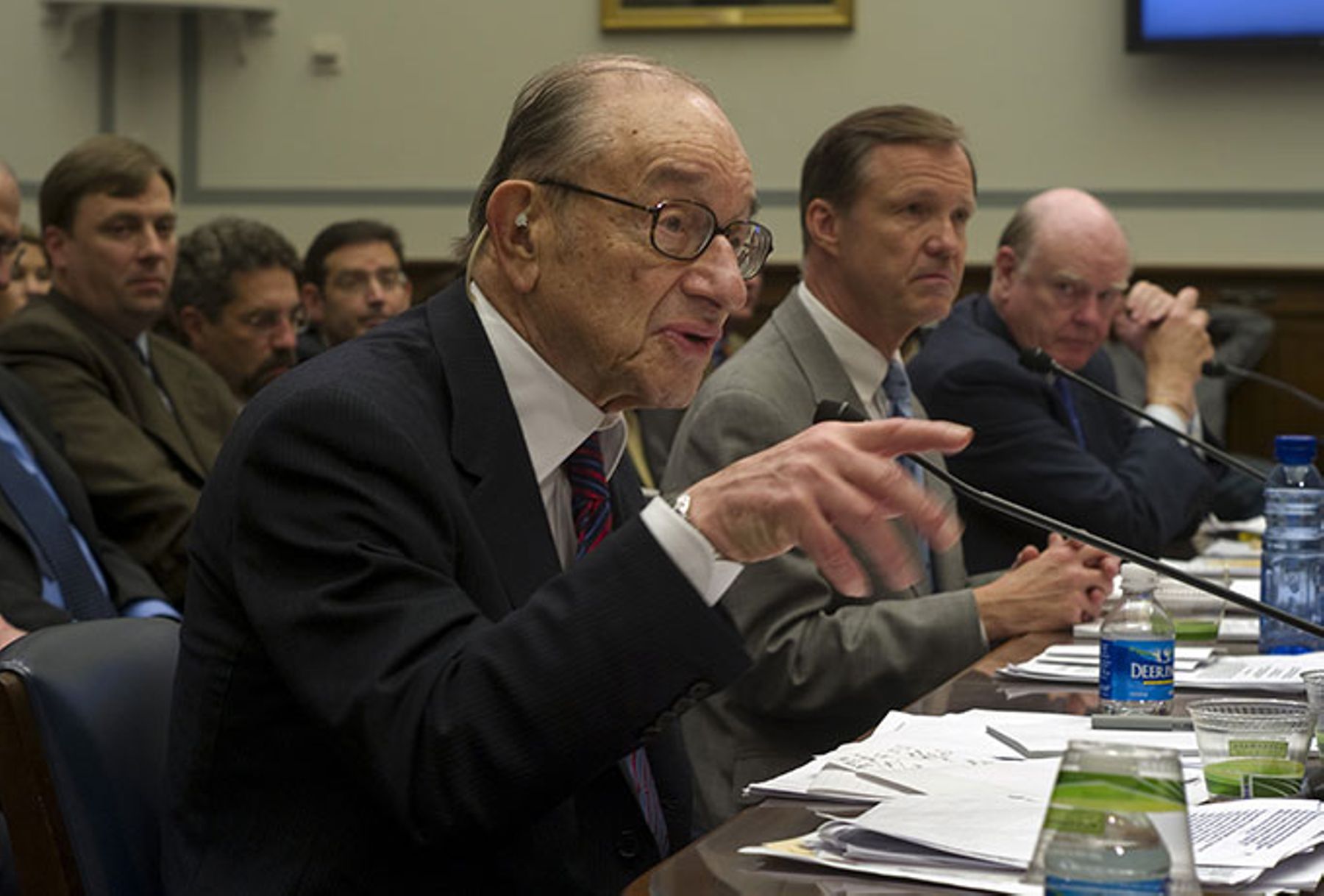
For all his elliptical quips spanning the Ronald Reagan-to-George W. Bush era, Greenspan is perhaps best remembered for words he uttered after leaving office. Testifying before Congress in October 2008, he said that he had watched in “shocked disbelief” as investment firms, banks, and insurers collapsed one after another, beginning with Bear Stearns that March and extending to household names such as Countrywide Financial and Washington Mutual.
Finally, a reason to check your email.
Sign up for our free newsletter today.
Customers lined up outside banks to withdraw their money, fearful that their savings could vanish along with the latest financial institution despite the existence of federal deposit insurance. After Lehman Brothers fell that September, only massive government intervention in the marketplace—undertaken by the ostensibly free-market administration of President Bush—prevented the collapse of Citigroup, AIG, and the government-sponsored mortgage giants Fannie Mae and Freddie Mac.
To someone like Greenspan, the crisis was not just terrifying but bewildering. Having befriended libertarian icon Ayn Rand in the 1950s and later served as a Republican economic adviser, he believed deeply in free markets and limited regulation. As Fed chairman, he allowed financial firms to begin combining commercial and investment banking activities several years before Congress repealed the Glass–Steagall Act during the Clinton administration. Since the Great Depression, that law had separated speculative businesses such as securities underwriting and trading from more traditional banking activities like commercial lending. Even as the line between speculation and lending blurred, Greenspan urged Congress and regulators to avoid heavy oversight of the new derivative instruments that banks and insurers were creating and holding—products whose complexity and opacity would help spread panic throughout the global financial system in 2008.
Moreover, during Greenspan’s 19-year tenure, the Fed largely succeeded in the dual mandate Congress had assigned it: keeping inflation and unemployment low. The central bank influences broad interest rates by controlling the money supply, chiefly through the purchase and sale of bonds. Greenspan’s Fed concluded that interest rates could remain low for extended periods because inflation itself was subdued, owing largely to global forces beyond anyone’s control. Hundreds of millions of workers in China and Eastern Europe were entering the global labor market, producing goods at low cost, while governments and corporations around the world invested vast new pools of savings in U.S. Treasury and mortgage-backed securities, pushing interest rates lower still.
During the 2008 crisis, then, Greenspan experienced a crisis of confidence. Why weren’t free markets working as they were supposed to? Why had executives at major financial firms—people ostensibly skilled at assessing risk—failed to grasp the dangers of dealing in ever more complex mortgage-related securities and derivatives against the backdrop of a wildly overextended housing market, where even borrowers with no income could obtain mortgages? Why, when one investment bank failed, didn’t others step in to buy the assets at bargain prices without extraordinary government guarantees? And why, by that autumn, had investors stopped distinguishing between relatively prudent firms, such as Goldman Sachs and JPMorgan Chase, and reckless ones, instead fleeing the financial system en masse? The resulting freeze in credit threatened a new Depression, bringing lending to a halt even for routine business needs such as meeting payroll while awaiting customer payments.
At Congress’s hearing on the financial failures that October, Rep. Henry Waxman, a California Democrat, had an observation for Greenspan, and a question. “You had an ideology,” Waxman told the former chairman, then quoted back Greenspan’s ideology to him: that “free, competitive markets are by far the unrivaled way to organize economies. We have tried regulation, none meaningfully worked.” That ideology failed, Waxman said, and “now, our whole economy is paying its price. Do you feel that your ideology pushed you to make decisions that you wished you had not made?”
Greenspan, ever the economics student, took the question seriously. “To exist, you need an ideology,” he stated. On whether his own ideology was “accurate or not,” he said, “I found a flaw. I don’t know how significant or permanent it is, but I have been very distressed by that fact . . . . I found a flaw in the model that I perceived is the critical functioning structure that defines how the world works, so to speak.”
Waxman gaped. “In other words, you found that your view of the world, your ideology was not right?” “Precisely,” agreed Greenspan. “That’s precisely the reason I was shocked, because I had been going for 40 years or more with very considerable evidence that it was working exceptionally well.”
Greenspan’s revelation was global news—but had he really found a flaw in his philosophy?
Free markets were doing what they do best: processing the signals that investors glean from world events, from corporate expansion plans to changes in tax policy. Since the early 1980s, however, investors had also been adapting to a different signal from government: that some financial firms, if they grew large enough, complex enough, or sufficiently interconnected, had become “too big to fail.” If such firms became insolvent, investors increasingly assumed that the government would step in rather than wind them down, protecting only small depositors and leaving other creditors and investors to absorb the losses.
Instead, the government began, on an ad hoc basis, to offer post facto guarantees to bigger investors, too, including bondholders. The government had cemented this policy for banks in 1984, before Greenspan’s time, in bailing out Continental Illinois, the nation’s eighth-largest bank, to avoid spreading a panic in financial markets. But Greenspan expanded the idea, flooding the economy with cheap money whenever markets crashed and supporting extraordinary rescues of global debt markets to limit financial losses. Investors learned over time that they didn’t have to be too careful—the government would bail them out.
Greenspan understood this risk. On May 10, 2001, he told financiers that a “prerequisite to effective market discipline is the belief by uninsured creditors that at least they may be at risk of loss. Uninsured counterparties have little reason to engage in risk analysis, let alone act on such analysis, if they believe that they will always be made whole under a de-facto too-big-to-fail policy.”
Greenspan’s real flaw was that he never tried to do much about this growing reliance on debt. But what, realistically, could he have done? He lasted so long—appointed by one Republican president and reappointed by two more Republicans and a Democrat—because he worked within the political system, not against it.
Why, after all, did the government continue expanding too-big-to-fail guarantees? Because that is what the political system demanded. Increased debt was politically expedient at home: as Americans gained new spending power via mortgages, home-equity loans, credit cards, car loans, and student debt, they remained complacent about sluggish wages. The world became ever-more dependent on debt, too, which handily papered over problems. Reordering an increasingly debt-dependent economy would have caused sharp, immediate economic pain—and that wasn’t in the Federal Reserve’s remit.
Further, Greenspan was Fed chairman; he wasn’t King Canute. When Greenspan did try to rein in markets, the markets steamrolled him. In 1996, as stocks, particularly tech stocks, rose in value, he had warned of “irrational exuberance.” After a few hiccups, markets kept rising until 2000, when the tech bubble burst. Was it Greenspan’s job to hike interest rates to such levels that they burst the tech bubble, and took millions of jobs along with it—and would that have even worked, had he tried?
Greenspan enjoyed his rock-star status at the height of America’s millennial prosperity. But rock stars succeed because they give the people what they want.
As for the ”flaw” in Greenspan’s own ideology, and his 2008 bewilderment at supposed free-market failures? Greenspan had known about the flaw seven years before, and warned of it in his May 2001 speech. In talking about the perception of “too big to fail,” he said, “reform of the [financial] safety net must remain on the agenda. I believe this means being very cautious about purposely or inadvertently extending the scope and reach of the safety net.”
Four months later, the world order shattered with the terror attacks of September 11, and any slim political hope of curtailing American consumers’ debt-fueled spending habits vanished altogether. Free markets weren’t flawed, but the signal that Greenspan and many others sent to them was. Government-encouraged debt kept flowing—and still does.