

Soon after 9/11, law enforcement and national security officials identified the perpetrators of the deadliest terrorist attack in American history.
While Osama bin Laden, the attack’s architect, was killed in 2011 and al-Qaeda is now a shadow of its former self, New York faces no shortage of potential threats a quarter-century after September 11. Police Commissioner Jessica Tisch recently said that New York City now confronts the most perilous threat environment that she has seen in her 18 years in government. “It’s an everything, everywhere all at once terrorist threat environment,” said Rebecca Weiner, the New York Police Department’s Deputy Commissioner for Intelligence and Counterterrorism.
Finally, a reason to check your email.
Sign up for our free newsletter today.
Today, the threats are so wide-ranging, idiosyncratic, individualized, and unpredictable that they require an extensive and creative response—and not just from the NYPD. Protecting New York, which remains the world’s top terrorist target, increasingly requires coordination among federal homeland security agencies, some 18,000 state and local law-enforcement groups, and nonprofit organizations like the Community Security Initiative.
Created in 2019 by the UJA–Federation of New York and the Jewish Community Relations Council with an initial $4 million grant supplemented by philanthropists, CSI is a community-based counterterrorism and security organization that helps protect New York’s 1.8 million Jews and the city’s some 3,400 synagogues, schools, camps, museums, and other Jewish institutions against threats that have soared since Israel’s response to Hamas’s invasion of the Jewish state on October 7, 2023, the deadliest attack against Jews since the Holocaust.
“We can’t pick and choose which threats we try to prevent,” observes Mitchell Silber, a former NYPD director of intelligence analysis who has headed the CSI since its establishment. “We must try to thwart all of them all at once.” In 2025, his group passed along to law enforcement some 221 of these suspected “threats to life.” This year, the rate has increased.
In interviews with me, Silber described some of what the NYPD and nonprofits like his are doing to prevent another mass-casualty attack in the city and protect New York Jews from growing threats posed by the Left and the Right, as well as by religiously, ideologically, and grievance-motivated groups and individuals. The current environment, he says, is “a perfect storm—the most precarious moment for American Jews since their arrival on American shores 352 years ago.”
Nationally, four deadly attacks (two of them in the New York metro area) on Jewish targets over a 14-month period from October 2018 to December 2019, which left 16 people dead, led Jewish national security experts to conclude that Jews could no longer rely solely on the NYPD’s impressive resources for their protection. Jewish New Yorkers—the largest Jewish population outside Israel—account for roughly 25 percent of America’s 6 million Jews. About 60 percent of all hate crimes and extremist plots targeting New York and New Yorkers are directed against Jews.
“The threat has changed,” said Silber. “So has our culture. While most people agreed after 9/11 that terrorism was evil and civilians were innocent victims, now terrorism’s evil seems up for debate and Jews are often seen as legitimate targets. On the internet and even from some politicians, you hear that Jewish terror victims are fair game.” Because of Israel’s massive response to October 7 in Gaza, he said, “it’s not uncommon to hear social media influencers and even politicians say, ‘they had it coming.’ ”
Fortunately, says Silber, the NYPD’s intelligence and counterterrorism “architecture”—the post-9/11 counterterrorism programs created by former Police Commissioner Raymond Kelly, Central Intelligence Agency veteran David Cohen, and the late Michael Sheehan, a former government official and military officer—“remains intact, durable and effective.”
Since 9/11, the NYPD, working with the Federal Bureau of Investigation’s New York Joint Terrorism Task Force—which includes representatives from some 50 federal, state, and local agencies—has thwarted roughly 20 known terrorist plots, along with dozens more never publicized, against the city and its residents.
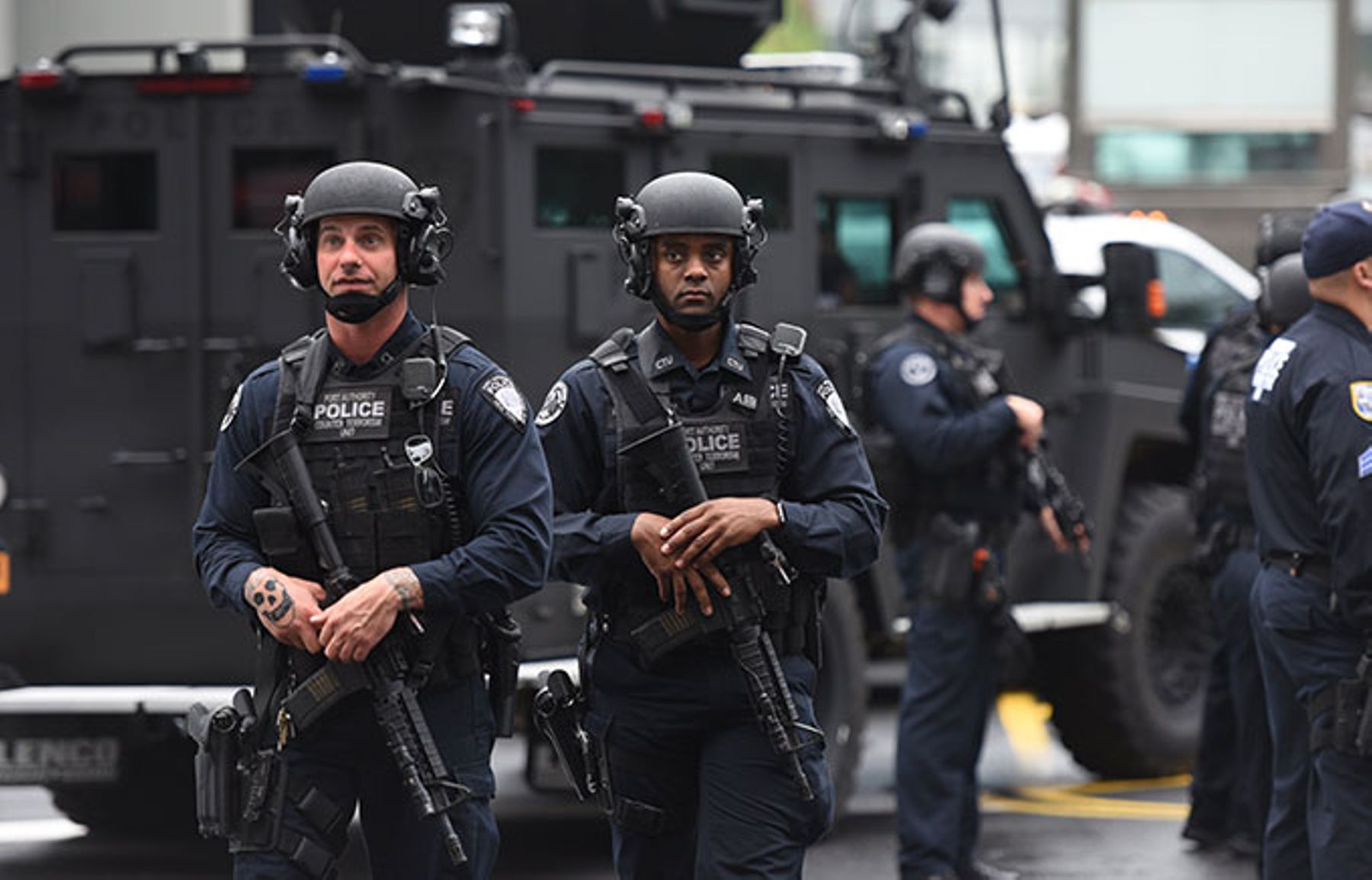
Some 36,000 officers conversant in 168 languages—roughly 1,000 assigned to counterterrorism—are now supported by a fleet of boats patrolling the waters around Manhattan, counter-drone aircraft, explosive-detection dogs, bomb squads, heavy-weapons teams, additional plainclothes officers, a dozen detectives embedded with police departments overseas, and more than 2,600 Argus cameras linked to a data center staffed by intelligence analysts. There, AI-driven algorithms help detect “anomalous” packages and behavior. “AI doesn’t need to take lunch breaks or go to the bathroom,” Silber said.
With the NYPD’s operational and intelligence practices in its institutional DNA, Silber’s CSI employs what he calls “a layered defense.” His staff, which has grown more than fourfold since October 7—from six to more than 30—advises institutions on how to “harden” themselves against attack by installing cameras, coating windows with shatter-resistant film, and establishing safe rooms and emergency procedures. CSI also trains personnel at Jewish institutions to deter and respond to terrorist attacks, should the worst occur. This year alone, the team has worked with Jewish groups on 33 university campuses along the Amtrak Northeast Corridor from Boston to Washington, D.C., where many New Yorkers attend college.
Increasingly, however, cyber defense, some of it AI-assisted, lies at the heart of CSI’s post-9/11 deterrence effort. The group’s “threat detectors,” many of them young, troll social media and public internet platforms—Telegram, TikTok, Facebook, and Instagram—in search of often-atomized dangers. To detect and counter what Silber calls “grievance-fueled” threats, “you need to be in the Telegram chat rooms—on Gab, 4Chan, and other deep and dark parts of the internet.” Intelligence analysts using AI-guided algorithms scanning the web help threat detectors spot Islamic State and Iran-linked plotting, signs of online radicalization, overt threats to kill and seek revenge, and other forms of violence.
The threats don’t just involve New York. In November 2024, one of Silber’s threat detectors—“Ali,” as he asked to be called, in order to protect his identity—found an alarming post in a chat space on Telegram. “The message screamed ‘Islamist,’ ” Ali recalled. Following the username, Ali saw myriad disturbing posts—an Islamic State video, a manual on how to assemble a rifle, and a photo of the user holding a knife in front of an Islamist flag. Reviewing the posts, he identified the user and his location—Brazil. He passed the posts to a partner in Brazil who, in turn, passed them along to the FBI and Brazilian law enforcement.
A month later, Brazilian police announced the arrest of Thiago José Silva Barboza de Paula, 44, on suspicion of terrorism in São Carlos, a university city and research hub in southeastern Brazil. A subsequent indictment charged him with working to recruit Brazilians for the Islamic State and Boko Haram and efforts to establish an Islamist caliphate in Brazil and Latin America. A search of his house turned up replica firearms, a machete, and bomb-making manuals and chemicals for making explosives. As a result of what the Brazilian police dubbed “Operation Machete,” Barboza was convicted of membership in a terrorist organization and preparing acts of terrorism. In 2025, he was sentenced to 11 years in jail, later reduced to eight years. This past January, Leandro Claro Telles, aged 16, one of his “students” recruited online, was also arrested, again with FBI support. He was charged with seeking to buy weapons and explosives. Barboza has denied the charges and is appealing his sentence.
“The global jihad still wants to return to the U.S.,” said David Cohen, who helped develop the NYPD’s groundbreaking counterterrorism program and applauds Silber’s work. But perpetrating mass murder no longer requires the involvement of an organized group like ISIS or Iran. “Mass casualty can now be the result of a simple grievance—an individual who drives a car bomb into a building,” he said. “Grievance is the taproot of all evil.” And today, he added, Americans—particularly, young Americans—seem to have “grievances galore.”
Silber, too, worries about the youthfulness of those posting violent messages. There’s “a lot of activity in the 16–19-year-old range, and those as young as 15.”
However vital they are to the intelligence network that protects New York, groups like CSI, which has a $6.3 million budget this year, cannot operate effectively—much less expand—without indirect government support. Some of that aid comes through the federal Nonprofit Security Grant Program, created by Congress in 2004. Though the program has distributed roughly $300 million annually in grants through the Department of Homeland Security’s Federal Emergency Management Agency to help nonprofits (many of them Jewish) enhance security, funding was reduced and delayed this year.
In 2024, institutions affiliated with CSI received $43 million in grants. But by July, the Trump administration had approved grants for only 1,600 of the 6,000 applications submitted in 2025—just 27 percent, a significant decline from previous years. FEMA spokespersons have attributed the delays to the state agencies that administer the grants and to repeated Department of Homeland Security shutdowns related to immigration-enforcement disputes. The program’s supporters remain unconvinced. In an email statement, Senator Kirsten Gillibrand, the New York Democrat, called the funding “essential to protecting New York from terror threats and supporting nonprofit groups who keep our communities safe.”
If federal dollars for nonprofit counterterrorism groups are constrained and political support is tepid, the same is true at city hall. New York Mayor Zohran Mamdani, whose criticisms of Israel and its leadership have created what Silber calls a “permissive environment” for potential terrorism against Jews, has so far neither reduced funding for the NYPD programs that have helped prevent another 9/11 nor boosted funding or voiced support for them.
As mayor, Mamdani now sits through briefings on the nonstop threats facing the city—an experience that may have thrown what Silber calls “buckets of ice water” on his oft-stated desire to eliminate what Commissioner Tisch considers vital counterterrorism programs. But, Silber notes, the city has done little to strengthen those capabilities. “The NYPD is trying to police the city and carry out its counterterrorism mission with 34,000 uniformed officers—the same number we had in 1994,” he said. “But the city has added a million more people since then. Do the math.”