

The attendees who begin filing in around 7:30 a.m. are dressed as if they could be arriving for any large, outdoor, warm-weather event on a cloudy, humid day—a casual wedding, a graduation. Middle-aged women wear floral-print sleeveless dresses and canvas sandals; older women wear dark dresses and solid shoes. Hair is freshly cut and colored, makeup carefully applied. Sunglasses abound. Children, in crisp button-down shirts and linen shorts, concentrate hard on behaving well. The dress code is unclear; some attendees wear T-shirts and jeans. Many carry supermarket bags with flowers peeking out: fair-trade Whole Foods roses still in their stickered wrappers, dyed bodega carnations in red, white, and blue. People smile as they greet and hug relatives, friends, and acquaintances. Some walk beneath the full-leafed oak trees to find a place to unfold their portable chairs.
Some of the T-shirts feature various messages and photos. Siempre vivira (he/she will live forever). Nunca olvidare (I will never forget). Above or below the photos are birth and death dates—the first in the 1960s or the 1970s, the last always the same: 9/11/01. Even without the dates, though, the photos mark themselves as from the past. People did not regularly take daily pictures of themselves or one another back then and the enlarged snapshots mark special occasions of full-haired young people: graduations, birthday dinners, trips. The people in the images pose carefully, self-consciously, so as not to waste finite camera film on bad shots.
Finally, a reason to check your email.
Sign up for our free newsletter today.
Jenn Nilsen and her family wear pastel-blue tees that match the sign she holds. Troy Nilsen—born March 2, 1968—was a “dedicated family man,” “valuable employee,” and “avid sportsman,” the sign informs us. He took the express bus from their Staten Island home to his job at Cantor Fitzgerald that day, Jenn, his widow, says, and she never heard from him again. He was 33; she is now 57. In one of his photos, Troy wears a bright-yellow raincoat, smiling next to a large fish he has just caught. She smiles. “He loved to fish.” The disparity in ages grows with each year: surviving husbands and wives in late middle age and early old age display photos of spouses permanently left behind in their twenties and thirties.
At 8:42, a drum begins tapping out a signal for people to stand or sit at attention. A minute later, a chorus begins singing the National Anthem, and three minutes later, a bell chimes . As a violin plays, a man recites a single name: Gordon McCannel Aamoth, Jr. A child follows with a second: Edelmiro Abad. Attendees hoist their photo signs in the air, an enduring four-hour protest against the mass severing of these individual lives so early.
The names become a backdrop as the crowd resumes its muted activity. Family members, waiting for their loved one’s name to be called, talk quietly among themselves as they review snapshots they’ve brought with them. The families of Antonio Melendez, 30, and Leobardo Lopez Pascual, 41, pass around photos, including one of the two men standing, smiling, in front of Fritz Koenig’s “Sphere” sculpture at the old World Trade Center plaza.
Both men worked the breakfast shift at Windows on the World that morning. “I was eight,” says Melendez’s daughter, Yaritza. “Their lives mattered. We like to keep the memories alive” for the children. These young men’s grandchildren, small kids sipping from juice boxes, wear pink and blue tee shirts with cursive printed messages to “Grandpa watching me from Heaven” and messages about their karate and “pre-K princess” milestones. As the readers of the names get to the “Ma’s, the “Mc’s, and begin the “Me’s, the two families stand and arrange themselves in a neat row, falling silent to listen.
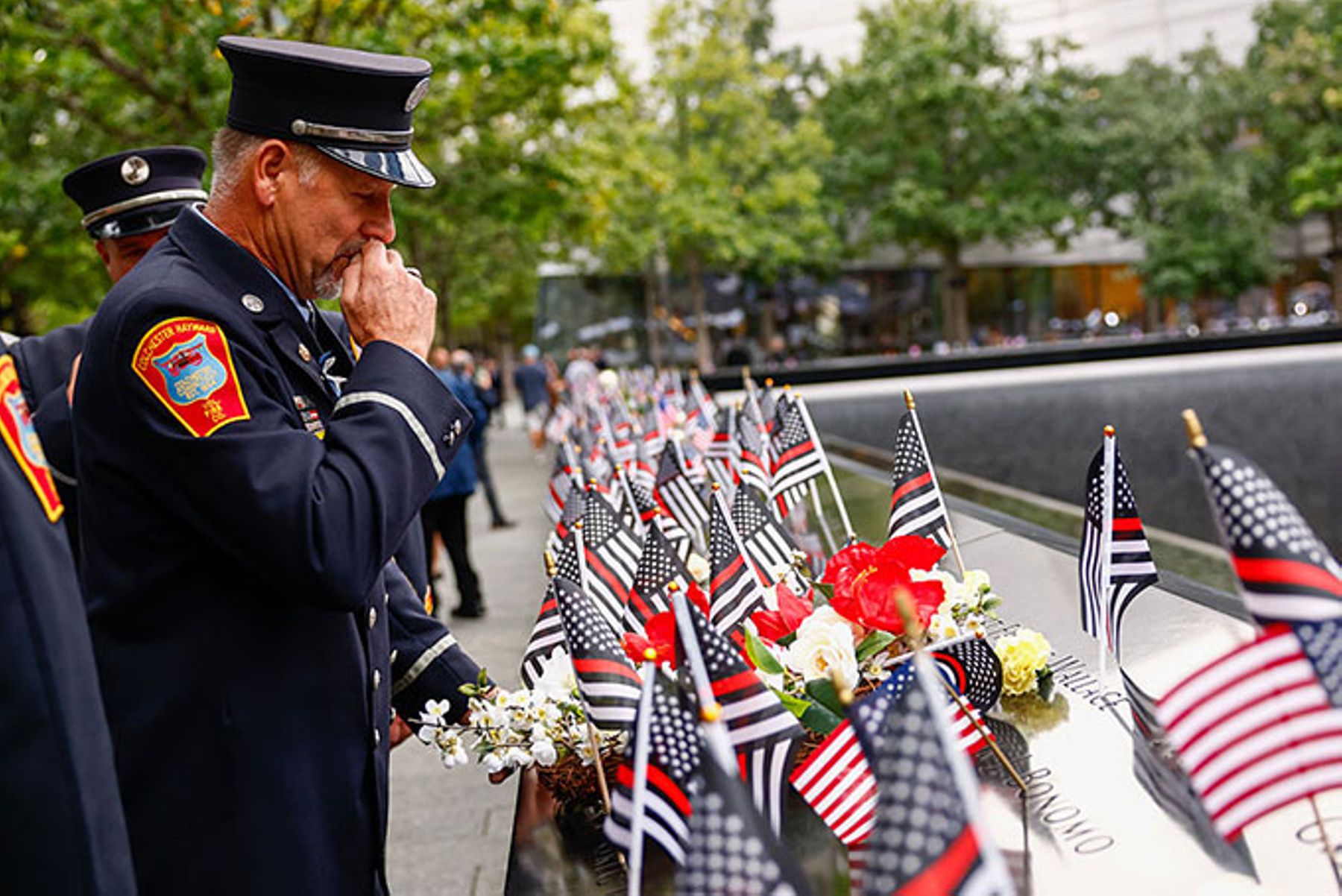
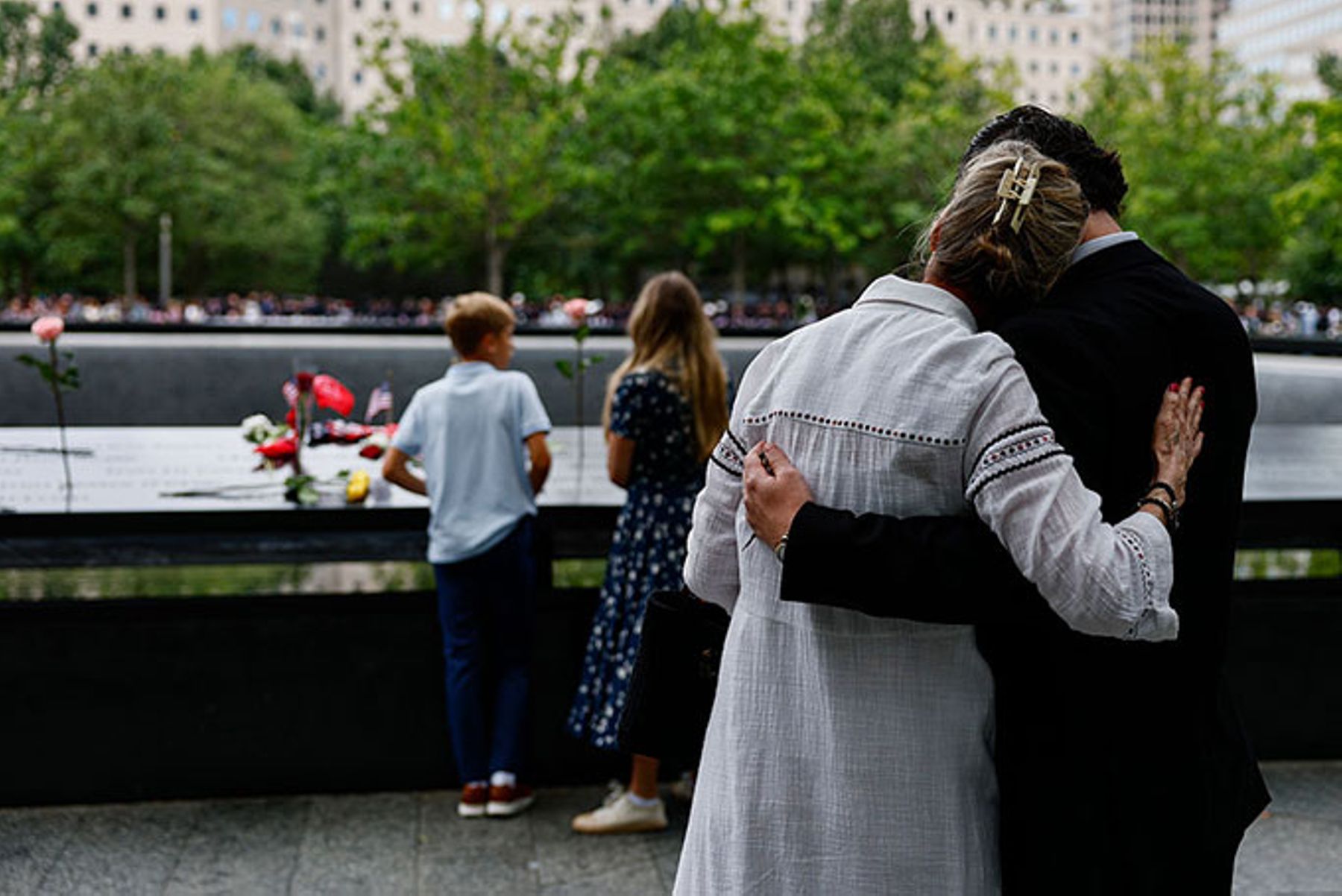
The clouds clear, and the sun begins to burn off the humidity. Some children sit atop adults’ shoulders; others stamp on spotted lanternflies. Service dogs, police dogs, and pets watch squirrels run across the paths and through the branches of the memorial-glade oaks above, scattering acorns along the stonework. Small groups move to and from the memorial pools, placing flowers, notes, stuffed animals, pins, and American flags, Italian flags, and Mexican flags.
A few speakers interrupt the earnest roll call of names with carefully rehearsed speeches. At least two survivors demand that the U.S. government hold Saudi Arabia accountable for its government’s alleged role in the attacks. One victim’s brother says to me of the president’s relationship with the Saudis, “Trump kisses their ass.” The final speaker at the podium, Michael Massaroli, Jr., says the name of “my father, Michael Massaroli.” (The name reading hews only loosely to the alphabet.) He shakily observes that “this is an unusual position to be the last one to go here, I gotta admit,” and says that he will “use the little platform I have” to ask everyone to cease using this “tragedy” as an excuse for hatred of Muslims. “Please stop.” As with the other scattered political speeches, some people applaud and others remain silent. And the crowd generally pays little heed to the tent in the background that shelters the rest of the politicians: a sitting vice president, four former presidents, and three former and one current New York City mayor.
A child carefully memorializes “the best uncle that I never met, Uncle Douglas Benjamin Gardner.” Twenty-five-year-old Trisha Pakkala addresses her mother, Deepa Pakkala, 31: “You dreamed my whole life for me, and you only got eight months,” she says. “The mom who raised me got the rest. . . . I think you’d be glad she was the woman who raised me.”
The sky is now fully blue behind the new One World Trade Center as trumpeters sound Taps and grandchildren, children, nieces, nephews, wives, husbands, sisters, brothers, and parents continue to unsheathe their flowers and place them beside one of the 2,983 names carved along the borders of the flowing dark waters where the once-glinting Twin Towers stood. A teddy bear atop the name of Sebastian Gorki pronounces itself a “Comfort Cub therapeutic teddy bear.” The squirrels continue noisily loosening acorns from the late-summer trees, and another September 11 morning is gone.