

On the morning of September 11, 2002, I was crossing Midtown Manhattan as the clock neared the moment, one year earlier, when the first plane struck the North Tower of the World Trade Center. Along the way, I watched construction workers slowly put down their tools and join pedestrians lining the sidewalks. By 8:46 am, I had reached Grand Central Terminal. In its great hall, where hundreds of people are normally in constant motion, travelers stopped and stood silently beneath the massive domed ceiling. The familiar buzz of Manhattan vanished. The stillness lasted only a few moments before people began moving again, as New Yorkers always do.
A year earlier, when I had finally arrived home late that afternoon after being stranded in Manhattan for much of the day, the idea of the city moving on seemed unimaginable. When Mayor Rudy Giuliani told the nation that the tragedy’s scope “will be more than any of us can bear ultimately,” I wondered how life could ever return to normal. New York had spent the previous eight years enjoying a glorious revival—crime had plummeted, the economy had added hundreds of thousands of jobs, and businesses and residents had poured back into the city. Lower Manhattan itself had rebounded from the exodus of the 1980s. But in the immediate aftermath of the attacks, people were already asking: Who would come to Manhattan now? Who would stay? Those questions only got louder in the weeks and months that followed.
Finally, a reason to check your email.
Sign up for our free newsletter today.
By September 2002, two things were apparent. First, the momentum that New York had built over the previous eight years had not disappeared. Essential institutions like the NYPD, despite the devastating losses it suffered on 9/11, continued to serve the city well. And neighborhoods across the other boroughs that had revived during the city’s resurgence maintained their sense of order and industry in the months following the attacks, helping sustain New York through its darkest hours.
Second, turmoil increasingly engulfed the effort to rebuild Lower Manhattan. Though governments and private foundations pledged enormous resources, the state-led process was soon overwhelmed by competing interest groups—many hostile to commercial redevelopment—that sought to remake the World Trade Center site into everything from subsidized housing to a vast memorial cemetery. Years were lost to these battles. Only after officials tired of the endless wrangling and deferred to the lone private developer with a meaningful stake in the site did rebuilding finally move forward. By then, rather than leading New York’s post-9/11 revival, the World Trade Center redevelopment followed the resurgence already underway across the rest of the city.
Early on, it was clear that a rebuilding effort directed by a government commission with access to billions in public funds could become a giant racket. New York politicians, who had warmly embraced President George W. Bush when he promised federal support for reconstruction, quickly showed their priorities. Among their first requests was funding for a high-speed rail line from Schenectady to Lower Manhattan—a fanciful project scarcely relevant to the city’s recovery. Even as they passed a fat state budget filled with extravagant goodies, Albany legislators asked the feds for $12 billion to offset projected tax-revenue losses from the attacks. Giuliani, by contrast, pledged to cut the city’s budget by $1 billion to cope with the economic fallout. Asked what the federal government could do to help, he called for a federal tax cut, arguing that New Yorkers should be allowed to keep more of their own money instead of sending it to Washington.
New York Governor George Pataki appointed a commission filled with experienced business executives to help guide the redevelopment, but I quickly got an uneasy feeling about the group’s direction. In July 2002, it hosted a massive “listening” session at the Javits Center, inviting thousands of New Yorkers to weigh in on the site’s future. Partnering with the commission were organizations with scant interest in commercial redevelopment, including the Natural Resources Defense Council, the NOW Legal Defense and Education Fund, and the Ford Foundation.
The event stood in sharp contrast to the heroism and stoicism that New Yorkers had displayed on 9/11. Thousands of attendees, many recruited by the participating groups, were divided into facilitated discussion circles, with grief counselors on hand and journalists asked not to disrupt the groups’ “dynamics.” Unsurprisingly, many of the ideas that emerged didn’t have much to do with restoring the site to commerce, though the terrorists had targeted the World Trade Center precisely because it symbolized America’s economic power. More surprising was how readily many previously sensible commissioners embraced this sentimentality, drifting toward a vision of the site that bore little resemblance to what the World Trade Center had been.
Politicians assumed that events like this reflected the direction of public opinion. In a meeting with families of those killed on 9/11, Governor Pataki suggested that perhaps nothing should be built where people had died and that the site should remain sacred ground. John Whitehead, the former investment banker leading the redevelopment commission, envisioned surrounding that vast memorial with attractions that would turn Lower Manhattan into a tourist destination—a “Disneyland of Death,” as I dubbed it in the Wall Street Journal. The New York Times Magazine weighed in with a series of designs that imagined the center of the site vacant, while surrounding it with postmodern buildings devoted to various civic uses. In some renderings, Lower Manhattan resembled a postapocalyptic landscape.
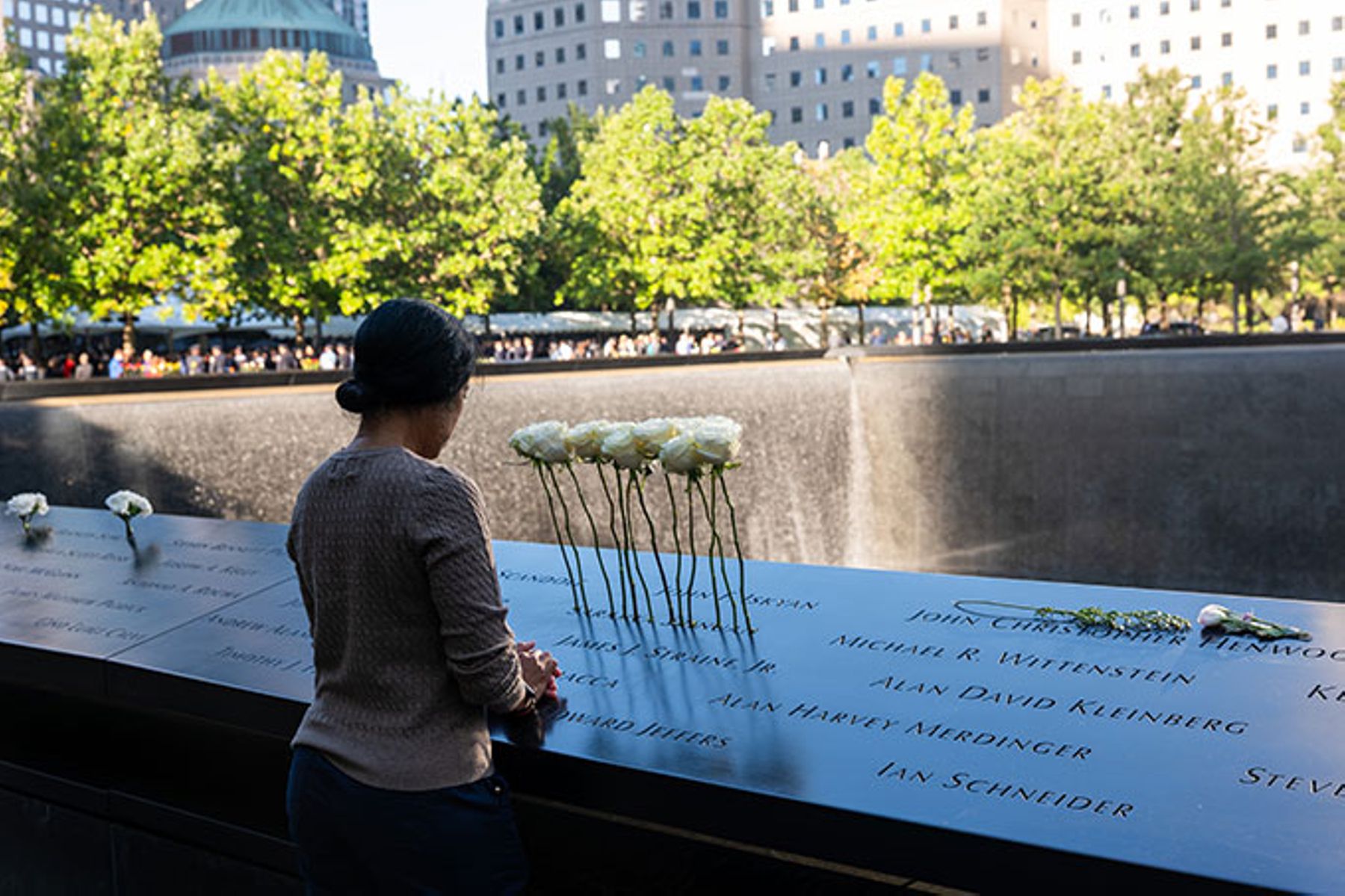
Much of this failed to inspire the public, and interest gradually waned. The same was true of the effort to build a privately financed memorial and museum. Fundraising lagged for years as projected costs ballooned to roughly $1 billion. The memorial’s design—two vast reflecting pools—embodied the prevailing style of modern shrines, emphasizing absence rather than the heroism and fortitude displayed that day. The original plan did not even distinguish the police officers and firefighters who died in the line of duty, a decision reversed only after public outcry. Ultimately, businessman-turned-mayor Michael Bloomberg took over the troubled project, cut hundreds of millions from its budget, and persuaded wealthy donors and businesses to finance it. Even then, the museum did not open until 2014.
Even as squabbles consumed the memorial and redevelopment efforts, communities across the greater New York region quietly found ways to honor their own dead. Nearly six in ten of those killed at the World Trade Center were not New York City residents. They commuted each day from the Hudson Valley, Westchester, Long Island, and New Jersey. Late on the evening of 9/11, police in Middletown, New Jersey, counted 192 cars still sitting in the commuter lot at the town’s train station. While many stranded residents eventually made it home from Manhattan, 37 never returned. They were among the 147 people from Monmouth County killed in the attacks. To honor them, the county commissioned sculptor Franco Minervini to create a memorial of an American eagle clutching a twisted steel beam from the World Trade Center in its talons.
Entire families from these communities perished. The 9/11 memorial in Hazlet, New Jersey, honors John and Sylvia Resta, a husband and wife who worked together at Cantor Fitzgerald and died together in the North Tower. Beneath their photographs is a painting of a small angel resting its head on a cloud, titled Baby Resta. Sylvia was seven months pregnant. Her unborn child—unnamed, without a history, and absent from the official death toll—was nonetheless another victim of that day.
Back at Ground Zero, the first signs of real progress emerged, and the private sector drove the change. Developer Larry Silverstein had first established a foothold at the World Trade Center in 1987 with the opening of 7 World Trade Center, a 47-story office tower beside the North Tower. When New York and New Jersey privatized the World Trade Center complex, after three decades under the Port Authority, Silverstein won the lease and closed the deal just weeks before the 2001 attacks. On 9/11, his 7 World Trade Center also collapsed. Unlike the Twin Towers, however, it had not been directly struck, allowing everyone inside to evacuate safely.
Though Silverstein knew he would not have much control over rebuilding the Twin Towers site, which government had effectively taken over, he quickly committed to replacing 7 World Trade. As soon as debris removal at Ground Zero was completed in May 2002, he began construction, despite efforts by the redevelopment commission to stop him until a comprehensive master plan was in place. Media opinion was reflected in a Daily News editorial headlined “Butt Out, Larry,” urging him to surrender his stake in the site. Government officials threatened to withhold the Liberty Bonds that Congress had authorized to finance rebuilding, and one state official denounced him as “greedy.” But Silverstein persevered. “I simply did not listen to all the naysayers because I was spending my money, not theirs,” he told me for a Wall Street Journal feature. “Fortunately, I had no government involvement in 7 World Trade, which gave me the opportunity to do what I do best.”
Even after the new 7 World Trade Center opened in 2006, government leaders continued to pressure Silverstein. State and city officials pushed him to accept a below-market lease with a Chinese company for an international center in the building. Silverstein refused when the prospective tenant could not provide adequate financial guarantees and instead leased the space on his own terms. Within a year, the tower was home to blue-chip tenants like Moody’s, with 1.1 million square feet leased at rents roughly 50 percent higher than those offered in the proposed China deal.
Silverstein’s initiative proved decisive. As 7 World Trade Center neared completion, the state reached a deal granting him development rights to three additional sites, while he ceded the parcel designated for One World Trade Center. That symbolic “Freedom Tower” opened in 2014. Silverstein opened 4 World Trade Center in 2013 and 3 World Trade Center in 2018. The final Silverstein Properties site, 2 World Trade Center, broke ground in July of this year. The complex is now home to tenants including Condé Nast, Uber, and Ameriprise Financial. The attacks destroyed roughly 13 million square feet of office space; more than 11 million square feet have since been rebuilt.
The interminable delays and political battles over the World Trade Center meant that its redevelopment contributed little to New York’s post-9/11 recovery. Between 2002, when the attacks’ economic effects rippled through the city, and mid-2014, just before One World Trade Center opened, New York added nearly half a million jobs and roughly 400,000 residents. Rather than fleeing, businesses and investment continued to flock to the city, while neighborhoods that had begun reviving in the 1990s grew stronger still. Communities devastated by the city’s decline in the 1960s and 1970s, like Bushwick, finally started to revive. Despite the stagnation at Ground Zero, New York’s tech sector, which had taken root in Lower Manhattan during the 1990s, began a new round of growth.
After some false starts in the early days of his administration, Mayor Bloomberg also found his footing. City government’s chief contribution to the recovery was providing the basics: preserving and improving public order by keeping crime low, controlling costs—especially the social-welfare spending that had helped cripple the city in the 1970s—and making it easier to build through rezonings that opened areas like Manhattan’s Far West Side to a new business district.
Today, many of the lessons of 9/11 and its aftermath have been forgotten or were never learned. New York and other American communities are more vulnerable after a period of open borders and the rollback of security measures adopted after the attacks. During the pandemic, New York stopped enforcing many of its most basic laws, contributing to troubling increases in everything from violent crime to shoplifting that have only now started to recede. Meantime, a new politics at city hall has revived the extravagant social-welfare spending that once brought New York to the brink of bankruptcy, alongside higher taxes and heavier regulation reminiscent of the antibusiness mindset that bogged down the redevelopment of the World Trade Center.
The 25th anniversary of 9/11, then, offers an opportunity not only to remember the dead and honor those who sacrificed their lives doing their duty that day—but also to admonish the living.